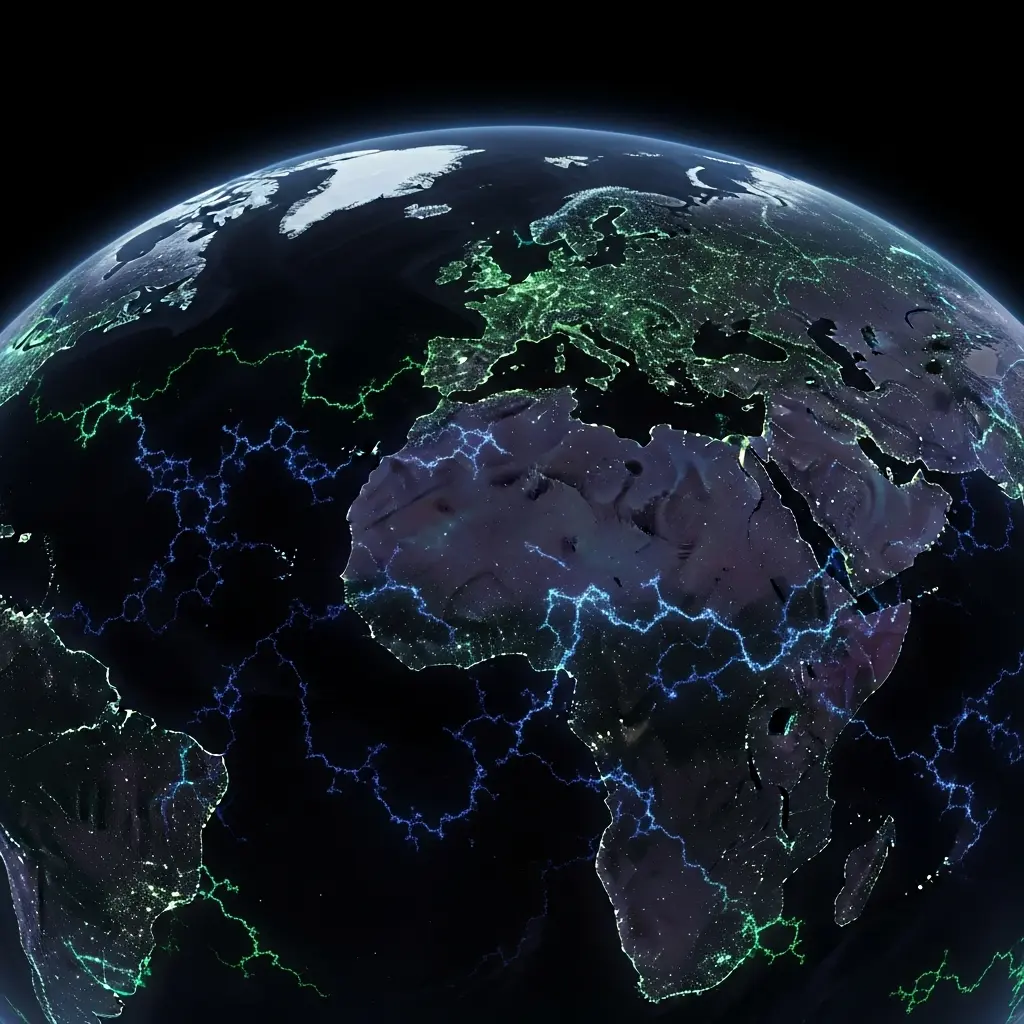
Earth observation relies increasingly on labelled data to train algorithms, but acquiring these labels is often expensive and time-consuming, limiting the availability of data for crucial tasks like land monitoring and disaster response. Francesco Mauro from University of Sannio, Francesca De Falco and Andrea Ceschini from Sapienza University of Rome, alongside Lorenzo Papa and Alessandro Sebastianelli from the European Space Agency, and Paolo Gamba from University of Pavia, address this challenge by pioneering a new approach to generating synthetic labelled imagery. Their research introduces a novel architecture, combining classical and quantum computing techniques, to create realistic Earth observation data with significantly improved efficiency and accuracy. The team demonstrates a substantial reduction in key image quality metrics and a corresponding increase in semantic accuracy, representing the first successful application of class-conditioned diffusion modelling to the Earth observation domain and opening new possibilities for enhanced remote sensing data synthesis.
Quantum Generative Models and Advantage Demonstration
Scientists are exploring quantum machine learning, specifically generative models, to address challenges in areas like Earth Observation. Research focuses on leveraging quantum computing to enhance image generation and data augmentation, particularly when labeled data are scarce. Several studies investigate novel architectures and techniques to demonstrate a quantum advantage over classical methods in generating realistic and high-quality imagery.
Quantum U-Net for Earth Observation Data Generation
Scientists developed the Quanvolutional Conditioned U-Net (QCU-Net), a hybrid quantum-classical architecture designed to generate synthetic labeled Earth Observation (EO) imagery. This pioneering work adapts class-conditioned quantum diffusion modeling to the EO domain, addressing the need for high-quality labeled data in remote sensing. The QCU-Net utilizes a U-Net architecture with strategically placed quantum layers to improve feature extraction and generative capabilities. Experiments on the EuroSAT RGB dataset demonstrate that the QCU-Net significantly outperforms classical diffusion-based models, reducing the Fréchet Inception Distance by 64% and the Kernel Inception Distance by 76%.
Quantum Synthesis of High-Fidelity Earth Observation Imagery
Scientists have achieved a breakthrough in Earth Observation (EO) imagery synthesis with the development of the Quanvolutional Conditioned U-Net (QCU-Net), a novel hybrid quantum-classical architecture. Extensive experiments conducted on the EuroSAT RGB dataset demonstrate the superior performance of the QCU-Net, with a remarkable 64% reduction in the Fréchet Inception Distance and a substantial 76% decrease in the Kernel Inception Distance. These results confirm the model’s ability to create synthetic data closely matching real imagery, offering a powerful tool for data augmentation when labeled data are limited.
Quantum Generation of Realistic Earth Observation Imagery
This research successfully integrates quantum computing with established class-conditioned diffusion models to generate synthetic Earth Observation imagery. The developed Quanvolutional Conditioned U-Net (QCU-Net) demonstrates a significant advancement in generative modeling for remote sensing tasks. Results indicate substantial improvements in image realism and accuracy, with a 64% reduction in Fréchet Inception Distance and a 76% reduction in Kernel Inception Distance compared to classical models. The model’s ability to generate labeled imagery directly applicable to real-world remote sensing applications is particularly valuable when labeled data are scarce.
🗞 Enriching Earth Observation labeled data with Quantum Conditioned Diffusion Models
🧠 ArXiv: https://arxiv.org/abs/2512.20448
See today’s quantum computing news on Quantum Zeitgeist for the latest breakthroughs in qubits, hardware, algorithms, and industry deals.