Radial basis function networks gain a powerful new capability through the integration of quantum kernel functions, creating a hybrid classical algorithm with promising applications in both interpolation and classification. Emily Micklethwaite and Adam Lowe, both from QinetiQ, demonstrate this advancement by introducing synthetic examples that validate the concept, and importantly, highlight a potential advantage over traditional support vector machines. While kernel methods commonly feature in support vector machines, this research establishes that kernel-enhanced radial basis networks offer a native ability to perform multi-class classification, a significant benefit over standard support vector machine implementations. This work therefore represents a step forward in leveraging quantum kernels for more versatile machine learning tasks, potentially broadening the scope of quantum-enhanced algorithms.
This work introduces synthetic examples to demonstrate the concept for both interpolation and classification tasks, showcasing a potential advantage over standard kernel-based support vector machines due to the network’s native ability to handle multi-class classification. The core of this achievement lies in encoding classical data into quantum wavefunctions, allowing for the computation of kernel metrics based on wavefunction overlap. To achieve this, the team developed a method to map input data onto the Bloch sphere using rotation matrices, specifically the RX gate, ensuring each data point occupies a unique position.
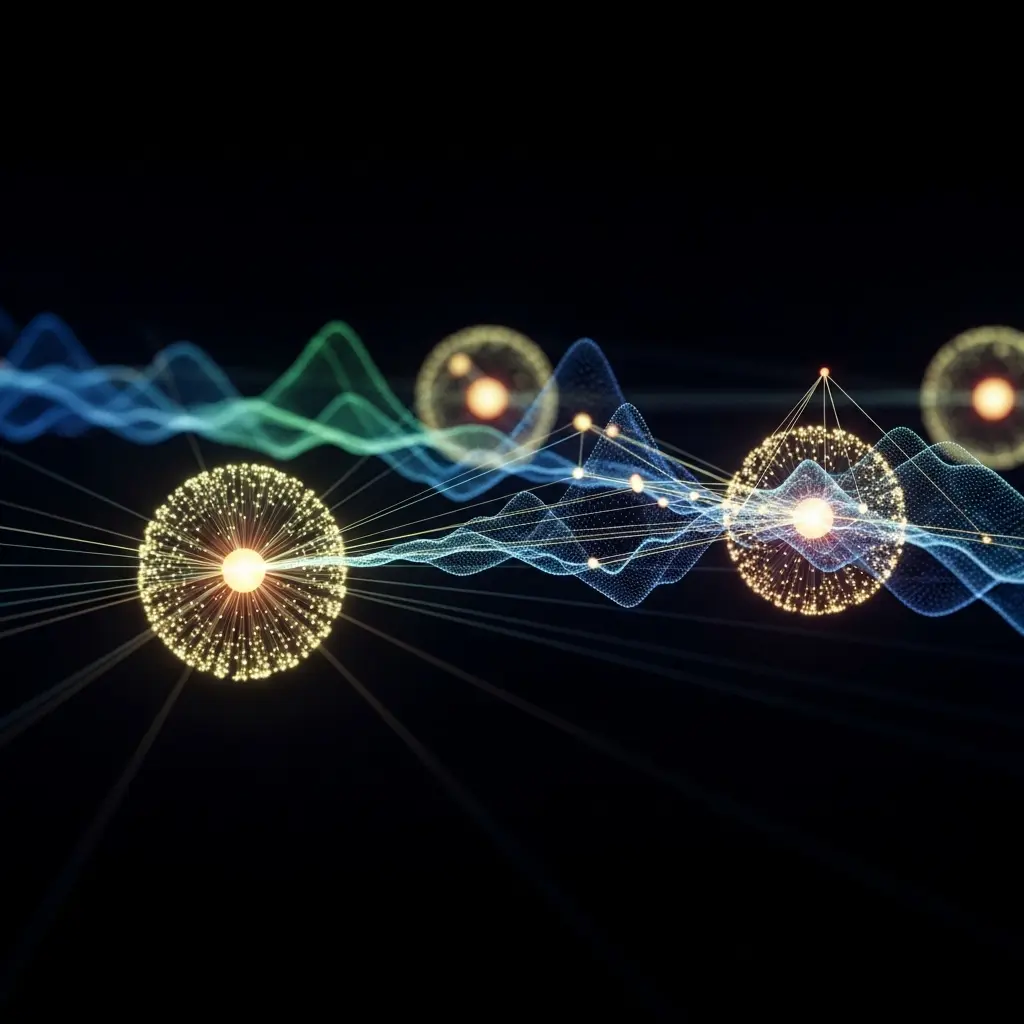
Each feature within a data point is encoded onto two qubits, enabling quantum effects within the data itself. For datasets with multiple features, an entangling unitary gate, either a CNOT gate or a random Haar unitary matrix, is employed to create entanglement between the qubits, effectively linking the features. This process results in a wavefunction, |ψ(xi)⟩, which is then used to compute the kernel matrix, ˆφ, using the overlap of training data points and chosen centres. The resulting kernel matrix, ˆφ, comprises classical values despite being computed from quantum wavefunctions, allowing the radial basis function network to be solved using established methods. The team demonstrated that this approach allows for the computation of kernel metrics based on the overlap of quantum wavefunctions, represented as |⟨ψ(yj)|ψ(xi)⟩|², which forms the basis for the kernel matrix. This breakthrough establishes a framework for integrating quantum kernels into classical machine learning algorithms, opening avenues for exploring improved performance through different kernel function choices, such as Gaussian versus linear kernels, a topic reserved for future investigation.
Quantum Kernel Networks Demonstrate Machine Learning Potential
This research introduces a novel implementation of radial basis function networks, enhanced with quantum kernels, building upon established techniques used in support vector machines. Through testing on synthetic datasets, the team demonstrated the capability of this quantum-kernel radial basis function network, or Q-RBF, for both interpolation and classification tasks, achieving comparable results to existing classical machine learning methods. Notably, the Q-RBF network natively supports multi-class classification, a potential advantage over standard support vector machine implementations. The work successfully establishes a proof of concept for the Q-RBF algorithm, highlighting its potential within the field of quantum machine learning. The authors acknowledge that further investigation is needed to fully understand the model’s capacity, particularly regarding hyperparameter optimisation and practical implementation on real-world problems. Future research directions include developing and implementing this algorithm on actual quantum hardware, with the aim of demonstrating its feasibility for near-term quantum computing applications and exploring its performance in more complex scenarios.
🗞 Classification using quantum kernels in a radial basis function network
🧠 ArXiv: https://arxiv.org/abs/2512.20567


See today’s quantum computing news on Quantum Zeitgeist for the latest breakthroughs in qubits, hardware, algorithms, and industry deals.