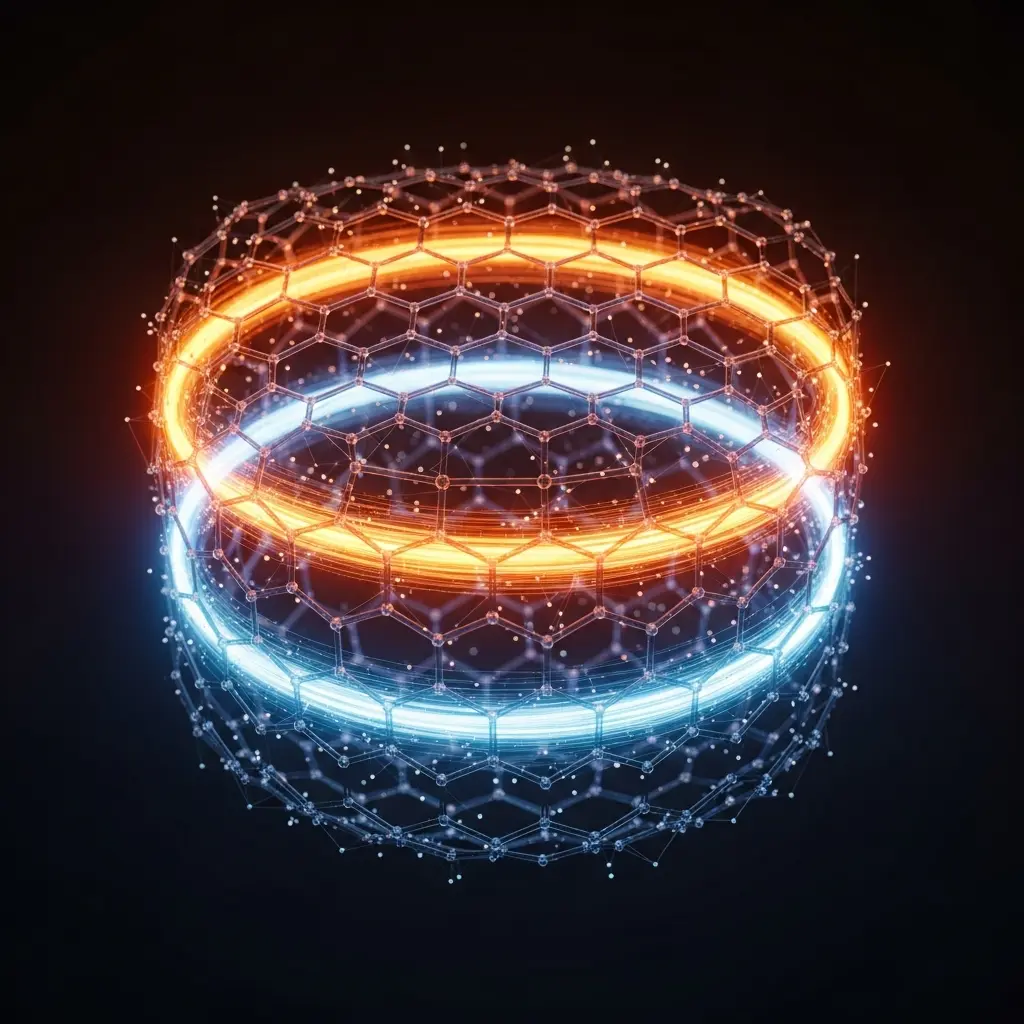
Artificial lattices represent a powerful new approach to materials design, allowing scientists to recreate and enhance the electronic properties found in natural materials. Emre Okcu, Emre Mesudiyeli, Hâldun Sevinçli, and A. Devrim Güçlü investigate how to engineer specific energy behaviours within these artificial structures, focusing on the creation of quartic energy dispersion, a characteristic not commonly found in conventional materials. Their work demonstrates that carefully designed honeycomb lattices can support multiple types of these quartic bands, including unique ‘Mexican-hat-shaped’ formations, and reveals how the lattice’s geometry dictates the resulting electronic properties. This achievement establishes a pathway towards tailoring artificial materials with unprecedented control over their energy characteristics, potentially leading to advances in areas such as novel electronic devices and energy technologies.
Scientists are creating artificial structures that mimic the electronic properties of graphene, but with tailored energy landscapes for electrons. This work demonstrates the engineering of quartic energy dispersion, a unique way electrons move through a material, within artificial semiconductor honeycomb lattices, opening new avenues for quantum simulation and materials design. Researchers have successfully created three distinct types of quartic bands, characterized by their shape: Mexican-hat-shaped, purely quartic, and non-Mexican-hat-shaped, and have determined the precise conditions needed to achieve each.
Graphene Band Structure Manipulation and Quantum States
Research focuses on manipulating the electronic band structures of two-dimensional materials, particularly graphene, to achieve novel properties crucial for advanced technologies. Scientists are exploring strain engineering, where applying stress alters a material’s electronic characteristics, and creating heterostructures by stacking different materials to tailor their properties. They are also investigating how defects and functional groups influence graphene’s behavior, and studying the quantum properties of graphene quantum dots and nanoribbons. A key area of investigation is band structure engineering, with a particular emphasis on achieving Mexican hat dispersions and flat bands.
Mexican hat dispersions, characterized by a unique cone-like shape, are essential for realizing massless Dirac fermions and exotic quantum phenomena. Flat bands, where electrons have zero kinetic energy, are crucial for creating strongly correlated electron systems, Mott insulators, and potentially, superconductivity. Researchers are also exploring topological insulators and semimetals, materials with protected surface states and unique transport properties, and investigating the role of Berry curvature in controlling electronic transport. Computational methods, including density functional theory and tight-binding models, are central to these investigations.
These techniques allow scientists to calculate the electronic structure and properties of materials, providing insights into their behavior. Molecular dynamics simulations are also used to study the dynamic properties of materials and their response to external stimuli. These theoretical studies underpin the development of potential applications in nanoelectronics, quantum computing, energy storage, and sensing. Research consistently demonstrates the ability to open a band gap in graphene through strain, making it suitable for transistor applications. Combining graphene with other two-dimensional materials, such as hexagonal boron nitride or transition metal dichalcogenides, allows for precise control of band alignment and the creation of novel heterostructures.
The creation of flat bands is seen as a pathway to induce strong electron-electron interactions and realize Mott insulating behavior, potentially leading to superconductivity. Topological phases are being harnessed to protect electronic states from scattering and disorder, and the anomalous Hall effect is being explored for spintronic applications. The ability to manipulate the electronic properties of two-dimensional materials is highly significant for the advancement of materials science and nanotechnology, opening up a wide range of possibilities for creating novel devices and technologies.
Engineered Quartic Bands in Honeycomb Lattices
Scientists have demonstrated the engineering of quartic energy dispersion within artificial semiconductor honeycomb lattices, opening new avenues for quantum simulation and materials design. This work details the creation of three distinct types of quartic bands, Mexican-hat-shaped, purely quartic, and non-Mexican-hat-shaped, and identifies the specific conditions under which each arises within the lattice structure. Researchers found that a staggered honeycomb lattice reliably produces Mexican-hat-shaped dispersions due to enhanced coupling between second-nearest neighbors, while its planar counterpart yields only purely quartic or non-Mexican-hat-shaped forms, demonstrating precise control over band structure through lattice geometry. The study employed a tight-binding analysis and numerical Bloch-wave approach to model electron behavior within these artificial lattices.
Analysis reveals that the ratio of second-nearest to nearest-neighbor interactions plays a critical role in realizing quartic dispersion, with the researchers manipulating lattice parameters to enhance these interactions. Results demonstrate that the valence band edge exhibits a unique dispersion, centered at the Brillouin zone, and is significantly influenced by the ratio of interaction strengths. Expanding the energy dispersion for small values of momentum, scientists pinpointed a critical value for the ratio of second-nearest to nearest-neighbor interactions, which dictates the formation of the quartic bands. The team’s models and calculations confirm the feasibility of engineering both Mexican-hat-shaped and non-Mexican-hat-shaped quartic dispersions, providing a pathway to tailor the electronic characteristics of artificial materials for specific applications. These findings have implications for designing materials with enhanced thermopower, exploring ferromagnetic instabilities, and investigating strongly correlated many-body effects.
Engineered Quartic Dispersions in Honeycomb Lattices
This research demonstrates the successful engineering of quartic energy dispersions within artificial semiconductor honeycomb lattices. By carefully controlling lattice geometry and parameters, scientists have achieved three distinct types of quartic band structures. The research clarifies how lattice geometry can be used to tailor electronic properties, opening possibilities for designing materials with novel functionalities.
🗞 Quartic energy band engineering in artificial semiconductor honeycomb lattices
🧠 ArXiv: https://arxiv.org/abs/2512.16534