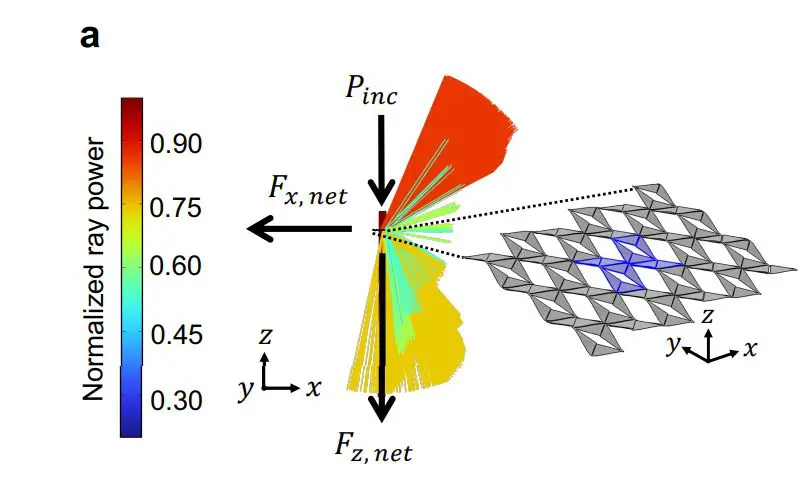
Controlling the direction of solar sails, vast reflective sheets propelled by sunlight, presents a significant challenge for deep-space exploration, as traditional methods often require substantial energy. Gulzhan Aldan and Igor Bargatin, both from the University of Pennsylvania, now demonstrate a novel approach utilising the unique properties of kirigami, the ancient art of paper cutting. Their research reveals that specially perforated and stretched films, when illuminated, redirect light and generate forces parallel to the sail’s surface, offering a potential means of steering without conventional propulsion systems. This breakthrough suggests a scalable, lightweight, and crucially, low-power method for controlling solar sails, paving the way for more efficient and ambitious interstellar missions.
Scientists created a kirigami structure from an aluminized polyimide film and used computer simulations to predict its behaviour. These simulations reveal how stretching the film causes it to buckle, redirecting normally incident light at an angle. This oblique reflection produces a net in-plane force, offering a potential method for steering solar sails without requiring substantial power. The team validated these predictions through physical experiments, observing reflected beam patterns consistent with the simulations.
Kirigami Films Enable Deployable Space Reflectors
This research explores the use of kirigami-structured films as lightweight, deployable reflectors for space-based antennas and solar sails. The core idea leverages the unique mechanical properties of kirigami, a traditional Japanese art of paper cutting, to create reflectors that are compact for launch and unfold into large, precisely shaped surfaces in space. Scientists demonstrate how kirigami patterns can be incorporated into thin films to create structures easily folded for launch and deployed in space with minimal actuation. The research focuses on achieving controlled reflection of radiation, whether solar photons for propulsion or electromagnetic waves for communication.
Key findings include:
-
Deployable Structures: Kirigami patterns enable reflectors to be folded for launch and expanded into large, stable surfaces in space with minimal actuation.
-
Anomalous Reflection: Integration of metasurfaces with kirigami designs allows steering of reflected radiation beyond conventional reflection laws, essential for directing solar sails or focusing communication signals.
-
Lightweight Materials: Kapton film is used for its high strength-to-weight ratio, flexibility, and resilience in space environments, making it well-suited for these applications.
-
Simulation and Optimization: Using COMSOL Ray Optics Module, researchers optimized kirigami and metasurface designs to maximize reflection control and efficiency.
-
Potential Applications: The technology is promising for solar sailing, space-based communications, and concentrated solar power in orbit.
The study notes challenges in precise fabrication, reliable deployment mechanisms, and long-term space stability. Future work aims to refine these aspects and develop advanced, optimized designs. Overall, this research presents a compelling approach to lightweight, deployable space reflectors by combining kirigami, metasurfaces, and advanced materials.
Kirigami Films Steer Light, Generate Force
This research demonstrates that specially designed, perforated films can redirect light and generate controllable forces, offering a potential new approach to solar sail steering. Scientists successfully created a kirigami structure, a patterned material with strategically placed cuts, from an aluminized polyimide film. Through both computer simulations and physical experiments, they show that stretching this film causes it to buckle and redirect normally incident light at an angle. This oblique reflection generates a net in-plane force, effectively allowing for control over the direction of the sail without requiring significant power input.
The team verified that the magnitude and direction of this force can be tuned by adjusting the amount of tensile strain applied to the film. This control is achieved through the precise geometry of the perforations, which act as small mirrors, and the resulting buckling behaviour under tension. The experiments closely matched the predictions from the simulations, confirming the feasibility of this approach for lightweight, low-power steering of solar sails. The authors acknowledge that further work is needed to optimise the design and explore the limits of scalability. Future research will focus on refining the perforation patterns and investigating the long-term performance of these materials in space environments. While this study focuses on millimeter-scale cuts, the principles demonstrated could potentially be adapted for different scales and materials, opening avenues for innovative designs in aerospace engineering and beyond.
🗞 Low-Power Solar Sail Control using In-Plane Forces from Tunable Buckling of Kirigami Films
🧠 ArXiv: https://arxiv.org/abs/2512.13596

See today’s quantum computing news on Quantum Zeitgeist for the latest breakthroughs in qubits, hardware, algorithms, and industry deals.