The manipulation of light’s velocity holds immense potential for advances in photonic technologies, and recent work explores how structured waves interact with moving boundaries. Zeki Hayran and John B. Pendry, from Imperial College London, now present a comprehensive theory describing how these interactions reshape the velocity content of light. Their research demonstrates that a single moving interface can dramatically alter the range of velocities within a light wave, leading to phenomena such as compression of velocities into a narrow band and the splitting of waves into distinct branches. These discoveries pave the way for reconfigurable optical systems capable of controlling the timing and velocity of light, potentially emulating dynamic effects previously associated with gravity or other complex processes, and offering new possibilities for time gating, buffering, and velocity multiplexing.
X-wave Double Refraction at Interfaces
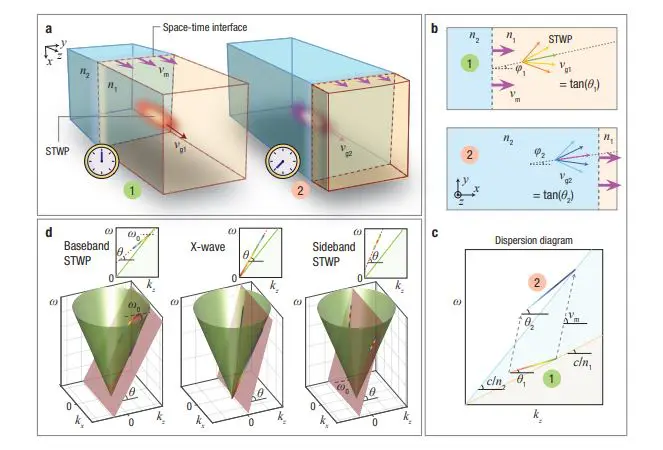
This research rigorously investigates the refraction of X-waves, waves propagating equally in space and time, at the boundary between two different materials. The study explores conditions where a single incoming X-wave splits into two transmitted waves, a phenomenon known as double refraction. Scientists combined geometric optics, wave propagation principles, and mathematical analysis to understand the conditions governing this splitting and to characterise the resulting waves, establishing a foundation for controlling light at material interfaces. The core of the research involves deriving a new refraction law for X-waves, which is quadratic and can have multiple solutions, leading to the possibility of double refraction.
Scientists identified specific conditions under which this double refraction occurs, depending on the refractive indices of the materials, the velocity of the interface, and the properties of the incoming wave. A geometric interpretation in three-dimensional space helps visualise how the interface interacts with the wave, leading to multiple possible solutions. The analysis connects these mathematical results to the real-world behaviour of the waves, explaining how the splitting manifests as two transmitted waves with different slopes and velocities. Researchers also explored “push broom” refraction, where the transmitted spectrum is compressed, demonstrating how to achieve this compression without distorting the signal. Furthermore, the study identified conditions where co-moving waves, waves travelling with the interface, maintain a constant velocity after refraction, offering a way to selectively isolate these waves. These findings provide a comprehensive theoretical framework for understanding the complex behaviour of X-waves at interfaces, with implications for designing new optical materials, improving wave optics, and developing advanced signal processing techniques.
Simulating Wave Refraction at Moving Interfaces
Scientists developed a sophisticated numerical simulation to investigate how structured waves behave when they encounter a moving boundary between two materials. This technique allows them to explore regimes of light manipulation previously inaccessible through conventional methods. The simulation represents light as a combination of plane waves, carefully defining their characteristics to match specific space-time wave packets, and uses this spectral representation to model wave behaviour computationally. To simulate a moving boundary, researchers imposed conservation of the wavevector component and a Doppler-invariant quantity, effectively modelling the change in wave properties as it crosses the interface.
The simulation calculates the resulting spectral distribution, revealing how the moving boundary reshapes the wave’s velocity content. The time-dependent electric field is then evaluated on a grid, reconstructing the overall field distribution at different points in space and time. This approach enabled the team to demonstrate phenomena such as “space-time anomalous push broom” and “velocity spectral fission”, revealing how a moving interface can compress a wide range of velocities into a narrow band or split an incident wave into two distinct branches. The simulations provide a powerful tool for understanding and designing novel photonic devices capable of manipulating light in dynamic media.
Moving Interfaces Reshape Light Velocity and Spectra
This research demonstrates a new method for controlling light using structured waves and moving interfaces, revealing how these interactions reshape the velocity of light. Scientists established a comprehensive theory of space-time refraction, detailing how structured waves respond when crossing a moving boundary between two materials. They identified conserved quantities, including tangential momentum and a Doppler-type invariant, allowing them to derive refraction laws applicable to various wave types and interface velocities. These laws successfully connect to established principles governing static and purely temporal scenarios.
Experiments show that a moving interface can act as a “space-time optical push broom” for structured waves, compressing a wide range of input velocities into a narrow transmitted band. By carefully tuning the interface velocity and refractive indices, scientists achieved this compression without approaching the speed of light, simultaneously accessing previously unattainable frequency and phase characteristics. Further investigations revealed “velocity spectral optical fission”, where a single incident wave splits into two distinct transmitted waves with different velocities. Detailed analysis confirmed that both resulting waves remain waves propagating with a constant velocity, and field snapshots displayed two well-separated intensity profiles after the interface.
This demonstrates the creation of two propagation channels from a single input, suggesting applications in velocity multiplexers and signal processing. These findings provide a unified framework for understanding how structured pulsed beams interact with moving interfaces, clarifying the role of optical horizons and connecting earlier observations within a single geometric model. The research establishes a foundation for manipulating light in dynamic media, opening new avenues for advanced photonic technologies.
Moving Interfaces Reshape Light Velocity Content
This research presents a unified theory describing how structured pulsed light beams interact with moving interfaces, revealing fundamental principles governing space-time refraction. Scientists identified conserved quantities analogous to momentum in traditional optics, allowing them to derive refraction laws applicable to various types of structured waves and valid across a range of interface velocities and incidence angles. These laws successfully connect to established principles governing static and purely temporal scenarios, offering a comprehensive geometric framework for understanding these interactions. The findings demonstrate that a moving interface can significantly reshape the velocity content of light, compressing a broad range of incoming velocities into a narrow transmitted band without causing distortions.
Furthermore, the research reveals a phenomenon termed “velocity spectral optical fission”, where a single incident wave splits into two distinct branches, each propagating with a different velocity. These effects, difficult to achieve with static optical components, suggest potential applications in reconfigurable time gating, selective buffering, and velocity multiplexing of light pulses. The authors acknowledge that their treatment focused on idealized conditions, specifically propagation-invariant waves and non-dispersive media with impedance-matched interfaces, and future work will extend these laws to more complex scenarios. Experimental advances in synthesizing structured waves and creating controllable space-time interfaces will be crucial for realising the full potential of these refraction mechanisms and exploring dynamic photonic structures.
🗞 Space-time refraction of space-time wave packets
🧠 ArXiv: https://arxiv.org/abs/2512.13572



See today’s quantum computing news on Quantum Zeitgeist for the latest breakthroughs in qubits, hardware, algorithms, and industry deals.