Graphite displays unusual behaviour in strong magnetic fields, forming distinct insulating states that scientists still struggle to fully understand. Masashi Tokunaga, from The Institute for Solid State Physics at The University of Tokyo, alongside Kazuto Akiba of Iwate University and Hiroshi Yaguchi from Tokyo University of Science, led a team investigating this phenomenon. They performed detailed measurements on graphite crystals subjected to extremely powerful, pulsed magnetic fields reaching 75 Tesla, revealing a surprising non-linear conductivity within these field-induced insulating states. This discovery, which extends to multiple stages of the insulating state, significantly advances understanding of electron behaviour in graphite and challenges existing theories regarding its magnetic properties, potentially paving the way for novel electronic devices.
Graphite exhibits multi-stage phase transitions in the quantum-limit states realised by magnetic fields applied along the c-axis. Despite extensive studies, the origin of this phenomenon remains a matter of debate. Researchers performed high-field magnetotransport measurements on single crystals of graphite, focusing on non-linear conductivity in pulsed-magnetic fields of up to 75 Tesla.
High-Field Magnetotransport Reveals Graphite Nonlinearity
Scientists investigated the unusual magnetic properties of graphite by performing high-field magnetotransport measurements on single crystals, focusing on non-linear conductivity induced by pulsed magnetic fields. Experiments employed non-destructive pulsed magnets generating fields up to 75 T, with pulse durations of 36 ms and 4 ms, installed at the International MegaGauss Science Laboratory. Out-of-plane resistance measurements, conducted using established contact formation techniques, allowed researchers to probe the material’s response under extreme magnetic fields.
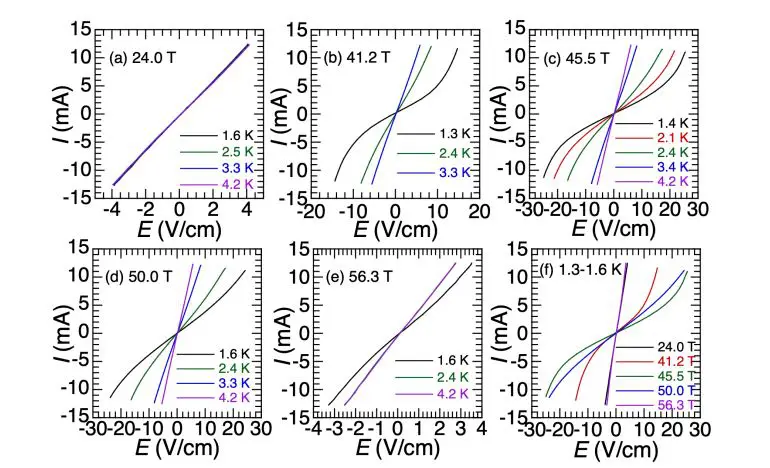
The study mapped the evolution of magnetoresistance across temperatures ranging from 1.5 K to 4.2 K, revealing distinct non-linear behavior at 34 T and 53 T, indicative of phase A. Further measurements up to 56 T identified phase B, characterized by positive magnetoresistance at high fields. Current-voltage curves at several temperatures and magnetic fields were analyzed to characterize the non-linear conduction: at 24 T, the I-V curves were nearly linear, while at 41.2 T, a superlinear increase in current was observed at 1.3 K. Similar superlinear behavior was seen in phases A and B at 45.5 T, 50.0 T, and 56.3 T.
Non-linearity was further explored by measuring magnetoresistance under different applied currents of 0.2 mA and 0.5 mA. At 0.2 mA, the out-of-plane resistance exhibited a double-peak structure corresponding to phases A and B, while at 0.5 mA, the peak structures were reduced, demonstrating current-dependent non-linear behavior in both phases. This detailed analysis of magnetoresistance and I-V characteristics provides crucial insights into the interplay between magnetic fields and electronic transport in graphite, advancing the understanding of its exotic magnetic phases.
Graphite Exhibits Two Distinct Magnetoresistance Phases
Scientists performed high-field magnetotransport measurements on single-crystal graphite, focusing on non-linear conductivity in pulsed magnetic fields up to 75 Tesla. Experiments revealed distinct non-linearities in the longitudinal magnetoresistance, observed in both the first and second field-induced phases. At 4.2 K, the out-of-plane resistance sharply increased at 34 T and then decreased at 53 T, signaling the emergence of phase A. This resistance enhancement in phase A became more pronounced at lower temperatures; at 1.5 K, positive magnetoresistance appeared above 53 T, corresponding to phase B.
Detailed analysis of current-electric field relationships at various temperatures showed nearly linear behavior at 24 T, but a superlinear increase in current for larger electric fields at 41.2 T and 1.3 K. Similar non-ohmic behavior was observed in phase A at 45.5 T and 50.0 T, and in phase B at 56.3 T, all at the lowest temperatures. Further measurements up to 75 T with different applied currents revealed a double-peak structure in the out-of-plane resistance at 0.2 mA, corresponding to phases A and B. Increasing the current to 0.5 mA reduced these peaks, confirming the non-linear nature of both phases.
These findings challenge the conventional sliding phenomenon model, as the expected reduction in the threshold electric field near 53 T was not observed; instead, the electric field increased between 41.2 T and 45.5 T. This study provides valuable insights into the complex multi-stage phase transitions in graphite and highlights the need for further systematic investigations to fully uncover the underlying mechanisms.
Graphite Conductivity Reveals Sliding Charge Carriers
This research investigated the electrical properties of graphite when subjected to extremely strong magnetic fields, reaching up to 75 Tesla along the crystal’s c-axis. Scientists observed non-linear conductivity, meaning the material’s resistance changes in a non-proportional way with the applied magnetic field, not only in the initial phase transition but also in a subsequent phase occurring at higher fields. These observations contribute to a long-standing debate regarding the underlying mechanisms driving the multi-stage transitions observed in graphite under these conditions. The findings suggest that the observed conductivity enhancement at high electric fields may be linked to the sliding motion of charge carriers within the material, potentially related to density wave states.
However, the team acknowledges that the current dataset is insufficient to definitively confirm this interpretation. Future research, involving systematic studies across a wider range of magnetic field strengths, will be necessary to fully elucidate the physical origin of these field-induced phases in graphite and to determine the precise mechanisms responsible for the observed non-linear transport properties. The work advances understanding of the behaviour of materials in extreme conditions and provides a foundation for further investigation into the complex interplay between magnetism and conductivity in graphite.
🗞 Non-linear transport in field-induced insulating states of graphite
🧠 ArXiv: https://arxiv.org/abs/2512.12956
See today’s quantum computing news on Quantum Zeitgeist for the latest breakthroughs in qubits, hardware, algorithms, and industry deals.