Preparing the ground states of complex quantum systems represents a significant challenge in modern physics and materials science, with implications for both simulation and optimisation tasks. Thanh Nguyen Van Long, Lan Nguyen Tran, and Le Bin Ho, from the University of Science, Vietnam National University, Ho Chi Minh City, now demonstrate a substantial advance in this field. Their work addresses a critical limitation of existing feedback-based quantum algorithms, which often fail when faced with certain complex energy landscapes. By integrating short ‘imaginary-time’ evolution steps into the feedback process, the researchers have created a new method, ITE-FALQON, that effectively suppresses unwanted quantum states, navigates challenging energy configurations, and consistently converges towards the true ground state, offering a promising pathway towards scalable quantum simulations of strongly correlated materials.
Imaginary Time Evolution Accelerates Ground State Preparation
Preparing ground states of strongly correlated quantum systems is a central goal in quantum simulation and optimization. The feedback-based quantum algorithm represents a promising approach, yet its performance often suffers from slow convergence and sensitivity to noise. This work introduces an imaginary-time-enhanced feedback-based quantum algorithm designed to address these limitations and improve the efficiency of universal ground-state preparation. The method leverages imaginary-time evolution, effectively guiding the quantum system towards its ground state by iteratively refining control parameters based on measurement outcomes.
Specifically, the algorithm incorporates an adaptive update rule that adjusts control parameters proportional to the gradient of the energy expectation value, estimated through repeated measurements of the system’s energy. Numerical simulations demonstrate that this imaginary-time enhancement significantly accelerates convergence compared to conventional feedback-based algorithms, particularly for systems with complex energy landscapes. Furthermore, the algorithm exhibits enhanced robustness against noise, maintaining high fidelity in ground-state preparation even in the presence of realistic experimental imperfections. These results establish a pathway towards practical implementation of feedback-based quantum algorithms for tackling challenging problems in quantum many-body physics and beyond.
Ground State Preparation With Degeneracy Resolution
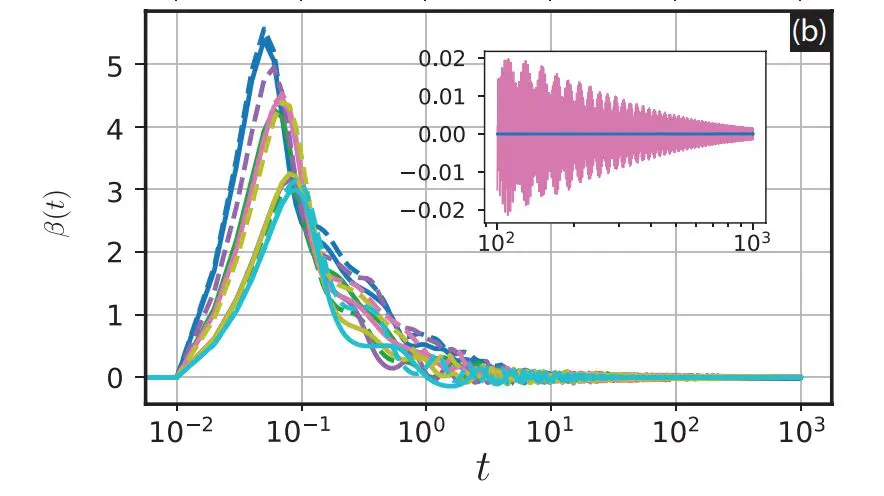
Researchers developed a novel approach to preparing ground states of strongly correlated quantum systems, addressing limitations found in existing feedback-based quantum algorithms. The study identified a critical failure mode in the standard feedback algorithm, FALQON, when applied to systems exhibiting spectral degeneracies, where the feedback signal weakens and prevents convergence to the ground state. Investigations using the Fermi-Hubbard model on lattices up to 3×3 demonstrated that FALQON reliably converged in doped configurations but consistently stalled at half-filling due to particle-hole symmetry creating degenerate energy states. This stalling occurred because the commutator signal, used to update the feedback control, became suppressed, resulting in insufficient control to drive the system towards the ground state.
To overcome this limitation, the team pioneered an imaginary-time-enhanced FALQON, or ITE-FALQON, scheme. This innovative method inserts short periods of imaginary-time evolution, generated by the problem Hamiltonian, directly into the feedback loop. Imaginary-time propagation effectively suppresses excited-state components, allowing the dynamics to escape the degenerate subspaces that trap the standard FALQON algorithm. Rigorous analysis and benchmarking on Fermi-Hubbard lattices up to 3×3 demonstrated that ITE-FALQON achieves monotonic energy descent and high-fidelity ground-state preparation across all fillings, even in the presence of spectral degeneracies. The system delivers consistent results with shallow simulation timesteps, establishing ITE-FALQON as a robust and scalable fully quantum optimization framework for strongly correlated many-body systems. The technique reveals a pathway to overcome limitations in existing algorithms and provides a practical route to preparing ground states in complex quantum systems.
ITE-FALQON Improves Fermi-Hubbard Ground State Energy
Researchers have demonstrated a significant improvement in preparing ground states of the Fermi-Hubbard model, a complex system used to study interacting electrons. Existing methods struggle when faced with larger, more strongly correlated configurations. This team addressed this challenge by combining a feedback-based optimization technique, FALQON, with periods of imaginary-time evolution, creating a new method called ITE-FALQON. This combination allows the algorithm to efficiently navigate the complex energy landscape and reliably find the lowest energy state, even in challenging configurations. Testing on lattices up to 3×3 demonstrated ITE-FALQON’s ability to consistently converge to the ground state across all tested configurations, offering a practical approach for tackling challenging problems in condensed matter physics and beyond.
Imaginary Time Evolution Stabilizes Quantum Ground States
Researchers have developed a novel method for preparing the ground states of strongly correlated quantum systems, overcoming a significant limitation of existing feedback-based approaches. Traditional methods struggle when encountering spectral degeneracies, where the feedback signal collapses and prevents the system from reaching its lowest energy state. This team demonstrated that this breakdown occurs in specific configurations of the Fermi-Hubbard model, hindering reliable ground-state preparation. To address this, the researchers introduced an imaginary-time-enhanced feedback scheme, known as ITE-FALQON.
This hybrid approach incorporates brief periods of imaginary-time evolution into the feedback loop, effectively suppressing unwanted excited-state components and allowing the system to escape degenerate subspaces. Through testing on increasingly complex lattices, ITE-FALQON consistently achieved reliable convergence to the ground state across all configurations tested, demonstrating a robust and scalable pathway for preparing ground states in these challenging quantum systems. Further investigation is needed to assess the method’s performance on even larger and more complex systems, and future work will likely explore its applicability to a wider range of physical models and investigate its potential for implementation on actual quantum hardware. Nevertheless, this research represents a significant advance in the field, offering a promising solution to a long-standing problem in quantum simulation and optimization.
👉 More information
🗞 Imaginary-time-enhanced feedback-based quantum algorithms for universal ground-state preparation
🧠 ArXiv: https://arxiv.org/abs/2512.13044
See today’s quantum computing news on Quantum Zeitgeist for the latest breakthroughs in qubits, hardware, algorithms, and industry deals.