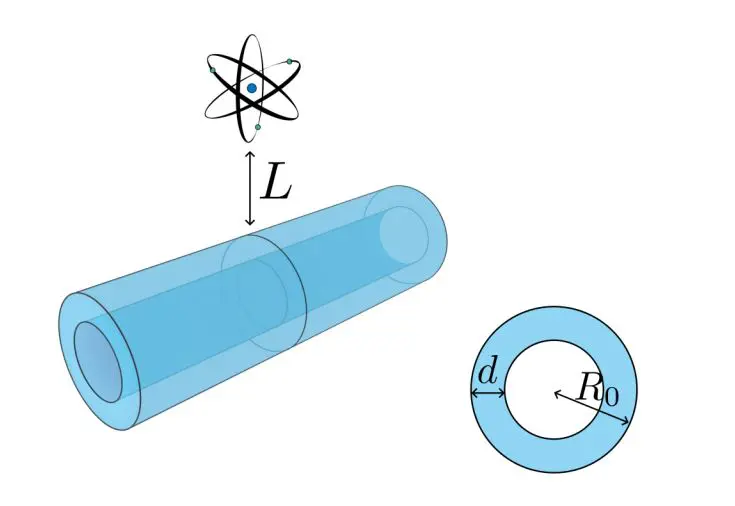
The subtle Casimir-Polder force, arising from electromagnetic fluctuations, profoundly influences interactions between atoms and nearby surfaces, and Bettina Beverungen, Daniel Reiche, Kurt Busch, and Francesco Intravaia from Humboldt-Universität zu Berlin, alongside researchers at the Max-Born-Institut, now present a detailed investigation of this force acting between atoms and hollow-core cylindrical fibres. This research addresses a crucial challenge in controlling and manipulating atoms, a capability vital for both fundamental studies and emerging technologies. The team develops a new computational method to accurately predict the strength of this interaction across a wide range of distances and temperatures, and importantly, reveals how the thickness of the fibre’s shell dramatically alters the potential experienced by nearby atoms. This discovery establishes shell thickness as a powerful parameter for controlling the Casimir-Polder force, potentially unlocking new possibilities in precision measurement and atom-based technologies, and also demonstrates the ability to differentiate between different material properties using this interaction.
This research investigates the Casimir-Polder interaction experienced by atoms positioned near cylindrical hollow-core fibres, focusing on how fibre geometry and material properties influence the force’s strength. The team employed a theoretical framework based on the Lifshitz theory of the Casimir force, adapting it to the specific cylindrical geometry of the hollow-core fibre, to calculate the frequency-dependent interaction potential. Results demonstrate a significant dependence of the interaction potential on fibre radius and dielectric properties, revealing both attractive and repulsive regimes depending on the distance between the atom and the fibre. This work advances our understanding of atom-surface interactions in confined spaces and has implications for developing new methods for integrating atoms and fibres in quantum technologies and precision measurements.
Cylindrical fibres with hollow cores are commonly used in experiments designed to control and manipulate atoms for both fundamental research and quantum technological applications. This research analyses how the interplay of geometrical and material characteristics determines the interaction strength, with particular emphasis on the impact of the fibre’s shell thickness. The team developed a flexible and rapidly converging numerical method to evaluate the interaction over a wide range of atom-cylinder separations at both zero and finite temperatures. Furthermore, a detailed analytical investigation explores how various material properties modify the Casimir interaction.
Casimir Forces and Near-Field Heat Transfer
Research detailed here covers nanoscale optics, heat transfer, and related phenomena, focusing on interactions at the nanoscale. The core research areas include the Casimir effect and Van der Waals forces, which describe attractive forces between uncharged surfaces due to quantum fluctuations. Many references focus on calculating these forces in various geometries and with different materials. Another key area is near-field radiative heat transfer, where heat transfer between closely spaced objects occurs through evanescent waves and surface modes, rather than traditional blackbody radiation, crucial for nanoscale devices. A significant portion of the research explores the excitation of surface plasmons and other surface modes in nanomaterials, enhancing near-field heat transfer and manipulating light at the nanoscale.
The research covers a wide range of nanomaterials, including nanowires, nanoparticles, and cylindrical structures, where geometry plays a critical role in determining optical and thermal properties. Some research delves into quantum friction and the effects of non-equilibrium conditions. Computational methods are prominent, including the use of Bessel functions, numerical integration techniques, and other numerical methods for accurate calculations. This body of work demonstrates an interdisciplinary approach, drawing on physics, materials science, and computational mathematics, and highlights recent advances in the field.
The research has potential applications in thermal management of nanoscale devices, near-field thermophotovoltaics for energy harvesting, nanoscale sensing, optical microscopy, and the design of new materials with tailored optical and thermal properties. This is a comprehensive collection of references reflecting cutting-edge research in nanoscale heat transfer, optics, and related phenomena.
Shell Thickness Modulates Casimir-Polder Force
This research presents a detailed investigation of the Casimir-Polder force acting on atoms near cylindrical fibres containing hollow cores, a geometry frequently encountered in experiments manipulating atoms. The team developed a fast-converging numerical method, alongside analytical approximations, to accurately evaluate the interaction across a wide range of atom-cylinder separations and temperatures. Their work demonstrates how both the geometry and material properties of the cylinder influence the strength of this interaction, with particular emphasis on the role of the shell thickness.
A key finding is that the shell thickness serves as a controllable parameter for modulating the Casimir-Polder force, offering potential benefits for both fundamental studies and technological applications. The researchers also revealed that, at finite temperatures, the system effectively distinguishes between ohmic and non-ohmic conductors, a distinction lost when considering perfect conductors. However, they note that the thermal regime tends to obscure material differences, causing the interaction to behave similarly regardless of the cylinder’s composition. Future work could explore the implications of these findings for specific experimental setups and investigate the potential for utilizing shell thickness to precisely control atomic interactions.
🗞 The Casimir-Polder interaction between atoms and hollow-core fibers
🧠 ArXiv: https://arxiv.org/abs/2512.11603




See today’s quantum computing news on Quantum Zeitgeist for the latest breakthroughs in qubits, hardware, algorithms, and industry deals.