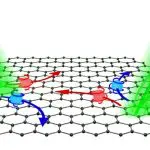
Recent discoveries of intervalley coherent states, phases where fundamental symmetries break down, are driving intense research into novel electronic properties. Hiroto Tanaka and Youichi Yanase, both from Kyoto University, investigate how these states generate electrical currents in a unique way, responding to surface acoustic waves, sound travelling along a material’s surface. Their work demonstrates that this interaction produces an unusual valley current, exhibiting a predictable relationship with the frequency of the sound waves, and significantly enhanced in specific materials. This achievement offers a new route for exploring exotic phenomena akin to superconductivity, potentially paving the way for innovative electronic devices based on valley-gauge symmetry breaking.
These anomalous valley currents exhibit a characteristic power-law relationship at low-frequency SAWs, indicating a unique response to acoustic stimulation. Through detailed calculations, the team establishes that the IVC order substantially enhances valley-current generation within rhombohedral graphene, revealing a significant material property with implications for novel electronic devices.
Valleytronics and Nonlinear Transport in 2D Materials
This compilation of research papers focuses on two-dimensional materials, primarily graphene and related systems, with a strong emphasis on valleytronics, acoustics, and nonlinear transport phenomena. A central theme is valleytronics, which exploits the valley degree of freedom for potential applications in information storage and processing, including generating, controlling, and detecting valley currents and utilizing the valley Hall effect. A significant portion of the research investigates the interaction of acoustic waves, specifically surface acoustic waves, with 2D materials, using acoustics to drive electronic currents and manipulate valley states. There is growing interest in nonlinear phenomena in 2D materials, including nonlinear Hall effects and nonreciprocal transport, alongside exploration of fundamental quantum effects.
This suggests research into exploiting topological properties for robust and efficient electronic devices. This compilation suggests several exciting research directions, including the development of novel electronic devices based on valleytronics, offering potential advantages in speed, energy efficiency, and robustness. Creating devices that combine acoustic and electronic functionalities could lead to new types of sensors, actuators, and signal processing devices. Using acoustic waves to dynamically tune the electronic properties of 2D materials enables reconfigurable devices, while exploiting nonlinear optical and electronic phenomena could lead to applications in optical signal processing and sensing.
Valley Currents Reveal Broken Gauge Symmetry
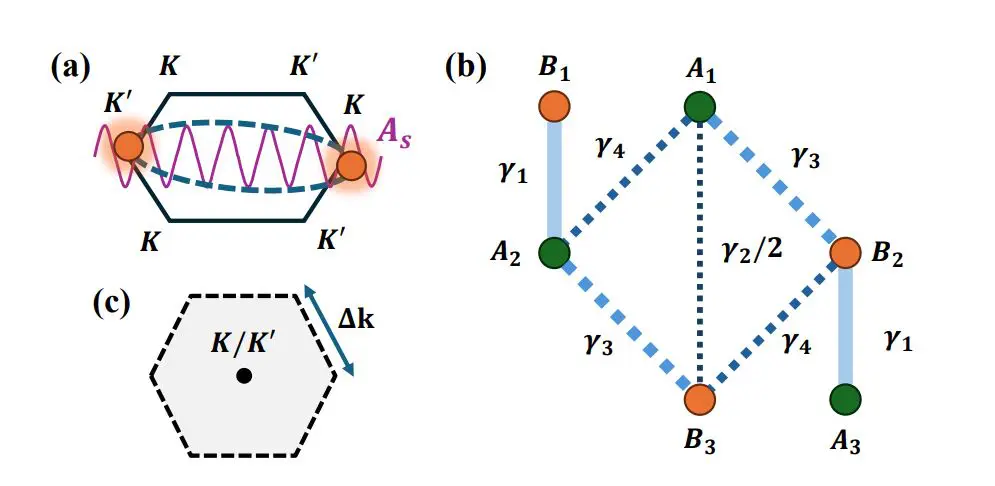
Recent research demonstrates the generation of unusual valley currents driven by surface acoustic waves (SAWs) in materials exhibiting intervalley coherent (IVC) states, a phenomenon closely linked to the breaking of valley-gauge symmetry. Scientists have shown that the IVC order gives rise to these unusual currents, revealing a characteristic power-law dependence for low-frequency SAWs, and confirming a fundamental connection to gauge-symmetry breaking observed in superconductors. The study focuses on rhombohedral graphene, where calculations demonstrate a significant enhancement of valley-current generation due to the IVC ordering. Experiments reveal that the magnitude of the generated valley current is directly related to a “pseudo-superfluid density”, a measure of how readily the material responds to the driving force of the SAWs, analogous to the superfluid density determining electromagnetic properties in superconductors.
The calculations demonstrate that the frequency dependence of the generated current follows a distinct power law, a direct consequence of the broken valley-gauge symmetry within the IVC state. This research establishes a clear link between the pseudogauge field and the valley gauge field, demonstrating that the former can be interpreted as an external valley gauge field driving anomalous responses. Further analysis of rhombohedral trilayer graphene reveals the intricate coupling between the pseudogauge field and electrons, confirming a similar relationship to that observed with the valley gauge field in monolayer graphene. The calculations demonstrate that the IVC order induces a large pseudo-superfluid density, significantly enhancing the SAW-driven valley currents and opening new avenues for exploring exotic phenomena emerging from valley-gauge-symmetry breaking. These findings establish a foundation for manipulating valley-based phenomena and potentially developing novel electronic devices.
Valley Current Enhancement via IVC Order
Recent research has demonstrated a significant enhancement of valley-current generation within materials exhibiting intervalley coherent (IVC) order, a phenomenon arising from broken valley-gauge symmetry. Scientists have shown that applying surface acoustic waves (SAWs) to these materials effectively generates valley currents, with the magnitude of this current notably increased by the presence of the IVC order. This enhancement is attributed to a unique contribution to the conductivity arising from the specific characteristics of the IVC state, distinguishing it from conventional materials where valley charge is conserved. The findings establish a clear analogy between the IVC order and superconductivity, suggesting a pathway for exploring exotic physical phenomena unique to systems where valley-gauge symmetry is broken. Researchers identified rhombohedral graphene, twisted transition metal dichalcogenides, and twisted multilayer graphene as promising candidate materials for observing the IVC state and its associated effects. Future work will likely focus on exploring a wider range of materials and refining the techniques used to generate and detect valley currents, potentially leading to novel electronic devices based on valleytronics.
🗞 Surface acoustic wave-driven valley current generation in intervalley coherent states
🧠 ArXiv: https://arxiv.org/abs/2512.10395

See today’s quantum computing news on Quantum Zeitgeist for the latest breakthroughs in qubits, hardware, algorithms, and industry deals.