Resistive switching memory represents a compelling alternative to traditional data storage, offering the potential for faster, more energy-efficient devices. Rahul Deb, Debajyoti Bhattacharjee, and Syed Arshad Hussain, all from Tripura University, investigate the use of bio-organic materials to create these innovative memory devices. Their work explores how naturally derived substances can achieve reliable resistive switching, a process where a material’s electrical resistance changes in response to a stimulus, enabling data storage. This research significantly advances the field by demonstrating the viability of sustainable, biocompatible materials for next-generation memory applications and opens new avenues for developing environmentally friendly and high-performance electronic devices.
Simple device structures, low power requirements, rapid switching and compatibility with high-density device integration characterise emerging memory technologies. Over the last two decades, these materials have been explored for both non-volatile memory and artificial synapse functions. This work provides an overview of resistive switching fundamentals, its major classifications, key applications, and recent trends in the use of organic and bio-derived materials. Resistive switching offers potential advantages over conventional memory technologies due to its simplicity and scalability, paving the way for innovative electronic devices. This research investigates the properties of various organic materials and plant extracts, aiming to identify promising candidates for next-generation memory applications and neuromorphic computing.
Organic Resistive Switching for Memory Applications
Resistive switching (RS) devices have garnered significant attention as alternatives to conventional silicon-based memory technologies, driven by limitations in cost, scalability, and reusability. These devices typically consist of a metal/insulator/metal structure, where the insulator acts as the active layer undergoing transitions between high resistance state (HRS) and low resistance state (LRS) upon applied bias, enabling binary data encoding. The behaviour can be nonvolatile, retaining resistance states after bias removal, or volatile, returning to HRS at low voltage. Recent research demonstrates a strong trend toward organic, biomolecular, and plant-derived systems for RS materials.
RS devices operate through reversible transitions between resistance states within the active layer, modulated by mechanisms such as redox reactions, charge trapping, space-charge-limited conduction, and conductive filament formation. Applying a voltage reaching the set voltage (VSET) transitions the material from HRS to LRS, potentially remaining in this state even after bias removal, resulting in nonvolatile memory. A subsequent voltage sweep can then transition the device from LRS to HRS at the reset voltage (VRESET). Scientists investigate charge transport mechanisms using current-voltage plots, with slope values identifying conduction regimes like thermionic emission and space-charge-limited conduction, and further verified through fitting schemes.
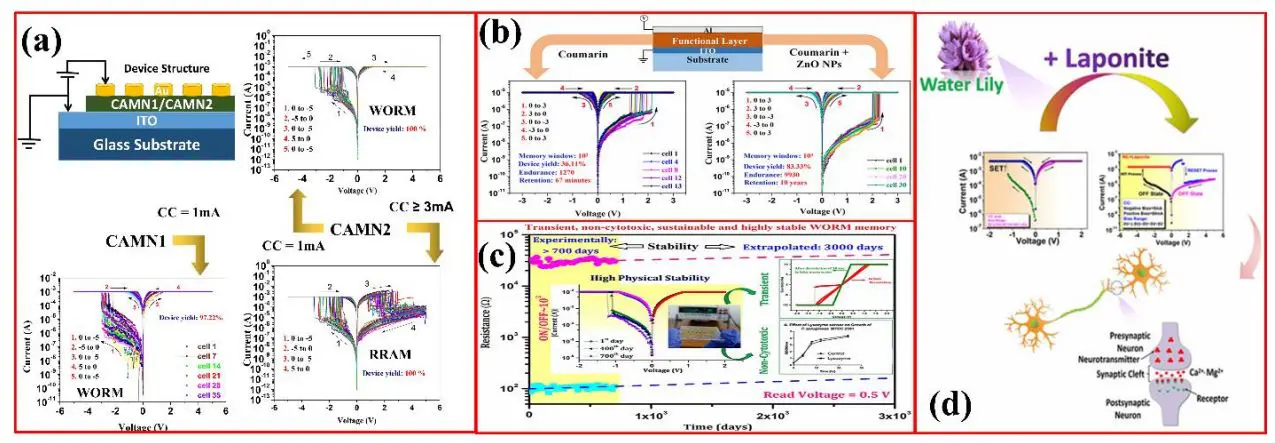
RS devices are classified based on current-voltage characteristics into write-once-read-many (WORM), resistive-random-access-memory (RRAM), threshold Switching (TS), and complementary resistive switching (CRS) memory. WORM devices exhibit irreversible transitions from HRS to LRS, suitable for permanent data storage. RRAM devices offer reversible transitions, ideal for rewritable storage and processing hardware. TS devices return to HRS upon removal of the switching bias, unlike other types. CRS devices utilise complementary resistance states to mitigate sneak-path currents.
Device performance is evaluated through key parameters including compliance current, which prevents device breakdown, on/off ratio, measuring readability and reliability, retention time indicating data stability, read endurance reflecting read cycles, cycling stability assessing device durability, and response speed critical for high-speed memory. Organic and biomolecular materials are gaining importance due to their structural tunability, low-cost fabrication, and compatibility with sustainable electronics. Molecular frameworks can be modified to control charge-transport behaviour, and simple processing methods like drop-casting and spin-coating are applicable. Water-soluble and recyclable biomolecules support environmentally friendly fabrication and transient electronics.
These materials also offer intrinsic charge-transfer capabilities and compatibility with flexible substrates. Recent advancements include organic small molecules, particularly π-conjugated donor-acceptor frameworks, demonstrating tunable WORM and RRAM characteristics. Hybridization strategies, such as incorporating ZnO nanoparticles into coumarin active layers, enhance device yield, endurance, and stability. Clay intercalation into plant-extract devices improves retention and enables transitions between WORM and RRAM. Plant-derived materials, due to their biodegradability and natural donor/acceptor groups, show stable WORM, rewritable read-only, and neuromorphic synaptic behaviours.
Protein-based systems offer biocompatibility, tunable functional groups, and potential for multilevel states. Studies on Lysozyme protein demonstrate potential for exceeding 10 years of stability. RS devices have applications in nonvolatile memory storage, secure data archiving, and brain-inspired computing. Their analog behaviour makes them ideal for artificial synapses. Challenges remain in addressing variability in switching parameters, improving device-to-device reproducibility, and achieving a robust understanding of switching and conduction mechanisms. Further research is needed to optimize material design, understand underlying mechanisms, and improve device performance for widespread adoption in high-density memory, neuromorphic computing, and flexible electronics.
Organic Memory Devices Demonstrate High Performance Ratios
Resistive switching (RS) devices, utilising organic, biomolecular, and plant-derived materials, present a promising alternative to conventional memory technologies. These devices offer simplified structures, low power consumption, rapid switching speeds, and compatibility with high-density integration. Research focuses on understanding and optimising key performance parameters crucial for practical applications. Scientists have meticulously characterised several metrics, including compliance current, carefully controlled to prevent device breakdown during the switching process. The performance of these devices is quantified through several key parameters, notably the ON/OFF ratio, or memory window, which measures the difference in current between the low and high resistance states at a specific read voltage.
Devices demonstrate high readability and noise immunity with significant ratios. Retention time, indicating long-term data stability, is another critical metric, with some biomaterial-based devices exhibiting stability exceeding 10 years. Read endurance, reflecting the number of times data can be read without error, and cycling stability, measuring the number of successful switching cycles, are also rigorously tested to assess device durability. Recent work demonstrates the tunability of these materials, with researchers achieving both write-once-read-many (WORM) and resistive-random-access-memory (RRAM) characteristics in coumarin-based devices.
Incorporation of zinc oxide nanoparticles into coumarin active layers markedly enhances device yield, endurance, and long-term stability, attributed to oxygen vacancy assisted filament formation. Clay intercalation into plant-extract devices improves retention to 10 years and enables a transition from WORM to RRAM, highlighting the role of inorganic trap states in stabilising switching events. Devices based on plant extracts like Ipomoea carnea and Nymphaea nouchali exhibit stable WORM, rewritable read-only, and even neuromorphic synaptic behaviours with physical stability exceeding 360 days. Furthermore, studies on the RS behaviour of Lysozyme protein demonstrate that biomaterial-based devices can achieve stability in excess of 10 years, reaffirming the potential for sustainable and flexible bio-integrated memory technologies.
🗞 Bio-Organic Materials Based Resistive Switching Memories
🧠 ArXiv: https://arxiv.org/abs/2512.10523