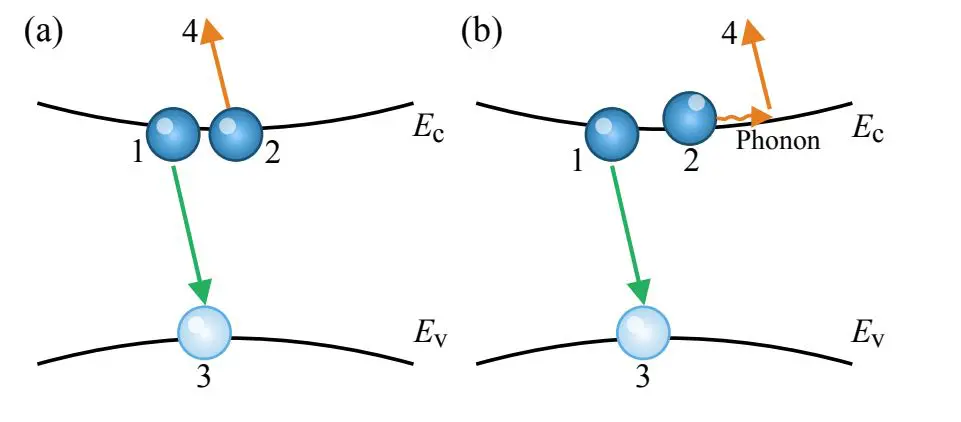
Auger recombination, a process that wastes energy as heat instead of light, significantly limits the efficiency of light-emitting technologies like lasers and LEDs. Utkarsh Singh and Sergei I. Simak, from Linköping University and Uppsala University, now demonstrate that conventional models of this energy loss fail to account for how materials respond to changing electrical conditions. Their research introduces a new framework that accurately incorporates these dynamic effects, revealing that they substantially reduce energy loss in metal-halide perovskites. The team’s calculations show a 50 to 60 percent reduction in Auger recombination for specific perovskite materials, and importantly, this improved understanding shifts the point at which these materials transition from efficient light emission to energy loss by nearly a factor of two, offering a pathway to brighter, more efficient devices.
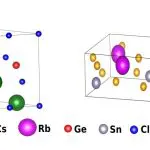
The dominant channel operates at carrier densities relevant to device operation, and accurately modeling this process is essential. Conventional approaches, however, neglect dynamic dielectric effects, limiting their predictive power at realistic operating conditions. Researchers have developed a comprehensive framework that incorporates the frequency-dependent screened Coulomb interaction, computed from a low-scaling many-body perturbation theory, into both direct and phonon-assisted Auger amplitudes. Applying this method to orthorhombic CsPbI₃ and CsSnI₃ demonstrates that dynamic screening enhances the dielectric response, lowering the room-temperature Auger coefficient by approximately 50-60 percent, and shifting the balance between radiative and non-radiative recombination pathways.
Perovskite Auger Recombination, Many-Body Perturbation Theory
This work details a sophisticated theoretical investigation into Auger recombination in metal-halide perovskites, a non-radiative process that limits the efficiency of solar cells and light-emitting diodes. The research aims to understand and mitigate this loss mechanism through a detailed analysis of the electronic structure and many-body effects involved. The study employs first-principles calculations, combining Density Functional Theory with many-body perturbation theory and the Bethe-Salpeter Equation to accurately describe the materials’ electronic properties. A significant focus is on dynamic screening, the way electrons respond to and shield each other’s interactions, which is crucial for accurately calculating energy levels and transition probabilities. The calculations go beyond simple approximations by including many-body effects, essential for describing excited states and recombination processes. The GW approximation calculates quasi-particle energies, providing a more accurate band structure, while the Bethe-Salpeter Equation calculates excited state properties and optical absorption spectra.
Dynamic Screening Reduces Auger Recombination Losses
This work presents a new framework for modeling nonradiative losses in light-emitting materials, specifically addressing the limitations of current methods that neglect dynamic dielectric effects. Researchers developed a method incorporating frequency-dependent screening into calculations of Auger recombination, a key process limiting the efficiency of lasers and LEDs. The approach utilizes a many-body perturbation theory method to compute the screened Coulomb interaction, enabling more accurate modeling of electron interactions within the material. Experiments on orthorhombic CsPbI₃ and CsSnI₃ demonstrate that incorporating dynamic screening enhances the dielectric response, resulting in a significant reduction of the room-temperature Auger coefficient by 50-60 percent.
This renormalization effectively shifts the crossover point between radiative and nonradiative recombination, requiring nearly half the carrier density to achieve the same recombination rate. Detailed analysis reveals the distribution of energy transfers within the materials, showing substantial frequency-dependent contributions, and validating the need to evaluate screening at event-specific energy transfers. The results demonstrate that dynamic dielectric screening is a quantitative determinant of Auger recombination, offering a transferable framework for predictive modeling across polar semiconductors where traditional, frequency-independent screening models are inadequate.
Dynamic Screening Boosts Perovskite Efficiency Predictions
This research establishes the importance of fully accounting for dynamic dielectric screening when modeling Auger recombination in halide perovskites. Scientists demonstrated that conventional models, which treat dielectric response as constant, underestimate this effect by a significant margin, leading to inaccuracies in predicting the performance of light-emitting devices. By incorporating frequency-dependent screening calculated using a sophisticated many-body approach, the team revised room-temperature Auger coefficients by up to a factor of two, suggesting that devices could operate efficiently at higher carrier densities than previously thought. The findings reveal that the dynamic response of the material’s dielectric properties substantially alters the balance between radiative and non-radiative recombination processes. This detailed understanding not only improves the accuracy of predictive modeling but also identifies potential strategies for materials design, suggesting that modifying the composition or band alignment of perovskites could further suppress Auger recombination, independent of dielectric effects.
🗞 Dynamic Screening Effects on Auger Recombination in Metal-Halide Perovskites
🧠 ArXiv: https://arxiv.org/abs/2512.07581



See today’s quantum computing news on Quantum Zeitgeist for the latest breakthroughs in qubits, hardware, algorithms, and industry deals.