

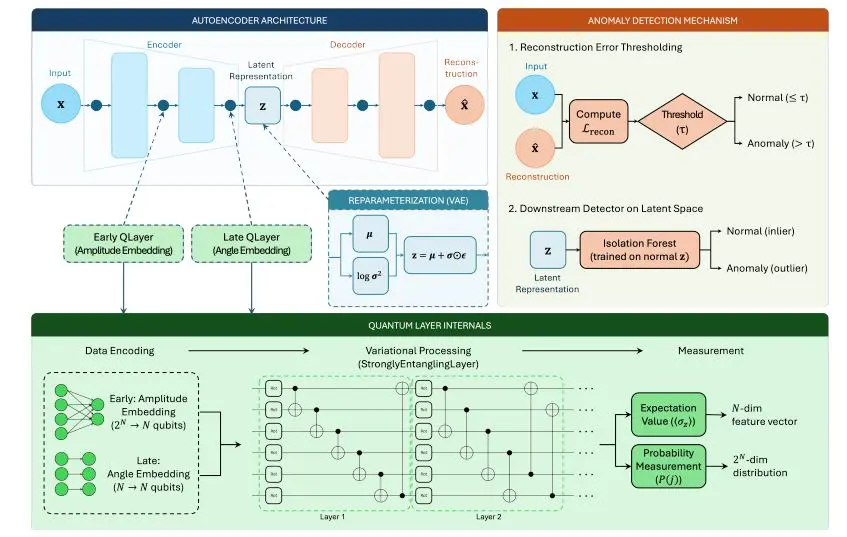
Network intrusion detection increasingly relies on identifying novel attacks, demanding systems capable of recognising anomalies without prior knowledge of specific threats. Mohammad Arif Rasyidi, Omar Alhussein, and Sami Muhaidat, working across Khalifa University and Università degli Studi di Milano, alongside Ernesto Damiani, present the first comprehensive evaluation of hybrid quantum-classical autoencoders for this critical task. Their research constructs a unified framework to explore the optimal design of these systems, investigating factors such as quantum layer placement and data encoding methods. Results across established network datasets demonstrate that, with careful configuration, hybrid quantum-classical autoencoders achieve comparable, and sometimes superior, performance to traditional methods, crucially exhibiting stronger generalisation capabilities when faced with previously unseen attacks, and offering valuable insights into the practical considerations for building robust, future-proof intrusion detection systems.
Quantum Machine Learning for Network Security
Research in network security increasingly focuses on using machine learning to detect malicious activity, with many studies leveraging deep learning models to identify unusual network behaviour. A growing area explores the potential of quantum machine learning for enhancing these systems. Key challenges lie in ensuring data quality, robustness against adversarial attacks, and achieving scalability for high-volume network traffic. Understanding why a system makes a certain decision, known as explainability, is also becoming increasingly important alongside effective feature engineering and data representation.
Researchers are exploring hybrid approaches, combining different machine learning techniques or integrating them with traditional signature-based methods. Leveraging network topology information, using techniques like graph neural networks, can improve detection accuracy. Several datasets, including KDD Cup 99, NSL-KDD, UNSW-NB15, and CICIDS2019, are commonly used for evaluating these systems, with some studies focusing on securing Internet of Things (IoT) and Industrial IoT (IIoT) networks. Current research highlights the growing interest in graph neural networks and the potential of quantum computing, while acknowledging the challenges related to data quality, adversarial attacks, and scalability.
Hybrid Quantum-Classical Autoencoders for Intrusion Detection
This work pioneers a comprehensive evaluation of hybrid quantum-classical (HQC) autoencoders for unsupervised anomaly-based intrusion detection, a critical challenge in network security. Researchers constructed a unified experimental framework to systematically investigate key design choices within HQC autoencoders, including layer placement and latent-space regularization techniques. This framework enabled rigorous comparison of different configurations across three benchmark network intrusion detection system (NIDS) datasets. Scientists engineered HQC autoencoders by embedding parameterized quantum circuits as layers within classical deep learning networks, leveraging the potential of quantum computation for more expressive feature representations.
Experiments employed both variational and non-variational autoencoder formulations, allowing for detailed analysis of their respective strengths and weaknesses. To assess the impact of noise, the team conducted gate-noise experiments, revealing performance degradation and highlighting the need for noise-aware HQC designs. The research team implemented a systematic approach to latent-space regularization, improving model stability and preventing overfitting. Performance was evaluated using zero-day attack scenarios, demonstrating the ability of well-configured HQC models to provide stronger and more stable generalization compared to classical and supervised baselines. This study delivers the first data-driven characterization of HQC autoencoder behaviour for network intrusion detection, outlining key factors that govern their practical viability and paving the way for future advancements in quantum-enhanced network security.
Hybrid Autoencoders Detect Network Intrusions Effectively
This work presents a large-scale evaluation of hybrid quantum-classical (HQC) autoencoders for unsupervised anomaly-based intrusion detection. Researchers constructed a unified experimental framework to systematically investigate key design choices within HQC autoencoders, including quantum layer placement and latent-space regularization techniques. Experiments across three benchmark NIDS datasets demonstrate that well-configured HQC autoencoders can match or exceed the performance of classical autoencoders, although architectural sensitivity remains a consideration. Notably, optimized HQC models exhibit stronger generalization and lower performance variability than both classical unsupervised and supervised models when evaluated under zero-day attack scenarios.
Further investigation involved simulating gate noise, revealing measurable reductions in performance. This confirms performance degradation due to noise, defining concrete requirements for noise-aware HQC designs and highlighting a crucial area for future development. This research provides a data-driven characterization of HQC autoencoder behaviour, providing valuable insights into their practical viability for network intrusion detection and establishing a foundation for leveraging quantum computing to enhance cybersecurity measures.
Hybrid Autoencoders Detect Novel Network Intrusions
This research presents a comprehensive evaluation of hybrid quantum-classical autoencoders for unsupervised network intrusion detection, offering the first quantitative characterization of their behaviour in this context. Experiments across established benchmark datasets demonstrate that, in well-configured setups, these models can match or exceed the performance of classical autoencoders and supervised learning approaches. The results suggest that hybrid quantum-classical models exhibit stronger generalization capabilities when faced with previously unseen attacks, offering improved stability against novel threats. However, the study also reveals a sensitivity to architectural choices, requiring careful tuning to achieve optimal performance.
Simulated gate noise experiments highlight a critical limitation, demonstrating significant performance degradation even at relatively low noise levels. This underscores the importance of developing noise-aware training strategies and quantum error mitigation techniques for practical implementation on near-term quantum hardware. Future research directions include testing these architectures on actual quantum devices, designing noise-resilient models co-adapted to specific hardware constraints, and exploring advanced quantum neural network architectures to enhance representational power and scalability for real-world network data.
🗞 Hybrid Quantum-Classical Autoencoders for Unsupervised Network Intrusion Detection
🧠 ArXiv: https://arxiv.org/abs/2512.05069



See today’s quantum computing news on Quantum Zeitgeist for the latest breakthroughs in qubits, hardware, algorithms, and industry deals.



