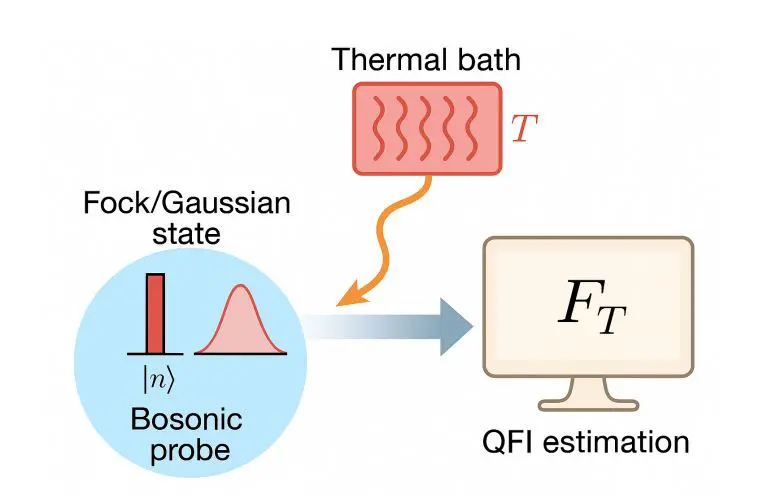
The quest to measure temperature with ever-increasing precision drives innovation in diverse fields, yet fundamental limits remain unclear, especially when dealing with complex quantum systems. Pritam Chattopadhyay from the Weizmann Institute of Science and colleagues now establish analytic boundaries for temperature estimation using quantum states that deviate from the commonly studied Gaussian forms, revealing a surprising advantage for these ‘non-Gaussian’ approaches. The team demonstrates that, under specific conditions, non-Gaussian probes decisively outperform their Gaussian counterparts, achieving a faster and more sensitive temperature reading. This research uncovers a unique linear scaling in temperature estimation accuracy for certain non-Gaussian states, a significant improvement over the weaker scaling observed in Gaussian systems, and charts a path towards practical applications in technologies like circuit QED.
Sian states evolve dissipatively, behaving like bosonic systems losing energy over time. By focusing on the initial moments of this evolution, governed by a precise mathematical description of energy loss, researchers derive clear rules explaining when and how non-Gaussian probes decisively outperform Gaussian states when both are limited to the same energy levels. The analysis reveals a unique, linear-in-time enhancement of the quantum Fisher information (QFI) for Fock states, a stark contrast to the weaker, quadratic scaling observed with Gaussian probes. These theoretical insights are validated through detailed numerical simulations and mapped onto experimentally accessible platforms such as circuit QED.
Short-Time Quantum Probe Temperature Sensing Limits
Scientists investigated the fundamental limits of temperature sensing using quantum probes, focusing on how non-Gaussian states compare to Gaussian states in realistic, noisy environments. The study employed a theoretical model of a single bosonic mode, representing the quantum probe, interacting weakly with a thermal bath at a specific temperature. Researchers developed equations describing how the probe’s quantum state changes over time due to energy loss, utilizing a precise mathematical description to accurately capture the dynamics. They analyzed two distinct initial states: Fock states, exhibiting maximal certainty in photon number and strong non-classicality, and various Gaussian states, including squeezed and displaced thermal states.
To ensure a fair comparison, all initial states were prepared with the same average energy. The study rigorously calculated the quantum Fisher information (QFI), a key metric determining the ultimate precision achievable in temperature estimation. Scientists demonstrated a quantifiable advantage of non-Gaussian Fock states over Gaussian states, particularly at low temperatures and under energy constraints. This advantage stems from the unique way Fock states evolve under energy loss, exhibiting a linear-in-time enhancement of the QFI. The research validated these theoretical findings through detailed numerical simulations, confirming the superior performance of non-Gaussian probes in estimating temperature.
Non-Gaussian States Enhance Temperature Estimation Precision
Scientists have established precise limits on the quantum Fisher information (QFI) for temperature estimation, investigating how non-Gaussian states perform compared to Gaussian states under identical energy constraints. The research focuses on a single-mode bosonic probe interacting with a thermal bath, evolving under a weakly dissipative mathematical description, and reveals a quantifiable advantage for non-Gaussian probes, particularly at low temperatures. Experiments demonstrate that Fock states exhibit a linear-in-time QFI enhancement, a significant improvement over the quadratic scaling observed with Gaussian probes. The team derived precise rules governing the QFI, demonstrating that the precision of temperature estimation with non-Gaussian probes improves linearly with time, while Gaussian probes exhibit a weaker, quadratic improvement. These findings were substantiated through detailed numerical simulations and mapped onto experimentally accessible platforms such as circuit QED.
Fock States Enhance Quantum Temperature Sensing
This research establishes fundamental limits to temperature sensing in open quantum systems, clarifying the potential advantages of employing non-Gaussian probes, specifically Fock states. Scientists demonstrate, through analytical calculations and numerical simulations, that Fock states exhibit a distinct linear-in-time enhancement in the quantum Fisher information, a key measure of estimation precision, surpassing the weaker quadratic scaling achieved by Gaussian probes under identical energy constraints. This advantage stems from the sharp, well-defined number statistics inherent in Fock states, which amplify sensitivity to temperature changes by improving the distinguishability of the probe’s evolved states. The findings bridge a conceptual gap in quantum thermometry, extending previous understanding from closed systems to more realistic, open environments where energy loss is unavoidable. Researchers quantified the trade-off between initial sensitivity and robustness to noise, revealing the metrological cost associated with the fragility of non-Gaussian states in noisy quantum systems.
🗞 Non-Gaussian Dissipative Quantum Thermometry Beyond Gaussian Bounds
🧠 ArXiv: https://arxiv.org/abs/2512.03735
See today’s quantum computing news on Quantum Zeitgeist for the latest breakthroughs in qubits, hardware, algorithms, and industry deals.