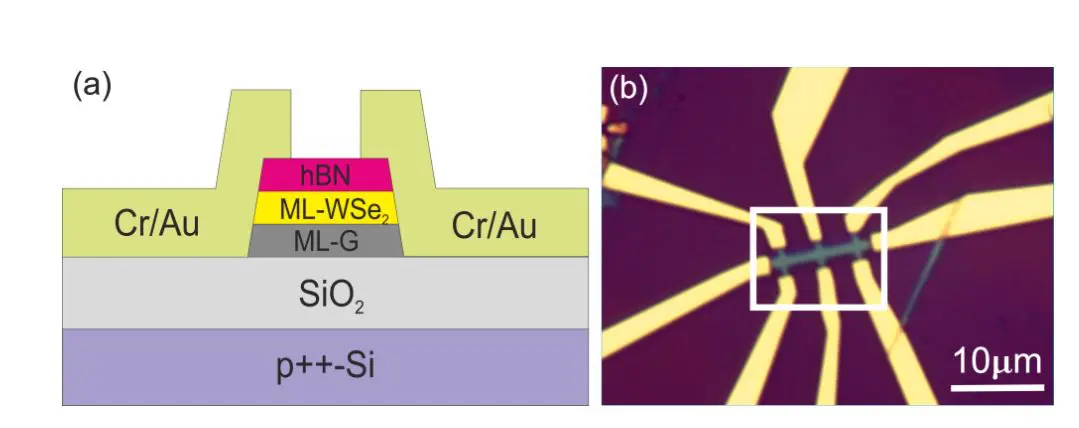
The interplay between materials can give rise to unexpected properties, and recent research focuses on how graphene interacts with other two-dimensional materials to create novel effects. Tobias Rockinger, Bálint Szentpéteri, and Szabolcs Csonka, along with their colleagues, investigate how spin-orbit coupling, a quantum mechanical effect influencing electron behaviour, arises when graphene is combined with tungsten diselenide. Their work demonstrates that this proximity-induced spin-orbit coupling is strongly dependent on the relative twist angle between the two materials, confirming theoretical predictions and opening new avenues for controlling quantum phenomena in these heterostructures. By carefully aligning the materials and applying mechanical pressure, the team successfully tunes the strength of this interaction, paving the way for potential applications in spintronics and quantum computing.
Recently, proximity-induced spin-orbit coupling (SOC) has been observed in heterostructures consisting of monolayer graphene and transition metal dichalcogenides. This research investigates correlated van der Waals structures, focusing on how the strength of this interaction changes depending on the momentum of electrons within the material. The team explores how this interaction manifests in these layered materials, aiming to understand the fundamental physics governing electron behaviour at interfaces, which is crucial for potential applications in spintronics and quantum electronics.
Twist Angle and Pressure Tuning of SOC
Detailed experiments demonstrate how the strength of spin-orbit coupling (SOC) in graphene/tungsten diselenide heterostructures can be tuned by varying the twist angle between layers and applying pressure. Analysis of electrical transport properties, weak localization, and anti-localization phenomena provides insights into the underlying mechanisms governing electron behaviour. Measurements of electrical resistance and conductivity as a function of applied voltage establish a baseline for understanding transport characteristics, while analysis of momentum relaxation time and diffusion coefficients reveals scattering mechanisms influencing charge transport. Measurements of magnetoconductance reveal information about weak localization and anti-localization, with the transition from weak localization to weak anti-localization indicating the presence of SOC. Detailed fitting of these curves allows for the extraction of parameters related to SOC strength. Experiments conducted under pressure demonstrate how applying force affects the magnetoconductance curves and SOC, providing a comprehensive understanding of the material’s behaviour under stress.
Twist Angle Controls Spin-Orbit Coupling Strength
This work demonstrates a strong relationship between twist angle and proximity-induced spin-orbit coupling (SOC) in monolayer graphene/tungsten diselenide heterostructures. Researchers meticulously fabricated devices with varying twist angles, employing fractured edges and crystallographic etching to precisely control alignment. Weak anti-localization measurements were then used to quantify the strength of both Rashba-type and valley-Zeeman-type SOC. Experiments confirmed a significant dependence of SOC strength on the twist angle, aligning with theoretical predictions. A novel method was developed for samples utilizing chemically grown tungsten diselenide, allowing unambiguous determination of the twist angle through crystallographic etching and identification of zigzag edges. The team could reproducibly fabricate samples with similar SOC strengths when using the same twist angle, and confirmed earlier findings regarding the tunability of SOC via mechanical pressure, demonstrating a measurable pressure dependence of the Rashba-type SOC.
Twist and Pressure Tune Spin-Orbit Coupling
This research successfully demonstrates that proximity-induced spin-orbit coupling within van-der-Waals heterostructures can be effectively tuned by both the twist angle between graphene and a transition metal dichalcogenide, and by applying mechanical pressure. By carefully controlling the alignment of the materials during fabrication, the team achieved more reproducible results and confirmed theoretical predictions regarding the relationship between twist angle and spin-orbit coupling strength. Furthermore, experiments revealed a significant increase in spin-orbit coupling parameters when the heterostructure was subjected to pressure, aligning with previous findings in the field. These findings are significant because they provide a pathway towards controlling spin-related phenomena in graphene, a material with promising applications in spintronics and quantum devices. Understanding and manipulating spin-orbit coupling is crucial for realizing advanced graphene-based technologies, including spin transistors and devices that exploit correlated electron states.
🗞 Tuning proximity-induced spin-orbit coupling in graphene/WSe heterostructures
🧠 ArXiv: https://arxiv.org/abs/2512.02522