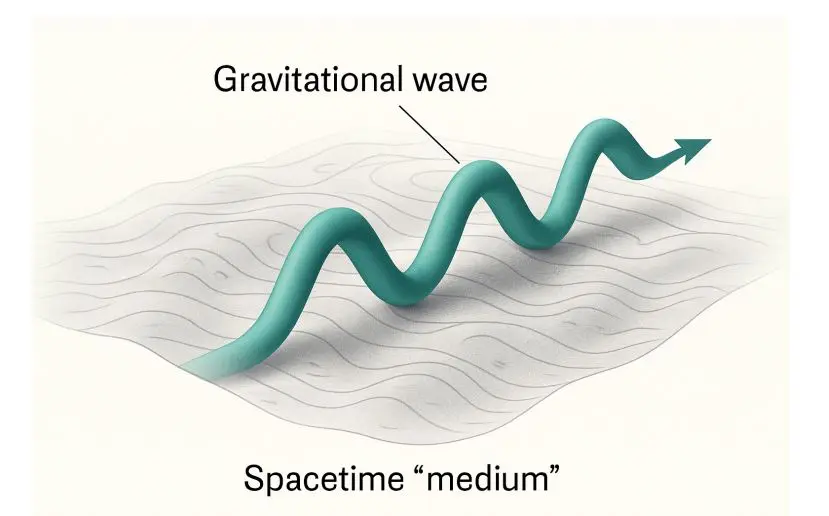
The subtle distortions of spacetime, and how they affect travelling gravitational waves, form the focus of new research led by Hu Cang and Yuan Wang from The University of Hong Kong. This work establishes a rigorous framework for understanding how these waves lose coherence as they propagate through a fluctuating cosmos, revealing that phase diffusion, a measure of wave distortion, is the dominant effect caused by microscopic fluctuations in spacetime curvature. The team demonstrates a surprising universality, proving that the accumulated phase variance grows predictably with distance, regardless of the specific underlying physics causing the fluctuations, provided these fluctuations have a finite range. This breakthrough offers a clear pathway to test exotic theories of spacetime, such as those involving string theory or quantum gravity, and provides a falsifiable prediction for future gravitational wave detectors like LIGO, LISA, and Pulsar Timing Arrays.
By directly analysing the distorted fabric of spacetime, the team avoids ambiguities present in previous approaches and defines a precise measure of decoherence, quantifying the loss of quantum superposition due to gravity. The framework predicts a specific relationship between decoherence, gravitational wave frequency, and the distance travelled, offering a potential pathway for observational tests using existing and future gravitational wave detectors. Furthermore, the analysis reveals a universal behaviour in the rate of decoherence, independent of the specific details of the quantum spacetime fluctuations, suggesting a fundamental limit on how coherently gravitational waves can travel across vast cosmic distances.
The research investigates the behaviour of the Riemann tensor and leverages the extreme adiabaticity of cosmological gravitational wave propagation, where the ratio of the expansion rate of the Universe to the wave frequency is exceptionally small. This analysis demonstrates that the primary effect of microscopic spacetime fluctuations on gravitational waves is a gradual shift in their phase, rather than a reduction in amplitude or mixing of different wave modes. The primary theoretical achievement is a universality theorem, which posits that for any quantum gravity model exhibiting curvature fluctuations with a finite correlation length, the accumulated phase variance grows linearly with distance. This diffusive scaling behaviour sharply contrasts with coherent astrophysical effects and with theoretical models that predict a different scaling behaviour.
Quantum Decoherence in Gravitational Waves
This paper investigates how quantum gravity effects might manifest as decoherence in gravitational waves. The central idea is that the fabric of spacetime at the quantum level is not perfectly smooth, but exhibits fluctuations. As gravitational waves propagate through these fluctuations, they lose coherence, similar to how a clear image becomes blurred. The goal is to develop a framework to predict and potentially detect these quantum gravity effects using gravitational wave observations. The authors aim to move beyond simply suggesting that such effects might exist and instead provide a concrete, calculable prediction for how they would appear in gravitational wave data.
The research focuses on the adiabatic approximation, simplifying calculations by assuming the gravitational wave wavelength is much larger than the characteristic scale of quantum spacetime fluctuations. The primary observable is the phase of the gravitational wave, which experiences random diffusion due to quantum fluctuations. A crucial finding is that all local, short-range quantum gravity models predict a linear relationship between the cumulative phase diffusion and the distance travelled by the gravitational wave. This universality simplifies the search for quantum gravity effects, as the specific details of the quantum gravity theory become less important than the general principle of quantum fluctuations. While the distance scaling is universal, the frequency dependence of the phase diffusion is model-dependent, captured by a parameter called the spectral index, allowing categorisation of different theoretical models.
Gravitational Wave Phase Diffusion Predicts Quantum Gravity
This research establishes a new framework for understanding how gravitational waves lose coherence as they travel through the Universe, offering a unique probe of quantum gravity. Scientists demonstrate that the primary effect of spacetime fluctuations on gravitational waves is a gradual accumulation of phase shifts, rather than a loss of amplitude or mixing of modes. A key finding is a universality theorem, which states that any local model of quantum gravity with a finite correlation length will cause gravitational wave phase to diffuse linearly with distance, irrespective of the specific microscopic physics involved. This simplifies the search for quantum gravity effects, allowing categorisation of different theoretical models based on their predicted spectral characteristics. The team’s work provides a means to distinguish between various quantum gravity scenarios, including those involving Planck-scale fluctuations, holographic noise, or causal sets, through precise measurements of gravitational wave decoherence. While current instruments are unlikely to directly detect the effects of standard Planck-scale fluctuations, the established scaling laws enable scientists to place increasingly stringent constraints on the granularity and locality of spacetime.
🗞 Universality and Falsifiability of Quantum Spacetime Decoherence: A Gauge-Invariant Framework for Gravitational-Wave Phase Diffusion
🧠 ArXiv: https://arxiv.org/abs/2512.02782

See today’s quantum computing news on Quantum Zeitgeist for the latest breakthroughs in qubits, hardware, algorithms, and industry deals.