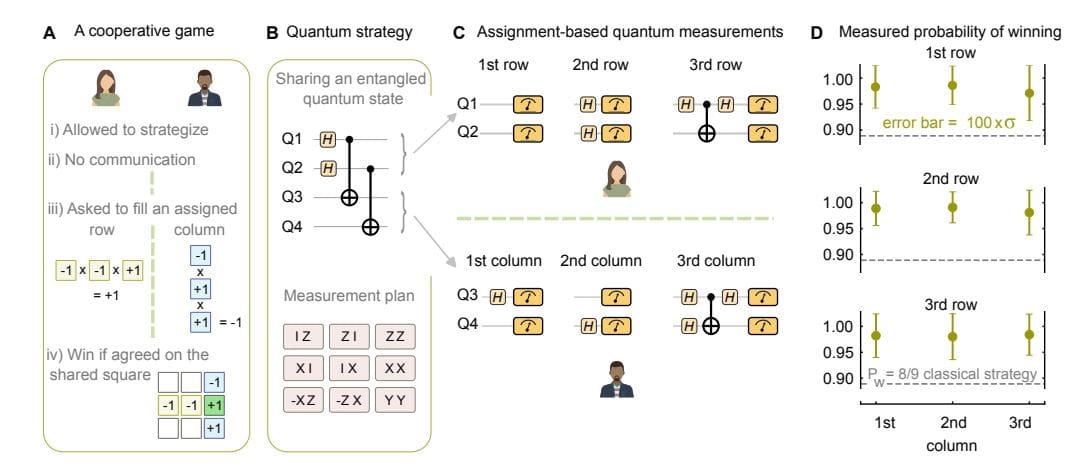
The potential for quantum computers to outperform their classical counterparts hinges on demonstrating a clear quantum advantage, yet achieving this remains a significant challenge. Shashwat Kumar, Eliott Rosenberg, and Alejandro Grajales Dau, all from Google Quantum AI, alongside Rodrigo Cortinas, Dmitri Maslov, and Richard Oliver, now present compelling evidence of this advantage through the exploration of quantum contextuality. Their work demonstrates that quantum systems exhibit behaviours impossible for classical systems when performing specific tasks, exceeding the limits of classical success rates. By implementing and analysing several complex games, including the magic square game and a 2D hidden linear function problem, the team showcases how quantum contextuality enables performance beyond classical capabilities, and proposes new methods for benchmarking the power of quantum processors.
Experiments involving the magic square game, the N-player GHZ game, and a hidden linear function problem consistently exceed classical success rates, proposing novel ways to benchmark quantum processors and motivating extensive research on quantum processors.
Contextuality Benchmarks for Quantum Processors
This research details experiments designed to rigorously benchmark quantum processors, moving beyond theoretical claims to focus on practical performance. The team employed tasks reliant on quantum contextuality to probe system capabilities, emphasizing resource measurement, time, and operational count rather than theoretical complexity. Experiments measured fidelity in creating and maintaining entangled states, characterizing quantum states with X- and Z-stabilizer fidelities, and identified sources of error to guide processor improvements. The hidden linear function problem was implemented, determining the effective number of layers required for a solution, and quantum performance was compared to theoretical classical circuit depth.
While quantum performance exceeded classical bounds for certain problem sizes, this advantage diminished as the problem increased. Dynamical decoupling and randomized compiling suppressed errors, and statistical methods ensured reliable results, demonstrating the crucial role of practical benchmarking and error mitigation in evaluating quantum hardware. The research acknowledges challenges in applying theoretical lower bounds to finite-size experiments. The hidden linear function problem provides a useful framework for comparing quantum and classical performance, using time-to-solution and effective layer count as metrics. Statistical analysis ensured reliability, and comparisons to theoretical bounds provided context for the findings, providing a detailed account of experiments assessing near-term quantum processors.
Quantum Advantage Confirmed in Magic Square Game
Scientists have demonstrated a clear separation between quantum and classical behaviors, achieving success probabilities in tasks exceeding classical limits. Experiments involving the magic square game revealed a winning probability of 0. 9830 ±0. 0001, significantly exceeding the classical limit of 8/9, stemming from the non-commutativity of quantum observables. To quantify this advantage, the team employed a Bell-Kochen-Specker inequality, measuring the degree of contextuality in their processor with a circuit utilizing quantum non-demolition measurements on two qubits.
Analysis yielded a value of χKSB = 5. 618 ±0. 005, exceeding the classical limit of χKSB = 4 and approaching the theoretical quantum limit of χKSB = 6, confirming the advantage is rooted in quantum mechanics, not experimental noise. Extending their investigation to many-body quantum states, the researchers implemented a non-communication game based on an N-qubit GHZ state, providing a pathway to benchmark quantum processors using contextuality-based algorithms. The success of these experiments demonstrates the potential for harnessing quantum phenomena to solve problems intractable for classical computers.
Quantum Contextuality Demonstrates Computational Advantage
This research demonstrates that quantum processors can perform certain tasks with probabilities exceeding classical limits, establishing a clear quantum advantage. The team successfully implemented algorithms based on quantum contextuality, observing performance gains in the magic square game, the N-player GHZ game, and a hidden linear function problem, providing concrete evidence supporting the potential of quantum computation. The study acknowledges that the observed quantum advantage is currently limited by the size and performance of available quantum processors. Analysis reveals a point, around 35 qubits in this instance, where extrapolations of classical algorithms suggest they might outperform the current quantum implementation, cautioning against overinterpreting these extrapolations at smaller system sizes. Future work will likely focus on scaling up these algorithms and improving hardware performance to extend the range of problems where a demonstrable quantum advantage can be achieved.
🗞 Quantum-Classical Separation in Bounded-Resource Tasks Arising from Measurement Contextuality
🧠 ArXiv: https://arxiv.org/abs/2512.02284
See today’s quantum computing news on Quantum Zeitgeist for the latest breakthroughs in qubits, hardware, algorithms, and industry deals.