

Nitrogen-vacancy (NV) centres in diamond represent a promising platform for quantum technologies, but their performance relies on maintaining stable charge states. Audrius Alkauskas, Lukas Razinkovas, and colleagues at the Center for Physical Sciences and Technology in Vilnius, working with Chris G. Van de Walle at the University of California, Santa Barbara, and Ronald Ulbricht at the Max Planck Institute for Polymer Research, have now uncovered the mechanism governing charge state equilibration in these centres. The team investigated how photoionization affects NV centre ensembles and discovered that recovery occurs via electron tunneling between centres, rather than through temperature-dependent processes. This finding, achieved through careful pump-probe spectroscopy and supported by theoretical calculations, significantly advances understanding of defects in wide-bandgap materials and paves the way for improved control and reliability in quantum devices and other applications.
NV centers are sensitive to charge fluctuations within the diamond lattice, which can diminish their quantum coherence and measurement accuracy. This work investigates the mechanisms governing charge state equilibration within ensembles of NV centers, focusing on the role of electron tunneling between centers and defects. The research combines optical spectroscopy and theoretical modelling to understand how NV charge states respond to external stimuli and internal fluctuations.
The study reveals that charge state equilibration occurs via resonant tunneling, where electrons move between NV centers with different charge states through intermediate defect states. Calculations demonstrate that the tunneling rate is highly sensitive to the density and energy distribution of these defect states, as well as the distance between NV centers. The team finds that even small concentrations of defects can significantly enhance charge equilibration, leading to faster switching between charge states and reduced coherence times. These findings provide crucial insights into the charge dynamics of NV centers and their implications for quantum sensing and quantum information processing. Controlling the defect landscape in diamond is essential for achieving stable and high-performance NV-based devices. By minimizing the density of tunneling-active defects, it is possible to suppress charge equilibration and enhance the coherence of NV centers, paving the way for more sensitive and reliable quantum sensors and qubits.
Nitrogen Donor Impact on NV Center Equilibration
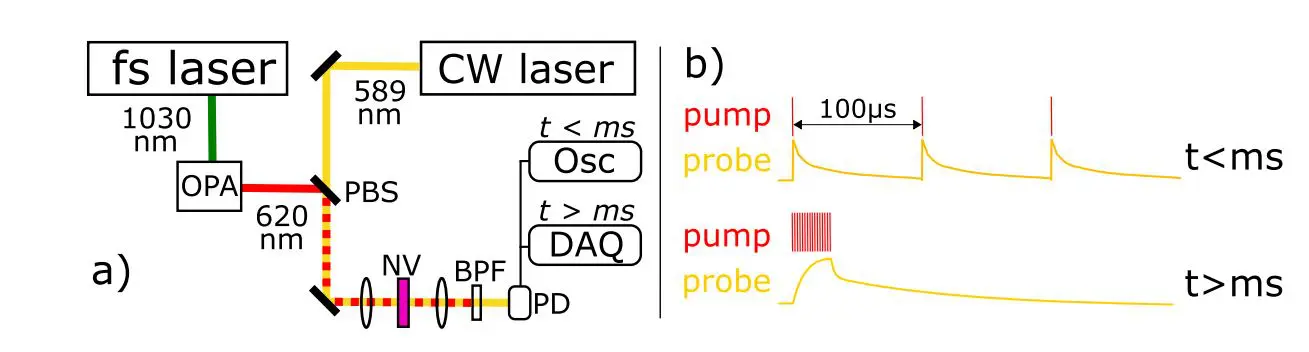
This study investigates charge state equilibration in nitrogen-vacancy (NV) centers, defects within diamond crucial for applications in quantum technologies, and employs a multifaceted approach combining pump-probe spectroscopy with sophisticated computational modeling. Scientists utilized pump-probe spectroscopy to ionize negatively charged NV centers, then meticulously monitored the recovery process over timescales extending up to several seconds. Crucially, the team discovered that the recovery rate is strongly dependent on the concentration of surrounding nitrogen donors, indicating a key role for these impurities in the equilibration process. To elucidate the underlying mechanisms, researchers performed density-functional calculations, modeling the NV center within a representative diamond structure.
These calculations enabled detailed analysis of the potential energy surfaces for both neutral and positively charged states of the NV center, revealing significant structural relaxation along the symmetry axis upon ionization. The team solved for the lowest vibrational states of each potential, forming the basis for evaluating the spectral function and accurately modeling electron-phonon interactions. Further analysis involved a simplified model to describe electron tunneling between deep-level defects, allowing the team to investigate the influence of distance between defects on the tunneling rate and gain insights into the charge state equilibration dynamics observed experimentally.
Defect Charge Dynamics and Lattice Interactions
NV centers underpin many quantum technologies, and understanding charge state conversion and equilibration is critical not only for these defects in diamond, but also for defects and impurities in wide-bandgap materials in general. The mechanisms by which these centers change charge state upon optical or electronic excitation, without the presence of external fields, remain incompletely understood. Recent investigations have focused on the role of local strain and charge redistribution in influencing these processes, revealing complex interactions between the defect, its surrounding lattice, and mobile charges. These studies demonstrate that charge state switching can occur on timescales ranging from picoseconds to milliseconds, depending on the specific defect and environmental conditions.
Nitrogen Donors Govern NV Center Charge Recovery
This research elucidates the mechanisms governing charge state conversion in nitrogen-vacancy (NV) centers within diamond, a critical aspect for their application as quantum bits. Scientists demonstrated that when negatively charged NV centers are ionized using light, they recover their charge state not through temperature-dependent processes, but via electron tunneling facilitated by surrounding nitrogen donors. The rate of this charge recovery is strongly linked to the concentration of these nitrogen donors, indicating their crucial role in the equilibration process. By employing pump-probe spectroscopy and supporting these observations with density-functional calculations, the team established a model that accurately explains the observed behavior. This framework extends beyond NV centers, offering insights applicable to other defects in wide-bandgap materials where carrier interactions are limited and tunneling dominates charge migration.
🗞 Charge state equilibration of nitrogen-vacancy center ensembles in diamond: The role of electron tunneling
🧠 ArXiv: https://arxiv.org/abs/2512.00952


See today’s quantum computing news on Quantum Zeitgeist for the latest breakthroughs in qubits, hardware, algorithms, and industry deals.



