The pursuit of stable and scalable quantum computers has led researchers to explore novel qubit platforms, and a promising approach involves trapping electrons on neon surfaces. Sosuke Inui, Yinghe Qi, and Yiming Xing, alongside colleagues at the National High Magnetic Field Laboratory and the University of Notre Dame, now demonstrate a significant advance in this field by presenting an on-chip architecture that levitates arrays of solid neon microparticles. This innovative design overcomes a key limitation of previous systems, namely the unpredictable binding of electrons to imperfections on the underlying substrate, and instead creates a highly controlled environment for electron qubits. By suspending the neon particles magnetically, the team achieves strong coupling between the electrons and microwave resonators, tunable transition frequencies spanning gigahertz ranges, and substantial anharmonicity, paving the way for robust, reproducible, and ultimately scalable quantum computation.
Electrons on Helium as Quantum Bits
Quantum computing relies on manipulating qubits, the quantum equivalent of classical bits, and scientists are exploring various materials and techniques to build stable and scalable systems. Current research focuses on improving qubit coherence and mitigating decoherence, the loss of quantum information due to environmental interactions. Several approaches are being investigated, including utilizing electrons trapped on the surface of superfluid helium, employing solid-state spin qubits, and leveraging photonic technologies for quantum communication. Material purity and isotopic enrichment are crucial for minimizing noise and extending coherence times, while advanced fabrication techniques are employed to create high-performance qubit devices.
Levitated Neon Microparticles for Quantum Computing
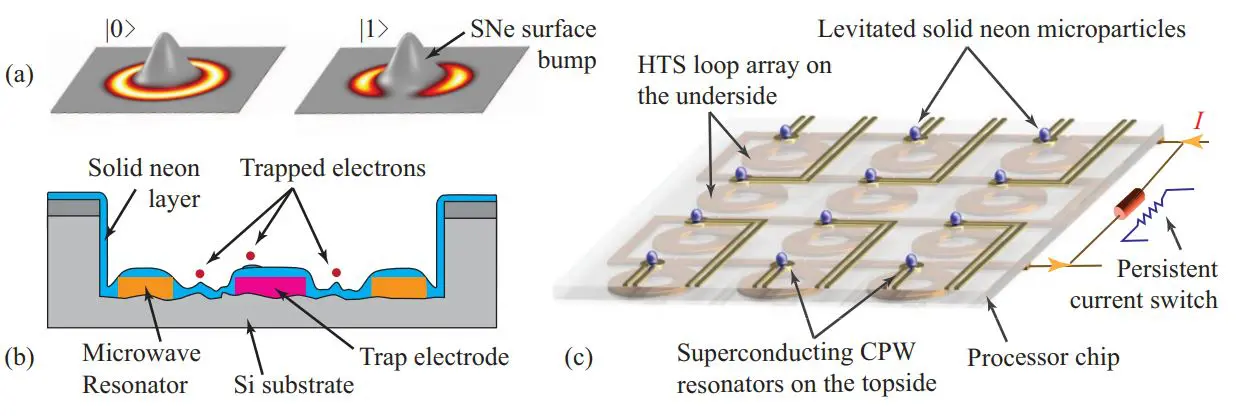
Scientists have engineered a novel architecture for electron-on-neon quantum computing by levitating solid neon microparticles above the processor chip using magnetic fields. This innovative approach overcomes limitations imposed by substrate effects and reproducibility issues that plague traditional electron-on-neon systems. The team adapted a mist-agglomeration method to create arrays of solid neon particles suspended in place, converting liquid neon into a mist and allowing droplets to spontaneously aggregate within magnetic traps. Maintaining a specific temperature prevented condensation during this process, and controlled evaporation cooled and solidified the droplets, resulting in uniform, spherical microparticles. Electrons are then trapped on the surface of these particles, offering a clean and isolated environment for qubit operation.
Levitated Neon Particles Enable Scalable Quantum Computing
Researchers have demonstrated a scalable platform for electron-based quantum computing by suspending solid neon microparticles using magnetic levitation. This breakthrough addresses the challenge of electron binding to imperfections on substrate surfaces, a significant source of noise and irreproducibility. The team successfully demonstrated that arrays of solid neon particles can be suspended above a processor chip using magnetic fields, eliminating substrate effects while maintaining strong coupling between electrons and microwave resonators. Detailed analysis reveals that the transition frequency of electrons on these levitated particles can be tuned across the gigahertz range, with significant anharmonicity achieved, crucial for fast on-chip operations and precise manipulation of quantum information. Experiments confirm that two electron qubits can be coherently linked through resonator-mediated interactions, paving the way for complex quantum circuits.
Levitated Neon Stabilizes Electron Qubit Control
This research demonstrates a pathway towards more stable and scalable quantum computing using electrons trapped on solid neon. Recognizing that variations in the supporting surface cause inconsistencies in electron behavior and introduce noise, scientists have developed an innovative on-chip magnetic-levitation architecture. By suspending arrays of solid-neon microparticles, the team eliminates the detrimental effects of substrate roughness, creating a more controlled and reproducible environment for trapping electrons. The method achieves magnetic levitation using relatively small current loops integrated directly onto the processor chip, and analysis confirms the ability to tune the transition frequency of the electron qubits across a gigahertz range, with significant anharmonicity achieved.
🗞 On-Chip Levitated Neon Particle Arrays for Robust and Scalable Electron Qubits
🧠 ArXiv: https://arxiv.org/abs/2512.00654