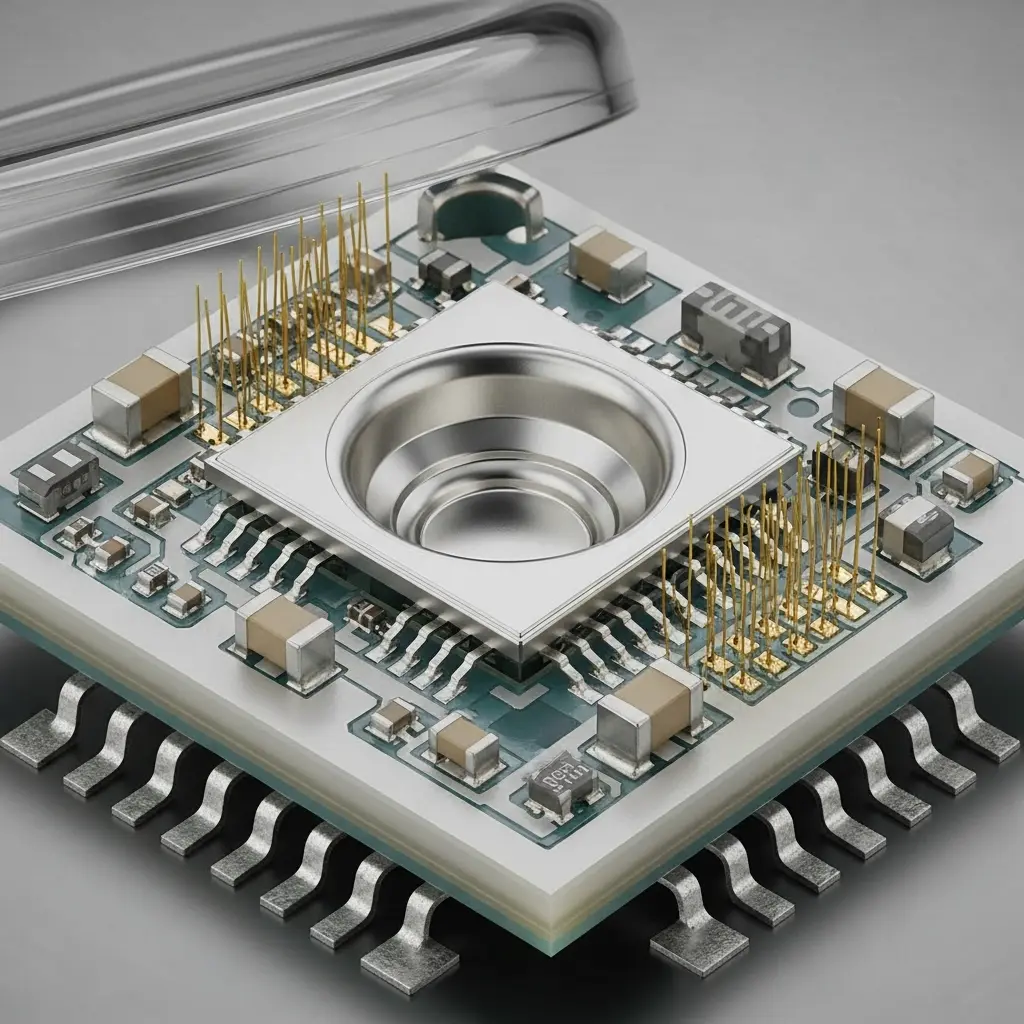
Atom-based sensors, including highly precise clocks, gyroscopes, and magnetometers, rely on micro-electro-mechanical systems, or MEMS, vapor cells, but fabricating these devices presents significant challenges. Rajesh Pandiyan, Sanyasi Bobbara, and Somayeh Mirzaee, all from Quantum Valley Ideas Laboratories, alongside Su-Peng Yu, Ruoxi Wang, and Adam Sibenik, now demonstrate a breakthrough in MEMS vapor cell design. The team addresses a longstanding problem, preventing atoms from adhering to the cell walls and ensuring uniform performance, by developing a low-temperature bonding scheme compatible with an internal coating of Octadecyltrichlorosilane. This innovative approach significantly reduces unwanted electric fields within the cell and achieves remarkably narrow spectral linewidths, paving the way for more stable and accurate atom-based sensing technologies.
Miniature Vapor Cells for Quantum Sensing
This research details the development of miniaturized vapor cells for use in quantum sensing applications. Atomic vapor cells are essential for technologies like magnetometry and atomic clocks, but traditional designs are often bulky and require high operating temperatures. Reducing the size of these cells is crucial for enabling widespread deployment in portable devices and distributed sensor networks. A major challenge in miniaturization is increased collisions between atoms and the cell walls, leading to signal loss and increased noise. The researchers addressed this problem with a two-pronged approach, combining low-temperature bonding with a coating of octadecyltrichlorosilane (OTS).
This innovative coating forms a hydrophobic layer on the cell walls, significantly reducing the sticking probability of cesium atoms and minimizing interfering electric fields. Measurements demonstrated a more than tenfold reduction in cesium coverage on OTS-coated surfaces compared to uncoated materials, directly translating to narrower spectral linewidths around 300kHz, indicating a cleaner signal and enhanced sensor performance. The successful fabrication and demonstration of these miniaturized cells represent a significant step forward in quantum sensing technology, with potential applications ranging from high-precision magnetometers and atomic clocks to electrometers and fundamental research.
Low Temperature Bonding Improves Vapor Cell Performance
Scientists have achieved a breakthrough in fabricating micro-fabricated vapor cells, essential components for highly sensitive atom-based sensors. The team successfully developed a low-temperature bonding process compatible with coating the interior of these cells with octadecyltrichlorosilane (OTS), preventing cesium atoms from adhering to the walls and improving sensor performance and longevity. The fabrication process begins with meticulous cleaning and surface preparation of silicon and glass wafers, achieving smooth vertical sidewalls with surface roughness between 1. 7 and 2. 2 nanometers.
A 150-nanometer layer of low-stress silicon dioxide provides a stable base for subsequent processing. Plasma treatment, using both oxygen and nitrogen, creates strong adhesion exceeding 10 megapascals. The core innovation lies in an anodic-like bonding process performed at 380°C with a DC voltage of 500-800 volts, establishing robust bonding between the silicon and glass. Crucially, this low-temperature approach preserves the integrity of the OTS coating, applied using a 7. 61x 10⁻³ molar solution.
Atomic force microscopy confirms the uniformity of the OTS layer, with RMS surface roughness of 0. 6 to 0. 9 nanometers on the glass. Characterization of the completed cells revealed exceptional performance, with contact angle measurements demonstrating hydrophobicity exceeding 100° for both water and cesium droplets on the OTS coating. Saturated absorption spectra obtained from the cesium-filled cells exhibited well-resolved peaks without collisional broadening, confirming the OTS coating preserves nuclear spin polarization during collisions, a critical factor for sensor sensitivity and stability.
Low Electric Fields Enable Sharper Spectra
This research demonstrates a significant advancement in fabricating micro-electromechanical (MEMS) vapor cells, crucial components for highly sensitive atom-based sensors. By minimizing unwanted electric fields, the researchers have created MEMS vapor cells with improved characteristics for applications including magnetometry, electrometry, rotational sensing, and the development of compact atomic clocks. Detailed analysis confirmed a significant, over an order of magnitude, reduction in cesium adsorption on the OTS-coated surfaces compared to uncoated glass or silicon. The resulting reduction in surface-induced electric fields, measured at less than 10 millivolts per centimeter, enables the observation of sharper spectral lines. The team intends to scale up this process for wafer-level manufacturing, paving the way for more widespread use of these improved sensors, and future work will focus on optimizing the manufacturing process for increased yield and reliability. This research represents a crucial step towards realizing the full potential of MEMS vapor cells in a range of quantum sensing technologies.
🗞 Micro-Electro-Mechanical System Vapor Cells With Passivated Internal Cavities
🧠 ArXiv: https://arxiv.org/abs/2512.00245




See today’s quantum computing news on Quantum Zeitgeist for the latest breakthroughs in qubits, hardware, algorithms, and industry deals.