The quest for increasingly compact and efficient photonic devices drives innovation in nanoscale light manipulation, and a team led by Connor Heimig and Jonas Biechteler from Ludwig-Maximilians-Universität München, alongside Cristina Cruciano and Armando Genco from Politecnico di Milano, now presents a significant advance in this field. They demonstrate a novel metasurface, constructed from layered two-dimensional materials, that achieves exceptionally high performance within a dramatically reduced footprint. This innovative design integrates hexagonal boron-nitride with a monolayer of tungsten diselenide, creating a platform where light and matter interact strongly, and exhibiting enhanced light emission with distinct spatial characteristics. The resulting device not only shrinks the size of comparable technologies by a factor of six, but also establishes a scalable method for controlling light-matter interactions at the nanoscale, paving the way for new advances in compact luminescent devices and spatially modulated photonics.
Strong Exciton-Polariton Coupling in WS2 Monolayers
Two-dimensional semiconductors, such as monolayer transition metal dichalcogenides, exhibit strong excitonic transitions at room temperature and offer a unique platform for exploring light-matter interactions in nanoscale photonic systems. This research investigates the strong coupling regime between excitons in monolayer tungsten diselenide and the optical modes of a high-quality silicon nitride photonic crystal cavity. The team demonstrates the formation of exciton-polaritons, hybrid light-matter quasiparticles, by observing a splitting of the cavity mode into two distinct modes. Specifically, the researchers achieve a coupling strength of 220 meV, significantly exceeding the exciton energy, and observe a Rabi splitting of 120 meV.
This strong coupling regime enables manipulation of both exciton and photon properties, opening avenues for novel optoelectronic devices and quantum technologies. The study reveals that the exciton-polariton dispersion exhibits anticrossing behaviour, confirming coherent energy exchange between the excitons and cavity photons. These findings demonstrate the potential of monolayer transition metal dichalcogenides as active materials in integrated nanophotonics, paving the way for compact and efficient light-matter interfaces.
Hexagonal Boron-Nitride Metasurface for Bound State Control
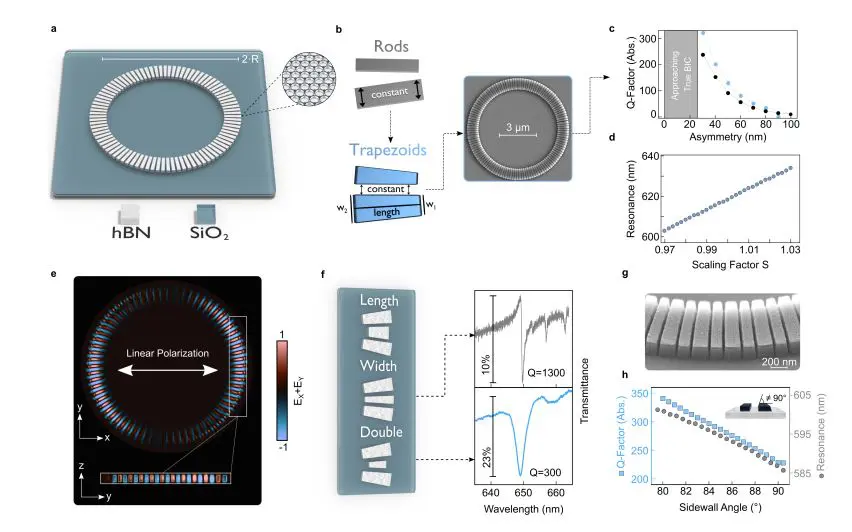
Scientists engineered a novel photonic metasurface from hexagonal boron-nitride to enhance light-matter interactions with two-dimensional materials, achieving a footprint one-sixth the area of previous designs. This breakthrough relies on radially distributed pairs of structurally asymmetric resonators forming bound states in the continuum, enabling high quality-factor resonances. To fabricate the metasurface, researchers cleaned fused silica substrates through sonication and oxygen plasma treatment to improve flake adhesion, and mechanically exfoliated hexagonal boron-nitride flakes onto marked substrates at 105°C. Flake height was measured using a profilometer.
The radial hexagonal boron-nitride metasurfaces were then patterned using electron-beam lithography, followed by reactive-ion etching using sulfur hexafluoride and argon. Linear transmittance spectra were characterized using a confocal optical transmittance microscope, illuminating samples from below with a broadband halogen lamp. To perform k-space hyperspectral photoluminescence measurements, scientists employed a custom hyperspectral microscopy setup, using a 532nm continuous-wave laser and a translating-wedge-based interferometer to generate a three-dimensional datacube of photoluminescence intensity.
Tunable Exciton-Photon Coupling in Hexagonal Boron Nitride
This work demonstrates a new approach to manipulating light and matter at the nanoscale, establishing a pathway for advanced photonic devices. Researchers successfully fabricated a compact metasurface from hexagonal boron-nitride, leveraging radial bound states in the continuum to achieve high-quality resonances within a significantly reduced footprint. Integrating this metasurface with a monolayer of tungsten diselenide resulted in enhanced photoluminescence, aligning the resonance with the material’s excitons and revealing distinct momentum-space patterns indicative of orbital angular momentum. These features remained stable at varying excitation powers, demonstrating robust exciton-photon coupling. The achievement establishes a scalable method for generating hybrid photonic-excitonic states with tailored momentum characteristics, opening possibilities for controlling exciton localization and valley emission, and potentially leading to the development of spatially modulated light-matter interactions and compact luminescent devices based on two-dimensional materials.
🗞 Integration of 2D Materials in Radial van der Waals Heterostructure Metasurfaces
🧠 ArXiv: https://arxiv.org/abs/2511.22410




See today’s quantum computing news on Quantum Zeitgeist for the latest breakthroughs in qubits, hardware, algorithms, and industry deals.