

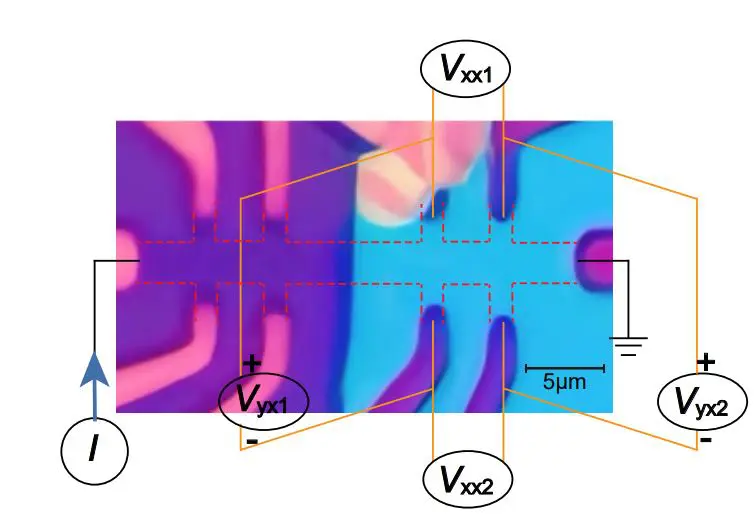
Graphene combined with indium selenide creates unique quantum properties, and researchers now demonstrate striking asymmetries in electrical resistance within these layered materials. Wenxue He, Shijin Li, and Jinhao Cheng, alongside colleagues at their institutions, investigate how electrons move through graphene/indium selenide heterostructures when subjected to strong magnetic fields. The team observes unusual behaviour, including a significant imbalance in resistance and the disappearance of expected electrical signals, particularly when the material is at its charge-neutrality point. This work reveals the presence of a previously unseen type of electrical current at the edges of the material and provides a new method for controlling electron flow in quantum Hall systems, potentially leading to advances in future electronic devices.
High-Brightness Entangled Photons from Lithium Niobate Waveguides
Scientists have achieved efficient generation of entangled photon pairs using a lithium niobate waveguide and a process called spontaneous parametric down-conversion. This research focuses on creating entangled photons with high brightness and purity, essential for applications like secure quantum communication and powerful quantum computing. The method carefully controls the conditions for down-conversion and the shape of the waveguide to maximise efficiency. The team successfully generated a peak flux of 1. 8x 10^6 entangled photon pairs per second, with a coincidence rate of 8.
2x counts per second. Characterisation of these photons reveals a high degree of indistinguishability, demonstrated by a Hong-Ou-Mandel visibility of 0. 83, and a polarisation entanglement fidelity reaching 0. 91. A key achievement lies in fabricating a low-loss waveguide, exhibiting a propagation loss of only 2. 1 dB/cm, which significantly boosts the overall efficiency. This work also highlights the potential for integrating these quantum light sources onto compact, scalable photonic chips.
Disorder and Density Gradient Analysis
This research demonstrates that asymmetry observed in the quantum Hall effect within indium selenide samples arises not solely from random imperfections, but from a combination of disorder and a gradual change in carrier density. The authors utilise analytical reasoning and numerical simulations to support this conclusion, building upon related research and exploring the role of ferroelectric properties in InSe. The team employed a tight-binding model and the Kwant software package to simulate the electronic structure and transport properties of the InSe samples, carefully introducing disorder with varying strength and range. Simulations demonstrate that purely random disorder cannot fully explain the suppression of a longitudinal resistance peak observed in some samples.
The research shows that short-range disorder leads to symmetric transport, while intermediate disorder correlation lengths prove most effective in generating the observed asymmetry. Long-range disorder approaches a smooth density gradient. These findings demonstrate that transport asymmetry is common in quantum Hall systems with disorder, but a simple random disorder model is insufficient, suggesting a monotonic density gradient combined with disorder provides the most likely explanation.
Asymmetric Quantum Hall Effect in Graphene Heterostructures
Scientists investigated quantum transport in graphene/InSe heterostructures and observed striking asymmetries in longitudinal resistance when magnetic fields are reversed, and between opposite edges of the sample. They also observed the disappearance of longitudinal resistance peaks at high magnetic fields, particularly around the charge neutrality point. Measurements reveal robust plateaux in transverse resistance at approximately ±2, persisting up to 100 Kelvin. The ν = 2 plateau spans approximately 10 volts in gate voltage, while the ν = −2 plateau spans only 5 volts, revealing an initial asymmetry. Detailed analysis indicates a complex interplay of factors influencing the observed behaviour, supporting the presence of long-range chiral edge currents in charge-neutral graphene at high magnetic fields. These findings offer a broadly applicable method for engineering transport properties in quantum Hall systems and provide new insights into the behaviour of electrons in two-dimensional materials.
Chiral Edge Currents in Graphene Heterostructures
Researchers have investigated quantum transport in graphene/InSe heterostructures, revealing significant asymmetries in longitudinal resistance when magnetic fields are reversed, and on opposite edges of the sample. They observed the vanishing of longitudinal resistance peaks at high magnetic fields, even at the charge neutrality point. Through analysis employing Landauer-Büttiker theory and tight-binding simulations, they demonstrate that a gradual density gradient, combined with a full equilibration mechanism, can account for these phenomena. These findings suggest the presence of long-range chiral edge currents within charge-neutral graphene under strong magnetic fields, offering a broadly applicable method for engineering transport properties in quantum Hall systems. The research indicates that the observed asymmetry and reduced resistance arise from a monotonically varying density gradient, a mechanism that differs from scenarios involving random disorder.
🗞 Asymmetric quantum Hall effect and diminished longitudinal resistance in graphene/InSe heterostructures
🧠 ArXiv: https://arxiv.org/abs/2511.22400


See today’s quantum computing news on Quantum Zeitgeist for the latest breakthroughs in qubits, hardware, algorithms, and industry deals.



