Fractional Chern insulators represent a fascinating state of matter with potential applications in quantum computing, and scientists are continually seeking ways to create and stabilise them. Moru Song from the Chinese Academy of Sciences and Kai Chang from Zhejiang University, along with their colleagues, now demonstrate a novel approach to achieving this, utilising the unique properties of alternating twisted trilayer graphene. Their research reveals that deliberately introducing a degree of ‘incommensurability’, a mismatch in the layers’ alignment, actively suppresses competing electronic states that typically disrupt the formation of fractional Chern insulators. This counterintuitive finding not only enhances the stability of these exotic states, but also establishes a new principle for exploring strongly correlated electron behaviour in materials with complex, mismatched structures, potentially opening doors to advanced quantum technologies.
These insulators mimic the behavior of the fractional quantum Hall effect without the need for strong magnetic fields. Scientists are discovering that intentionally introducing incommensurability, a mismatch in the repeating patterns of the graphene layers, can enhance the robustness of FCIs, even when the material’s band structure is not ideal. This enhancement suppresses the formation of charge-density waves, a competing electronic state that typically destroys the FCI, allowing the topological order of the FCI to prevail and creating a more stable insulator.
The team identified mixed phases where FCIs and charge-density waves coexist, but with the charge-density waves confined to regions where the incommensurability is weak. Particle entanglement spectrum diagnostics confirm the topological nature of the local FCIs, identifying them as being of the Laughlin-1/3 type. This work establishes incommensurability as a robust stabilizer of FCIs and provides a new paradigm for exploring strong-correlation physics in incommensurate systems, highlighting the potential for designing and realizing robust topological states in realistic materials.
Incommensurability Stabilizes Fractional Chern Insulators
Scientists have demonstrated a surprising method for stabilizing fractional Chern insulators (FCIs), a unique state of matter with potential applications in quantum computing, within twisted trilayer graphene. Their work establishes that intentionally introducing incommensurability, a mismatch in the repeating patterns of the graphene layers, can enhance the robustness of FCIs, even when the material’s band structure deviates from ideal conditions. Researchers utilized exact diagonalization to compute the ground states of various local patches within the material, revealing a counterintuitive result: the FCI gap, a measure of the insulator’s stability, actually increases as the quantum-geometric indicators, traditionally linked to FCI formation, worsen. This enhancement of the FCI gap was observed even while standard criteria for FCI stability were not met, challenging existing theoretical predictions.
The team identified mixed phases where FCIs coexist with charge-density waves (CDWs), another competing electronic state, but crucially, the CDWs were confined to regions where the incommensurability was weak. This spatial confinement suggests that incommensurability preferentially suppresses the formation of CDWs, allowing the topological order of the FCI to prevail. Measurements confirm that as the influence of incommensurability strengthens, the FCI gap remains robust, and beyond a certain threshold, patches weakly affected by incommensurability transition into CDW order. Particle entanglement spectrum analysis identified these local FCIs as being of the Laughlin-1/3 type, a specific and well-defined topological state. By tracking signatures of CDW formation, scientists concluded that intrinsic incommensurability primarily suppresses crystalline symmetry breaking, enabling the topological order of the FCI to dominate. This research expands the landscape of FCI emergence and provides a pathway for realizing robust topological states in realistic, incommensurate moiré materials.
Incommensurability Stabilizes Fractional Chern Insulators
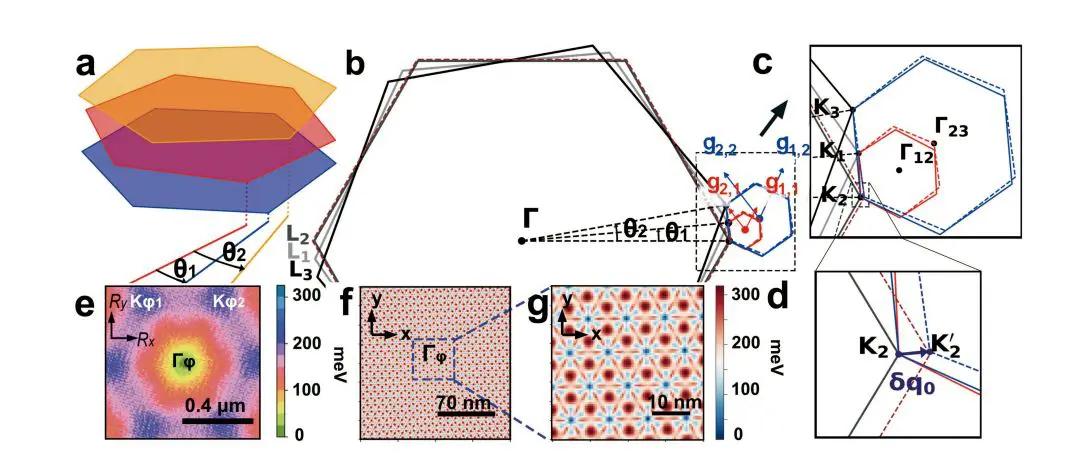
Scientists have established a new understanding of how fractional Chern insulators, exotic states of matter with potential applications in quantum computing, can be stabilized in twisted graphene structures. Their work demonstrates that these insulators become more stable even when conventional indicators of stability, related to the material’s quantum geometry, worsen. This counterintuitive finding reveals an intrinsic stabilization mechanism driven by the incommensurability, a mismatch in the repeating patterns, within the graphene layers, effectively suppressing competing charge-density-wave orders that typically disrupt the formation of these insulators. The research team developed a framework for analyzing strongly correlated phases in these incommensurate systems by encoding the incommensurability as a phase shift in the interlayer coupling.
Through exact diagonalization calculations, they uncovered that the fractional Chern insulator gap, a measure of its stability, increases as the quantum geometric indicators decrease. They also identified conditions where the insulator and charge-density-wave phases coexist, but with the charge-density-wave confined to regions of weaker incommensurability. This work provides a new mechanism for stabilizing these phases and sheds light on exploring topological orders in multilayer twistronics.
🗞 Incommensurate-Stabilized Fractional Chern Insulator in Alternating Twisted Trilayer Graphene
🧠 ArXiv: https://arxiv.org/abs/2511.22326



See today’s quantum computing news on Quantum Zeitgeist for the latest breakthroughs in qubits, hardware, algorithms, and industry deals.