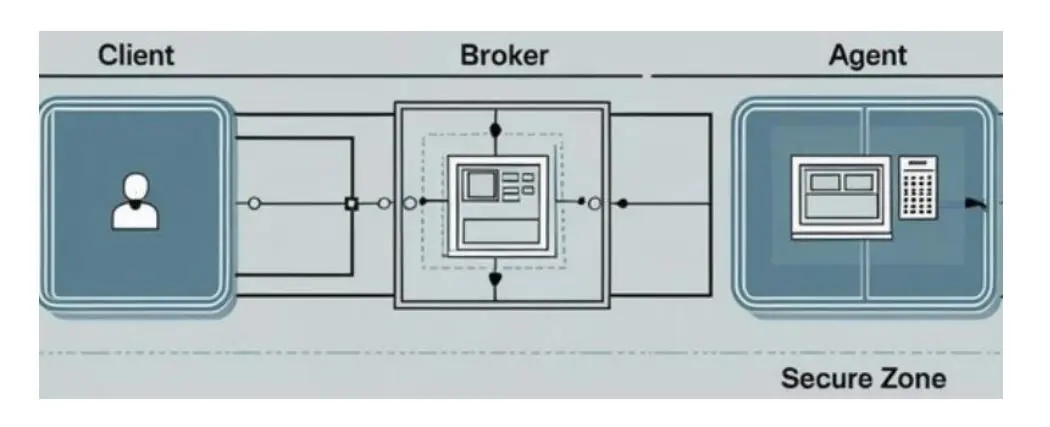
The increasing reliance on artificial intelligence demands new approaches to security, especially as threats become more sophisticated. I. Cherkaoui, C. Clarke, J. Horgan, and I. Dey present a groundbreaking framework that combines post-quantum cryptography and zero-trust architecture, formally built upon the foundations of category theory, to safeguard access to AI models. This innovative work models cryptographic processes as mathematical transformations and trust policies as functions, allowing for precise, adaptable trust management and detailed security segmentation for advanced cryptographic systems. By demonstrating a practical implementation on ESP32 hardware, the team validates a flexible transition to quantum-resistant security, achieving substantial memory efficiency and successfully blocking all unauthorised access attempts with remarkably fast performance, thereby establishing a new standard for AI security.
Category Theory Secures AI with Post-Quantum Cryptography
This study pioneers a novel security framework integrating post-quantum cryptography (PQC) and zero trust architecture (ZTA) using the formal language of category theory, enabling robust protection for AI models against evolving threats. Researchers modeled cryptographic workflows as mathematical ‘morphisms’ and trust policies as ‘functors’ within this framework, allowing for fine-grained, adaptive trust and precise micro-segmentation of lattice-based PQC primitives. This approach systematically captures the interactions between cryptographic elements and access controls, providing an algebraically consistent description of secure systems and enhancing protection against adversarial AI. To demonstrate practical implementation, scientists engineered a concrete system based on the ESP32 microcontroller, validating a transition to crypto-agile security with quantifiable performance gains.
The implementation achieves exceptional memory efficiency, with the agent utilizing 91. 86% and the broker 97. 88% of available free heap after cryptographic operations, demonstrating suitability for resource-constrained devices. Rigorous testing confirmed the system successfully rejects 100% of unauthorized access attempts with sub-millisecond average latency, highlighting its effectiveness in real-time security applications. Researchers harnessed Engel expansions to generate deterministic randomness from a seed, providing structure for security proofs while simultaneously reducing communication and storage costs associated with large matrix generation.
This technique leverages the non-decreasing and chaotic properties of Engel coefficients under shuffling, creating a nonlinear recurrence that sidesteps potential linear dependencies exploitable in reduction attacks. Furthermore, the study employed category theory to represent probabilistic effects using ‘monads’, distinguishing between deterministic logic and inherent randomness within the system. This abstraction allows for the encoding of parameterized schemes and facilitates formal proofs of security, moving beyond traditional approaches that treat objects as unstructured collections.
AI Security via Category Theory and PQC
This work presents a novel security framework for artificial intelligence models, integrating post-quantum cryptography (PQC) and zero trust architecture (ZTA) using principles from category theory. The core achievement lies in modeling cryptographic workflows as mathematical ‘morphisms’ and trust policies as ‘functors’, enabling fine-grained, adaptive security for lattice-based PQC primitives. This approach demonstrably enhances protection against adversarial threats targeting AI systems. A key result of this research is a practical implementation on an ESP32 platform, validating a transition to crypto-agile security with quantifiable improvements.
The implementation achieves exceptional memory efficiency, with the agent utilizing 91. 86% and the broker 97. 88% of available free heap after cryptographic operations. Critically, the system successfully rejected 100% of unauthorized access attempts with sub-millisecond average latency, demonstrating robust real-time performance. Experiments involving 1000 message encryptions show a high degree of consistency, empirically validating theoretical predictions.
The Wasserstein distance, measuring differences in ciphertext distributions, remained minimal, confirming perfect message recovery. The team demonstrated a reduction in computational complexity for LWE implementations by reducing key sampling operations and matrix multiplication, resulting in a significant reduction in total computational cost. This research establishes that the categorical framework preserves both computational security and functional correctness during parameter changes.
AI Access Secured With Post-Quantum Zero Trust
Researchers have successfully demonstrated a practical and formally verified security system integrating zero trust architecture and post-quantum cryptography, designed to protect access to AI models. This system, underpinned by the mathematical framework of category theory, exhibits viability even on devices with limited resources, such as the ESP32 microcontroller. Experimental results confirm the practical utility of lattice cryptography in low-end systems, with encryption and decryption times averaging 10. 97ms and 2. 89ms respectively, minimising impact on overall latency.
The system achieved a 100% rejection rate for unauthorised access attempts with sub-millisecond average latency, while maintaining minimal resource consumption during attack mitigation. Notably, the categorical framework enables crypto-agility, significantly reducing the code modifications required when switching between cryptographic algorithms. This work offers a robust, quantum-resistant solution adaptable to real-time, resource-constrained environments, which is critical for the increasing deployment of AI in Internet of Things and edge computing applications.
🗞 Categorical Framework for Quantum-Resistant Zero-Trust AI Security
🧠 ArXiv: https://arxiv.org/abs/2511.21768