The challenge of building sufficiently powerful quantum computers drives researchers to explore distributed architectures, linking multiple quantum processors together, but executing complex algorithms across these networks introduces significant hurdles. Brayden Goldstein-Gelb from Brown University, Kun Liu from Yale University, and John M. Martyn from Pacific Northwest National Lab and Harvard University, alongside colleagues, address this problem by focusing on multivariate trace estimation, a crucial subroutine for tasks ranging from quantifying entanglement to improving quantum error correction. They present COMPAS, a novel architecture that efficiently performs this estimation across a network of interconnected quantum processors, utilising pre-shared entangled pairs as a resource. This approach achieves a significant breakthrough by simultaneously minimising both the circuit depth and the required entanglement width, offering a practical solution for near-term quantum hardware and paving the way for more complex distributed quantum algorithms.
Entanglement, Networks, and Quantum Simulation Progress
Recent research focuses on advancing quantum computing through networking, algorithm development, and a deeper understanding of entanglement. Scientists are building and characterizing quantum networks, addressing challenges in distributing entanglement and maintaining signal fidelity over long distances, while simultaneously developing and refining quantum algorithms designed for complex simulations and factoring problems. A key area of investigation involves exploring the fundamental properties of entanglement itself, including methods for measuring, manipulating, and characterizing this crucial quantum phenomenon. Research also explores quantum error correction and fault tolerance, aiming to improve the reliability of quantum computations and communications. Theoretical studies continue to lay the groundwork for future advancements by investigating the underlying principles of entanglement, topological phases, and quantum information processing, while efforts to optimize existing algorithms focus on reducing resource requirements and improving performance. The use of diverse qubit technologies suggests a move toward hybrid quantum systems, combining the strengths of different platforms.
Distributed Quantum Computation with Entangled Bell Pairs
Researchers have developed COMPAS, a novel architecture for distributed quantum computing that overcomes limitations in scaling quantum processors. Recognizing the challenges of increasing qubit counts on a single chip, the team focused on interconnecting multiple quantum processing units (QPUs) and distributing computational tasks across them. This work introduces a method for multivariate trace estimation, a crucial subroutine with broad applications including Rényi entropy calculation, entanglement spectroscopy, virtual cooling, and quantum signal processing. The core of COMPAS leverages pre-shared entangled Bell pairs as a resource to realize multivariate trace estimation across a network of modular QPUs, achieving a constant depth overhead and consuming Bell pairs at a rate linear to the circuit width, making it practical for near-term quantum hardware.
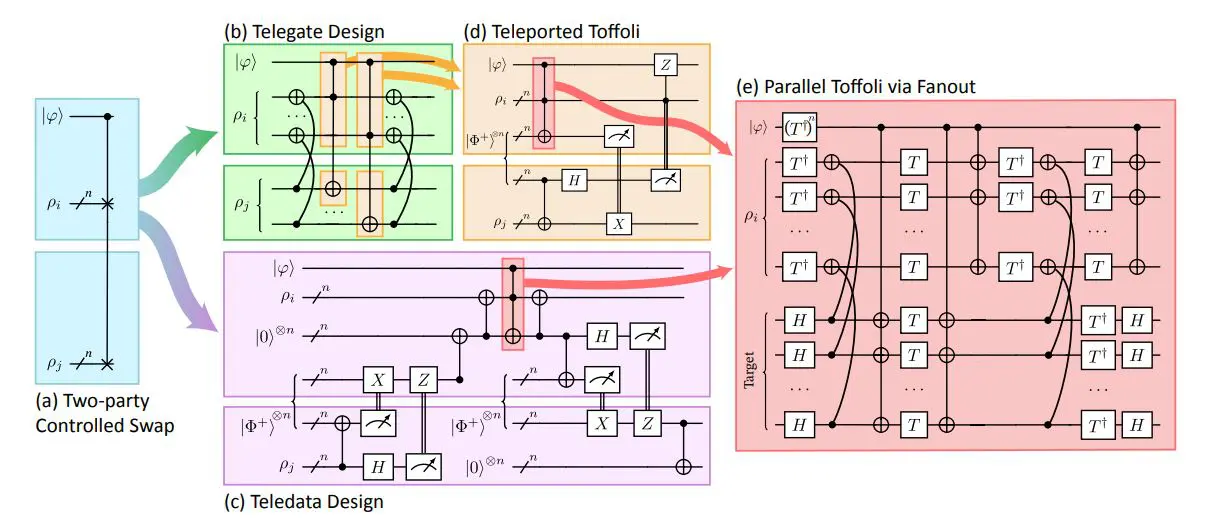
Unlike existing methods, COMPAS simultaneously optimizes both circuit depth and the width of entangled states, representing a significant advancement in distributed quantum algorithm design. To implement this architecture, scientists developed a distributed implementation of the controlled-SWAP (CSWAP) gate, utilizing the teledata and telegate primitives to facilitate communication between QPUs. They analyzed resource costs and simulated the impact of gate-level noise on the architecture’s performance, implementing a multi-party SWAP test by preparing an entangled state as control qubits and performing CSWAPs on the input states to estimate the real and imaginary parts of the trace. This method, achieving constant circuit depth, forms the foundation of the proposed distributed architecture and enables parallel multiplication of quantum states without sequential operations.
Constant Depth Multivariate Quantum State Estimation
Scientists have developed COMPAS, a novel architecture for realizing multivariate trace estimation across interconnected quantum processing units (QPUs). This breakthrough delivers a constant circuit depth, independent of the number of modules used, ensuring runtime is not hindered by communication between nodes and enabling true parallelism at scale. The team achieved this by carefully separating data into distinct modules, reducing network communication and improving synchronization during state preparation. Experiments demonstrate that COMPAS consumes Bell pairs at a rate linear in circuit width, making it suitable for near-term hardware.
The architecture utilizes pre-shared entangled Bell pairs as resources, enabling quantum-state teleportation and remote gate operations. Researchers implemented a distributed version of the controlled-SWAP (CSWAP) gate, utilizing both teledata and telegate primitives. Analysis reveals that COMPAS optimizes both qubit usage and inter-node communication while remaining robust to noisy communication and gate errors. Circuit-level simulations confirm the architecture’s resilience, providing a pathway toward scalable, high-performance quantum computing on distributed architectures by carefully balancing circuit design, entanglement distribution, and hardware constraints.
Constant Depth, Low Resource SWAP Test
This work presents a new distributed protocol for performing the multi-party SWAP test, a key subroutine in quantum computing, and demonstrates its application to multivariate trace estimation. The team’s approach, named COMPAS, achieves both constant depth overhead and efficient consumption of entangled Bell pairs, making it suitable for implementation on near-term quantum hardware. Unlike existing methods, COMPAS avoids trade-offs between circuit depth and the width of required entangled states. The researchers thoroughly analyzed resource requirements, including ancilla qubits, Bell pair consumption, and circuit depth, and quantified the performance of the protocol under realistic noisy conditions.
This analysis considered both circuit-level noise and network errors, revealing the relationship between the number of distributed nodes and overall error tolerance. The protocol’s versatility is demonstrated through applications in Rényi entropy estimation, entanglement spectroscopy, error mitigation techniques, and parallel quantum signal processing. The authors acknowledge that a more detailed analysis, incorporating error correction and Bell pair distillation overhead, would be necessary to determine the full physical resource requirements, and future work could focus on optimizing quantum network topology and the placement of Bell pair generation nodes. The team hopes this work will serve as a foundation for optimizing resource allocation in distributed quantum computing and benefit from the development of new classical simulation methods and programming languages for these systems.
🗞 COMPAS: A Distributed Multi-Party SWAP Test for Parallel Quantum Algorithms
🧠 ArXiv: https://arxiv.org/abs/2511.23434


See today’s quantum computing news on Quantum Zeitgeist for the latest breakthroughs in qubits, hardware, algorithms, and industry deals.