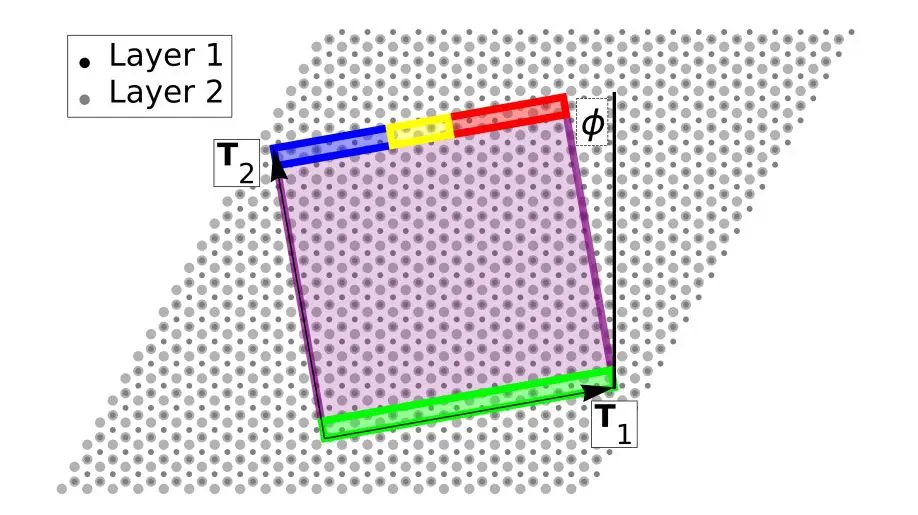
Electronic transport in bilayer graphene, a material with unique electronic properties, presents ongoing challenges for nanoscale device development. Jesús Arturo Sánchez-Sánchez and Thomas Stegmann, both from the Instituto de Ciencias Físicas at the Universidad Nacional Autónoma de México, now demonstrate the existence of conducting edge states within this material even when a gap is introduced by applying a voltage between the layers. This discovery is significant because it reveals a pathway for electrical conduction that does not rely on the material’s bulk properties, instead occurring along the edges of the graphene structure. The team’s calculations show these edge states are strongly influenced by the specific arrangement of atoms at the edge and can be controlled by adjusting the energy of electrons, offering potential for novel electronic devices and a deeper understanding of nanoscale conduction.
By combining computational modelling with band structure calculations, scientists have shown that these states arise from specific arrangements of atoms at the edges, including zigzag, armchair, and bearded terminations, and enable electrical conduction even when the main material is an insulator. The team confirmed these theoretical predictions by demonstrating edge-localized current flow within the gBLG structures.
Importantly, the research reveals that these edge states depend sensitively on the precise atomic arrangement at the device edges, rather than inherent topological properties of gBLG. While these edge states can be fragile, the ability to tune their presence with electron energy offers potential for controlling current flow through electrostatic gating. The findings align with observations of edge transport in twisted bilayer graphene, suggesting a common mechanism governs conduction at the edges of these two-dimensional materials.
Twisted Bilayer Graphene Edge State Transport
This research investigates electronic transport, particularly edge states, in bilayer graphene (BLG) and twisted bilayer graphene (tBLG). The motivation is to understand and control current flow at the nanoscale, focusing on the unique properties arising from the BLG structure, twisting, and edge effects. The research builds on theoretical models and computational methods to simulate and analyse these systems, with the ultimate goal of potentially engineering novel nanoelectronic devices.
The team employs a tight-binding model to describe the electronic structure of BLG and tBLG, utilising Green’s function formalism to calculate electronic transport properties, including transmission coefficients and current densities. The research relies heavily on numerical calculations to solve these equations and obtain quantitative results, crucial for dealing with the complexity of the systems.
A key aspect of the research is the careful modelling of edges and their impact on electronic transport. The team explores different edge terminations and configurations, including disorder such as random potential or defects, for realistic modelling and understanding the robustness of the observed phenomena.
The research demonstrates the existence and characteristics of edge states in BLG and tBLG, revealing that these states play a crucial role in conducting current along the edges of the material. A significant finding is the ability to steer current flow by manipulating the edge structure, for example, by changing the edge termination or introducing edge defects, representing a key step towards creating controllable nanoelectronic devices.
The twisting angle in tBLG profoundly impacts the electronic band structure and, consequently, the transport properties. Specific twisting angles can lead to the emergence of flat bands and enhanced edge state transport. The research also investigates the robustness of the edge state transport against disorder, suggesting that certain edge configurations are more resilient than others. Detailed current profiles show how the current is distributed within the material, helping to understand the mechanisms of transport and the role of edge states.
In some configurations, the research suggests the possibility of generating and detecting pure valley current, a promising concept for spintronics and valleytronics. The emergence of flat bands in tBLG at specific twisting angles is linked to enhanced edge state transport and the possibility of novel electronic phenomena.
This research provides a deeper understanding of the electronic properties of BLG and tBLG, particularly the role of edge states and twisting. The ability to steer current flow and generate valley current opens up possibilities for creating novel nanoelectronic devices with tailored functionalities. The generation of valley current could lead to the development of new spintronic and valleytronic devices, highlighting the importance of edge engineering and materials design for controlling electronic transport.
🗞 Edge-state transport in gapped bilayer graphene
🧠 ArXiv: https://arxiv.org/abs/2511.21049