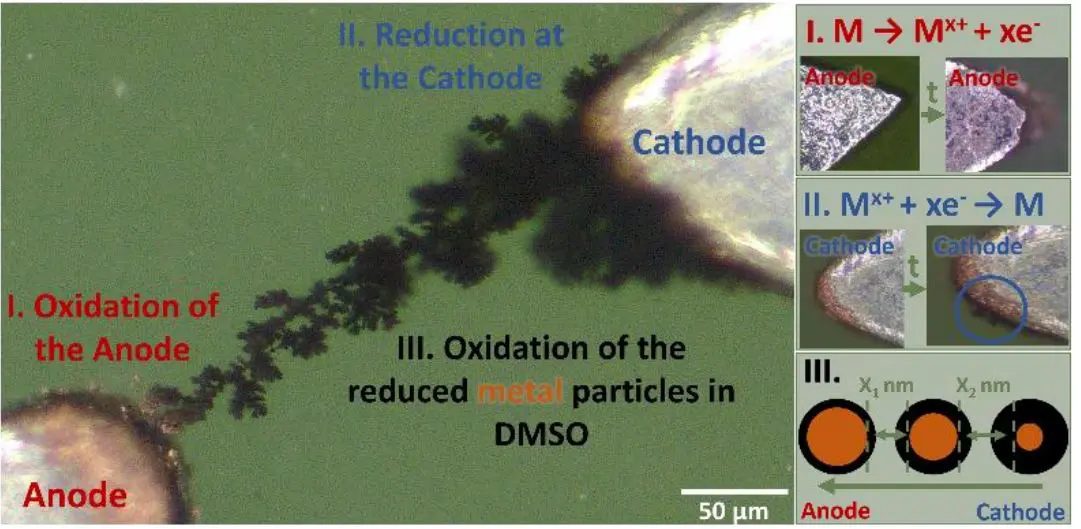
Inspired by the human brain’s efficient information processing, researchers are actively pursuing new hardware architectures that mimic its structure and function, a field known as neuromorphic computing. Roshani Madurawala, Kerstin Meurisch, and Louis Joswig, alongside colleagues at Kiel University, now demonstrate a significant step towards this goal by creating dynamically reconfigurable, three-dimensional circuits within a liquid environment. Their work focuses on ‘ionotronic’ systems, which harness both electron and ion movement to build conductive pathways, and importantly, establishes a method for sustained operation without material depletion. The team successfully grows brain-inspired wires connecting multiple electrodes at both micrometer and nanometer scales, exhibiting hierarchical organization and the ability to be disrupted or dissolved, thereby emulating the plasticity seen in biological neural networks. This achievement represents a crucial advance in creating adaptable and energy-efficient computing systems that more closely resemble the complexity of the human brain.
Filament Growth and Stability in Electrolytes
Researchers are investigating ionotronic filaments, conductive pathways formed in liquid electrolytes, to understand their growth, stability, and manipulation. Investigations center on how voltage, time, and electrolyte composition influence filament formation and stability. The team utilizes electrodes composed of copper with a protective tin coating, influencing the ions present within the electrolyte, and successfully grows filaments vertically between an electrode and a probe. Experiments demonstrate that filaments grow by applying voltage between electrodes immersed in a liquid electrolyte, and the addition of HCl to the electrolyte provides a means to dissolve and break these connections.
Researchers can manipulate filaments using electric fields, bending, extending, and redirecting them to control connectivity, and multi-electrode systems allow for the creation of complex networks. While filaments maintain stable resistance for a period, resistance increases over time due to oxidation. Fractal dimension analysis characterizes filament complexity, and electrochemical measurements assess filament resistance and behavior. Researchers hypothesize that oxidation contributes to increased resistance over time, and the fractal dimension serves as a measure of filament structural complexity. The ability to manipulate filaments with electric fields and dissolve them chemically opens possibilities for dynamic circuits and reconfigurable electronics.
Dynamic Ionotronic Systems Mimic Neural Networks
Scientists engineered ionotronic systems, incorporating both electron and ion movement, to create dynamically reconfigurable conductive filaments inspired by the human brain. This pioneering work employs liquid-based materials with in-situ ion generation, ensuring sustained operation and preventing ion depletion. Researchers developed four distinct ionotronic systems, each demonstrating the growth of three-dimensional wires connecting two or more electrodes. These wires exhibit resistive switching at both micrometer and nanometer scales, effectively demonstrating hierarchical organization and functionality mirroring biological neural networks.
The team harnessed redox reactions and ionic dynamics to achieve self-organized formation and dissolution of conductive filaments, eliminating the need for complex cleanroom fabrication techniques. This approach allows for the formation of complex networks with a greater number of nearest neighbors, enhancing information processing capabilities. The system delivers reconfigurable connectivity, where electrical connections form, dissolve, or become temporarily inactive in response to external stimuli, enabling energy-efficient operation. Scientists demonstrated the ability to disrupt these conducting filaments using an external electric field or allow them to dissolve over time, successfully emulating the blooming and pruning aspects of synaptic plasticity observed in biological brains. This innovative approach offers a pathway towards scalable and energy-efficient neuromorphic computing hardware.
Dynamically Reconfigurable Nanowires Mimic Brain Architecture
Scientists achieved dynamically reconfigurable conductive filaments inspired by the human brain’s architecture using ionotronic systems. Researchers demonstrated the growth of three-dimensional wires connecting two or more electrodes, exhibiting resistive switching at both micrometer and nanometer scales, thereby demonstrating hierarchical organization and functionality. These filaments are formed within an ionotronic system where ions are generated in-situ at the anode, enabling sustained operation without ion depletion. Experiments revealed that a connection between two electrodes can be established via filament growth, with the time required decreasing as the applied voltage increases.
The filaments exhibit resistive switching, a key characteristic of synaptic plasticity, demonstrated through cyclic voltage sweeps. Further investigations using multi-terminal arrangements showed the potential for sequential growth of connections between multiple electrodes in three dimensions, enabling complex network formation. The researchers also demonstrated control over filament growth and dissolution using a metal/HCl system, allowing for dynamic manipulation of long-range connections and emulating the blooming and pruning aspects of synaptic plasticity. This interplay between diffusion and electric field driven ion migration determines the self-organization of the filament, offering a pathway to control the topology of the filament through electrical stimulation.
The resulting filaments exhibit tunable growth and electrical properties, and can be deactivated or dissolved, mirroring aspects of brain-like plasticity. These findings collectively point towards the development of scalable, energy-efficient neuromorphic hardware where network configurations can adaptively change within a liquid medium. The team observed hierarchical resistive switching within these filaments, demonstrating both long-range and short-range connectivity, which suggests potential for memory operations.
🗞 Resistive switching and long-range filaments in metal/DMSO liquid systems for three-dimensional, multi-terminal connection schemes with on demand dynamic reconfigurability
🧠 ArXiv: https://arxiv.org/abs/2511.20314


See today’s quantum computing news on Quantum Zeitgeist for the latest breakthroughs in qubits, hardware, algorithms, and industry deals.