The escalating demands of high-energy physics experiments necessitate innovative computational approaches, and researchers are now exploring the potential of advanced technologies to overcome existing limitations. Hideki Okawa from the Institute of High Energy Physics, Chinese Academy of Sciences, and colleagues investigate how computing paradigms can revolutionise pattern recognition, a particularly intensive task within these experiments. This work examines the current status of three distinct computing technologies, gates, and -inspired, and assesses their suitability for tackling the challenges posed by the ever-increasing data volumes from high-energy colliders. By exploring these alternative computational methods, the team aims to deliver significant efficiency gains and unlock new possibilities for data analysis in the field of particle physics.
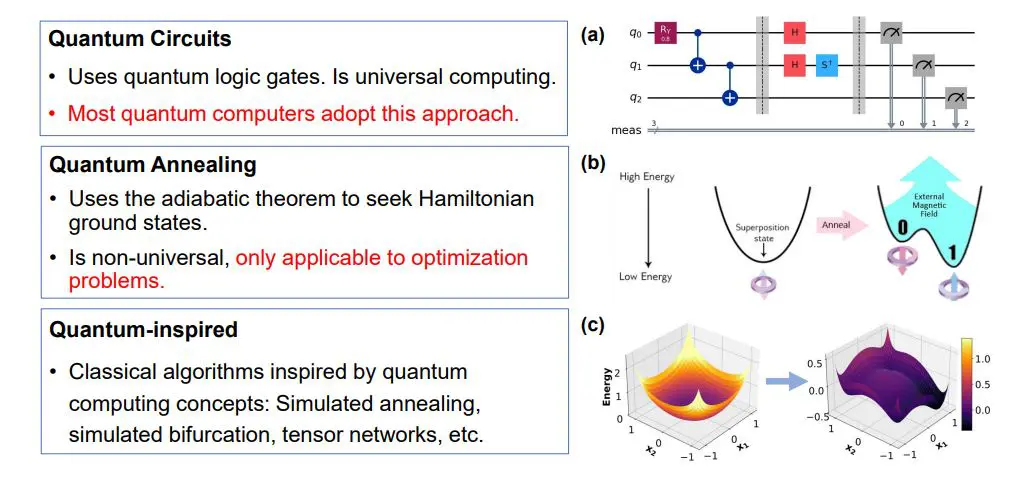
Recognizing the impending exabyte-scale datasets from future facilities, scientists are investigating how quantum algorithms can overcome limitations in data handling and analysis. This work focuses on three distinct quantum computing technologies, quantum gates, quantum annealing, and quantum-inspired computing, assessing their suitability for pattern recognition tasks crucial to particle physics. The study systematically examines the application of quantum algorithms to optimization problems, a cornerstone of many pattern recognition tasks. Researchers formulated problems as either Ising or quadratic unconstrained binary optimization (QUBO) models, leveraging the unique capabilities of quantum systems to find solutions. This approach allows for the exploration of complex datasets and the potential for significant speedups compared to classical algorithms, with applications to critical experimental tasks including track reconstruction and jet clustering.
Quantum Annealing Reconstructs Particle Tracks Efficiently
Researchers have achieved significant breakthroughs in applying quantum and quantum-inspired computing to the challenging task of particle track reconstruction in high-energy physics experiments. This work addresses a critical need for improved computational efficiency as experiments move towards higher collision rates and data volumes at future colliders. The team successfully implemented and evaluated several approaches, including quantum annealing and variational quantum algorithms, alongside classical optimization techniques, demonstrating performance comparable to traditional methods. Experiments utilizing the TrackML dataset, containing up to 6,600 tracks, showed that quantum annealing, performed on D-Wave 2X hardware, maintained stable efficiency even as track multiplicity increased.
A key innovation involved a sub-QUBO method, which splits the complex problem into smaller, more manageable sub-matrices, allowing for the processing of events with exceedingly high track multiplicity. To overcome a resulting speed limitation, researchers investigated quantum-inspired algorithms, specifically bSB, dSB, and D-Wave Neal SA, which demonstrated comparable or even slightly improved efficiency and purity, delivering a remarkable four orders of magnitude speed-up, reducing processing time from 23 minutes to just 0. 14 seconds for the largest dataset.
Quantum Annealing for Particle Jet Clustering
This research demonstrates the potential of emerging computing technologies to address the escalating computational demands of high-energy physics, particularly in the crucial task of pattern recognition. The team investigated three distinct approaches, gate-based, quantum-inspired, and quantum annealing, evaluating their effectiveness in reconstructing particle jets from collision data. Results indicate that both classical and quantum algorithms for sequential recombination achieve comparable efficiency, scaling at the same order of complexity. Further studies focused on quantum annealing, employing both thrust-based and angle-based formulations to cluster jets.
Utilizing a 5000-qubit quantum annealer, the researchers observed that, with careful tuning of annealing parameters, quantum annealing can achieve performance comparable to established classical methods and heuristics. Notably, the angle-based approach, when implemented with quantum annealing or QAOA, demonstrated a greater consistency in clustering jet constituents compared to the thrust-based method and the traditional ee-kt algorithm. The authors acknowledge that current quantum hardware limitations, such as noise, present challenges to realizing the full potential of these algorithms. Future work will likely focus on mitigating these hardware constraints and exploring hybrid quantum-classical approaches to further enhance performance and scalability. This research represents a significant step towards harnessing the power of advanced computing to unlock new discoveries in high-energy physics.
🗞 Quantum artificial intelligence for pattern recognition at high-energy colliders: Tales of Three “Quantum’s”
🧠 ArXiv: https://arxiv.org/abs/2511.16713
See today’s quantum computing news on Quantum Zeitgeist for the latest breakthroughs in qubits, hardware, algorithms, and industry deals.