

Zinc oxide nanoparticles present a fascinating challenge for materials scientists, exhibiting complex structural behaviour that dictates their properties, and researchers are now gaining unprecedented insight into their formation. Quentin Gromoff, Magali Benoit, and colleagues at CEMES, CNRS and Université de Toulouse, alongside Jacek Goniakowski and Carlos R. Salazar et al. from CNRS, Sorbonne Université, and Univ. Lille, have demonstrated how these nanoparticles undergo a surprising phase transition during growth. Their work reveals that, despite a preference for one crystal structure at equilibrium, the process of building these particles atom by atom actually drives a shift to a more stable arrangement, triggered by a specific redistribution of ions within the structure. This discovery significantly advances our understanding of nanoparticle formation, paving the way for the design of materials with precisely tailored structural characteristics.
ZnO Nanoparticle Growth and Phase Transitions
This study investigates the formation of zinc oxide (ZnO) nanoparticles, materials of significant technological interest, and explores growth-driven phase transitions in these structures. Combining advanced computational simulations with machine learning techniques, researchers predict and analyse these transitions, offering insights beyond traditional experimental methods. A coarse-grained molecular dynamics simulation, accelerated by a machine learning potential trained on fundamental calculations, enables the investigation of nanoparticle growth under various conditions, revealing pathways to different structural phases and identifying key parameters influencing morphology. The research demonstrates the ability to accurately predict the structural evolution of ZnO nanoparticles, providing a valuable tool for materials design and optimisation.
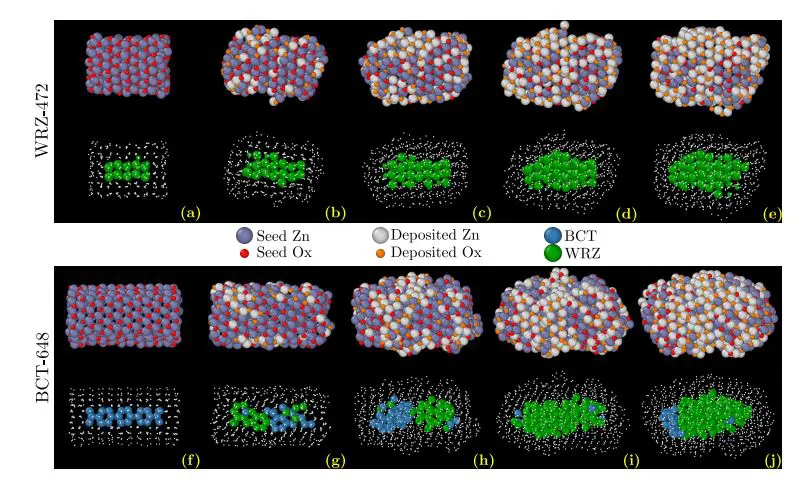
The findings demonstrate that, although the body-centered tetragonal structure is thermodynamically stable at equilibrium for small particle sizes, the deposition process induces a crystal-to-crystal phase transition into the more stable wurtzite phase. This transformation is facilitated by a specific redistribution of nanoparticle ions, effectively compensating for emerging polar facets as the structure evolves, offering a deeper understanding of how nanoparticle structure arises during synthesis.
ZnO Nanoparticle Growth Governed by Surface Polarity
This research investigates the nucleation and growth mechanisms of zinc oxide (ZnO) nanoparticles, focusing on the influence of surface polarity and long-range electrostatic interactions. Employing fundamental calculations, machine learning potentials, and molecular dynamics simulations, the authors understand the formation and stability of different ZnO crystal structures. The study highlights the significant role of surface polarity in determining the preferred growth direction and final morphology of ZnO nanoparticles, as polar surfaces exhibit a tendency to reconstruct or stabilize through the formation of facets with reduced polarity. Researchers developed and utilized advanced machine learning potentials, incorporating long-range electrostatic interactions, to accurately model interatomic forces, enabling large-scale simulations. Simulations revealed the relative stability of different ZnO crystal structures under varying conditions, providing insights into the factors governing their formation, and explored competing nucleation pathways leading to different structures, identifying initial steps and energy barriers.
The importance of accurately capturing long-range electrostatic interactions in the machine learning potentials is emphasized, as these forces significantly influence the stability and morphology of polar surfaces. This research provides a detailed understanding of the complex interplay between surface polarity, electrostatic interactions, and crystal structure in the formation of ZnO nanoparticles, crucial for controlling the synthesis and properties of these materials for applications including catalysis, sensing, and optoelectronics.
Potential applications of the research include controlled nanoparticle synthesis, materials design, optimization of ZnO catalysts, development of more sensitive sensors, and improvement of ZnO-based optoelectronic devices.
Growth Defines Wurtzite Zinc Oxide Structure
This research delivers new insights into the formation of zinc oxide nanoparticles through detailed atom-by-atom modeling of their growth. The team demonstrated that, despite the body-centered tetragonal structure being thermodynamically favoured for small particles, the deposition process induces a transition to the more stable wurtzite phase. This transformation occurs through a specific redistribution of ions within the nanoparticle, effectively compensating for polar facets as the structure evolves, expanding understanding of how oxide nanoparticles form and offering a foundation for designing materials with targeted structural characteristics. The study highlights the importance of growth-induced polarity imbalance during nanoparticle formation, a factor often overlooked in interpretations focused solely on surface and volume energy contributions.
This phenomenon may also be relevant to the formation of other metallic oxides, including those based on titanium, iron, and copper. The authors acknowledge that the model employed represents an approximation of complex interactions, and future work may benefit from more sophisticated approaches, while accurately modeling both polar and non-polar surfaces at a reasonable computational cost was successfully addressed by their chosen methodology.
🗞 Growth driven phase transitions in Zinc Oxide nanoparticles through machine-learning assisted simulations
🧠 ArXiv: https://arxiv.org/abs/2511.19025




See today’s quantum computing news on Quantum Zeitgeist for the latest breakthroughs in qubits, hardware, algorithms, and industry deals.



