

The pursuit of energy-efficient cryogenic devices drives innovation in superconducting spintronics, a field exploring the interplay between magnetism and superconductivity, and Pablo Tuero from Universidad Autonoma de Madrid, César González-Ruano from Comillas Pontifical University, and Igor Žutić from University at Buffalo, State University of New York, alongside Yuan Lu, Coriolan Tiusan, and Farkhad G. Aliev, now challenge conventional thinking about how to build these devices. Their research demonstrates that an insulating barrier, specifically a crystalline layer of magnesium oxide, can actually enhance the coupling between superconducting and magnetic materials, rather than decoupling them as previously believed. The team reveals how this barrier selectively allows certain electronic states to pass through, a process called symmetry filtering, which significantly boosts the performance of key spintronic effects like giant tunneling magnetoresistance. This discovery unlocks new possibilities for designing superconductor-ferromagnet hybrid structures, enabling the efficient conversion of electron pairings and paving the way for advanced functionalities in future superconducting devices.
Epitaxial Heterostructures Couple Superconductivity and Magnetism
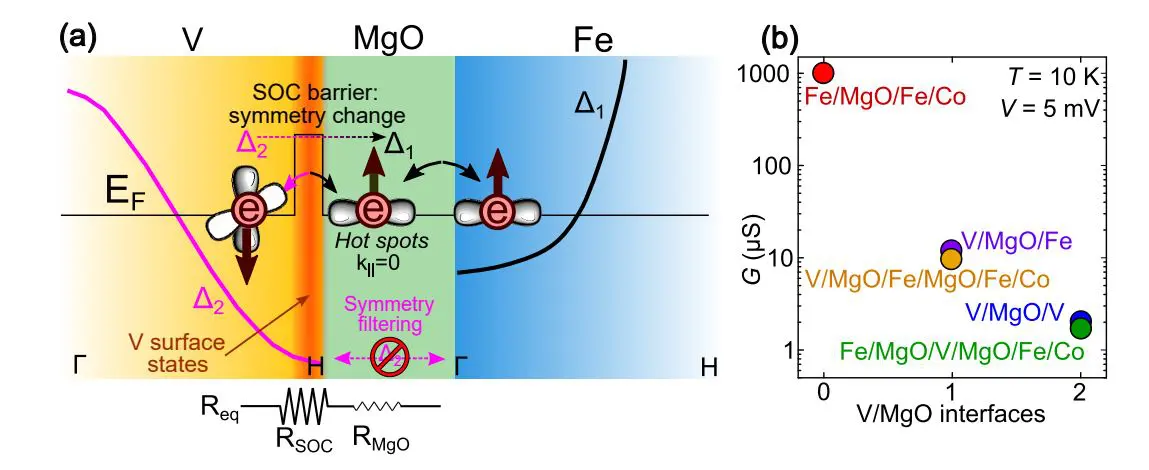
Scientists have engineered a novel approach to superconducting spintronics by demonstrating that an insulating barrier, crystalline magnesium oxide, effectively couples a superconductor and a ferromagnet, challenging the long-held belief that such barriers decouple spin and charge transport. The team fabricated epitaxial vanadium-magnesium oxide-iron heterostructures, meticulously controlling the interface to harness symmetry filtering and interfacial spin-orbit coupling. They deposited thin films using molecular beam epitaxy, ensuring precise crystalline alignment and layer thickness control. Researchers investigated how this barrier impacts the generation of equal-spin triplet Cooper pairs, crucial for long-range spin-polarized supercurrents, and pioneered a method for selectively transmitting specific electronic states, enhancing giant tunneling magnetoresistance vital for high-performance spintronic devices.
This selective transmission arises from symmetry filtering, where the crystalline structure of the barrier allows only certain electronic states to tunnel, maximizing spin-dependent transport. The team analyzed conductance anomalies to disentangle the contributions of spin textures and interfacial spin-orbit coupling to the formation of long-range triplet pairs. Furthermore, scientists developed a theoretical model to compute the free energy of the system and understand how magnetization alignment changes with temperature, accurately predicting a new local energy minimum for out-of-plane magnetization at lower temperatures. By carefully controlling material composition and interface quality, the team demonstrates a pathway towards designing advanced superconductor-ferromagnet hybrid structures with enhanced superconducting spintronic functionalities, paving the way for energy-efficient cryogenic devices and novel magnetic memory technologies.
MgO Barrier Enables Long-Range Spin Supercurrents
This work details a breakthrough in superconducting spintronics achieved through the creation of novel superconductor-ferromagnet hybrid structures. Scientists successfully demonstrated that an insulating barrier, crystalline magnesium oxide (MgO), effectively couples a superconductor and a ferromagnet, defying previous assumptions. This discovery unlocks new possibilities for energy-efficient cryogenic devices by enabling long-range spin-polarized supercurrents and magnetic control over superconducting states. Researchers fabricated a series of epitaxial single-crystalline samples using molecular beam epitaxy, incorporating vanadium and iron electrodes separated by MgO barriers with precise layer control achieved during deposition.
The team created four distinct sample types, including structures with single and double MgO barriers, allowing for detailed investigation of interfacial effects. Crucially, the vanadium layers exhibited superconductivity at approximately 4 Kelvin, confirming the superconducting nature of the hybrid structures. Measurements reveal a strong influence of the MgO barrier on the density of electronic states and transport properties. The team observed that the iron-magnesium oxide interface induces strong spin-orbit coupling, primarily of the Rashba type, due to the breaking of translational symmetry at the interface.
This coupling selectively transmits electrons, with a spin polarization reaching up to 80% in the iron electrodes. The symmetry mismatch between vanadium and iron creates a unique scenario where nearly all electrons experience spin-orbit coupling during transfer, enhancing the efficiency of electron transmission. This symmetry-selective transmission is a key finding, paving the way for advanced superconducting spintronic devices and potentially enabling topological quantum computing.
MgO Barrier Enables Spin Conversion and Coupling
This work demonstrates that crystalline magnesium oxide effectively couples a superconductor and a ferromagnet, even with an intervening insulating barrier, challenging the conventional understanding of spin and charge transport in these hybrid structures. Researchers established that symmetry filtering within the barrier enhances giant tunneling magnetoresistance, a crucial mechanism for high-performance spintronic devices. Specifically, the team showed that the MgO barrier selectively transmits certain electronic states between vanadium and iron, enabling interaction between superconducting and ferromagnetic orderings and facilitating the conversion of spin-singlet to spin-triplet Cooper pairs. Experiments revealed a zero bias conductance anisotropy, indicating a measurable difference in current flow depending on the magnetization direction.
Importantly, the observed differences in conductance are attributed to the electronic structure at the interface, rather than the presence of superconducting vortices, as the superconducting gap is stronger when magnetization is out-of-plane. These findings provide key insights for designing superconductor-ferromagnet hybrid structures with advanced spintronic functionalities. The authors acknowledge that extrinsic phenomena could potentially mimic some of the observed results, and they performed control experiments to rule out this possibility. Future work could focus on exploring different barrier materials and interface structures to further optimize the symmetry filtering effect and enhance the performance of superconducting spintronic devices.
🗞 Superconducting spintronics with electron symmetry filtering and interfacial spin-orbit coupling
🧠 ArXiv: https://arxiv.org/abs/2511.18951



See today’s quantum computing news on Quantum Zeitgeist for the latest breakthroughs in qubits, hardware, algorithms, and industry deals.



