The increasing complexity of quantum computing demands innovative approaches to circuit design, particularly as systems expand beyond single processors to encompass multiple chips. Atiye Zeynali and Zahra Bakhshi, both from Shahed University, alongside their colleagues, address this challenge with a new framework called DeepQMap. This research introduces a deep reinforcement learning system that dynamically adapts to the inherent noise present in multi-chip quantum computers, significantly improving circuit performance. DeepQMap achieves a mean circuit fidelity improvement of 49. 3% compared to existing methods, while also dramatically reducing the costly communication between chips by nearly 80%. These results demonstrate a substantial advancement towards building practical, scalable quantum computers for near-term applications, offering a proactive solution to the pervasive problem of hardware fluctuations and paving the way for more reliable quantum computation.
Deep Reinforcement Learning Optimizes Quantum Circuit Mapping
This research presents a novel approach to quantum circuit mapping, the crucial process of assigning qubits in a quantum computer to those used in a quantum algorithm. Scientists developed a deep reinforcement learning agent that learns to optimize this mapping, aiming to minimize errors and maximize performance on current, noisy quantum devices. The agent learns by interacting with a simulated quantum computer, adapting its strategy to improve mapping efficiency. The results demonstrate significant improvements over traditional methods, reducing errors and enhancing circuit fidelity. The team employed a sophisticated algorithm, combining several advanced deep reinforcement learning techniques, including prioritized experience replay and dueling networks.
This allowed the agent to learn more efficiently and effectively from its interactions with the simulated environment. The trained agent successfully generalized to different circuit structures and sizes, demonstrating its adaptability and potential for broader application. The approach shows promise for scaling to larger and more complex quantum circuits, paving the way for more powerful quantum computations.
Deep Reinforcement Learning for Quantum Compilation
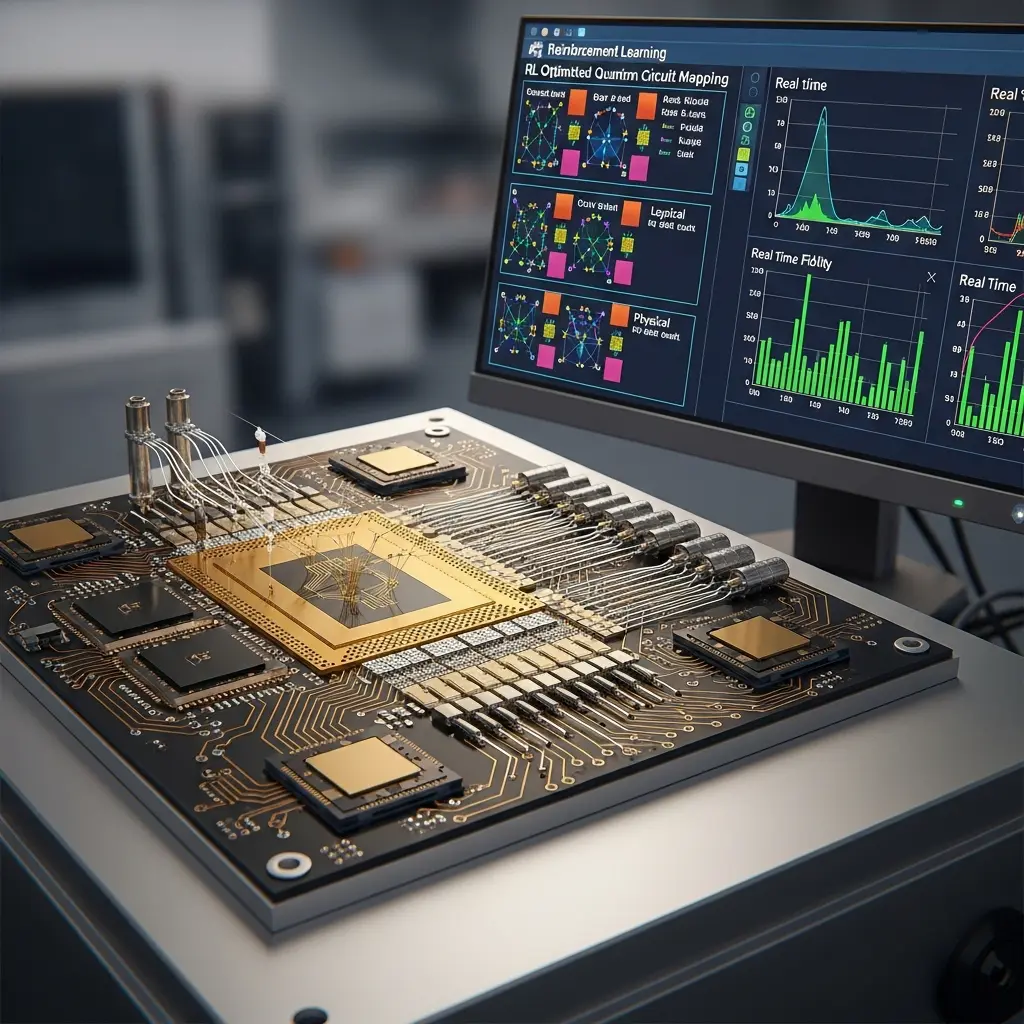
Scientists pioneered DeepQMap, a deep reinforcement learning framework designed to optimize quantum circuit compilation for multi-chip quantum processors. Unlike static optimization methods, DeepQMap dynamically adapts to fluctuations in hardware performance and minimizes costly communication between chips. The system integrates a network that predicts noise with a sophisticated deep reinforcement learning architecture, enabling proactive compensation for hardware variations and improved mapping decisions. Extensive evaluation across a wide range of benchmark circuits demonstrated that DeepQMap achieves a significantly higher circuit fidelity compared to existing methods.
The system reduces the overhead associated with communication between chips, decreasing the number of operations required per circuit. Scalability analysis confirms that DeepQMap maintains its performance even as the number of qubits increases, while competing methods degrade. Furthermore, the training process for DeepQMap is considerably faster than traditional optimization techniques, accelerating the development of quantum algorithms.
Deep Reinforcement Learning Boosts Quantum Circuit Fidelity
Scientists achieved a significant breakthrough in quantum circuit compilation with the development of DeepQMap, a deep reinforcement learning framework designed for multi-chip quantum processors. This work demonstrates a substantial improvement in circuit fidelity. The team successfully reduced the overhead associated with communication between chips, directly improving fidelity as cross-chip operations contribute significantly to errors. Furthermore, the training process for DeepQMap is considerably faster than traditional optimization techniques, enabling rapid iteration during quantum algorithm development.
Scalability analysis reveals that DeepQMap sustains performance up to 100 qubits, while competing methods degrade. The computational efficiency of DeepQMap ensures that solution time increases at a manageable rate as the problem size grows. The core of this achievement lies in a network that accurately predicts quantum hardware noise, enabling proactive compensation for fluctuations in performance.
Dynamic Quantum Compilation Boosts Circuit Fidelity
DeepQMap represents a significant advancement in quantum circuit compilation, addressing challenges posed by multi-chip architectures and the inherent noise of current quantum computers. This research introduces a deep reinforcement learning framework that dynamically adapts to hardware behaviour, unlike traditional static optimization methods. Through integration of a network that predicts noise with a sophisticated deep reinforcement learning architecture, DeepQMap achieves a substantially higher mean circuit fidelity compared to existing methods. The system demonstrably reduces the overhead associated with communication between chips, decreasing the number of operations required per circuit. The team’s approach maintains high noise prediction accuracy, enabling proactive compensation for fluctuations in hardware performance. Scalability analysis confirms that DeepQMap sustains performance across systems ranging from 20 to 100 qubits, while competing methods degrade considerably at larger scales.
🗞 Noise-Adaptive Quantum Circuit Mapping for Multi-Chip NISQ Systems via Deep Reinforcement Learning
🧠 ArXiv: https://arxiv.org/abs/2511.18079