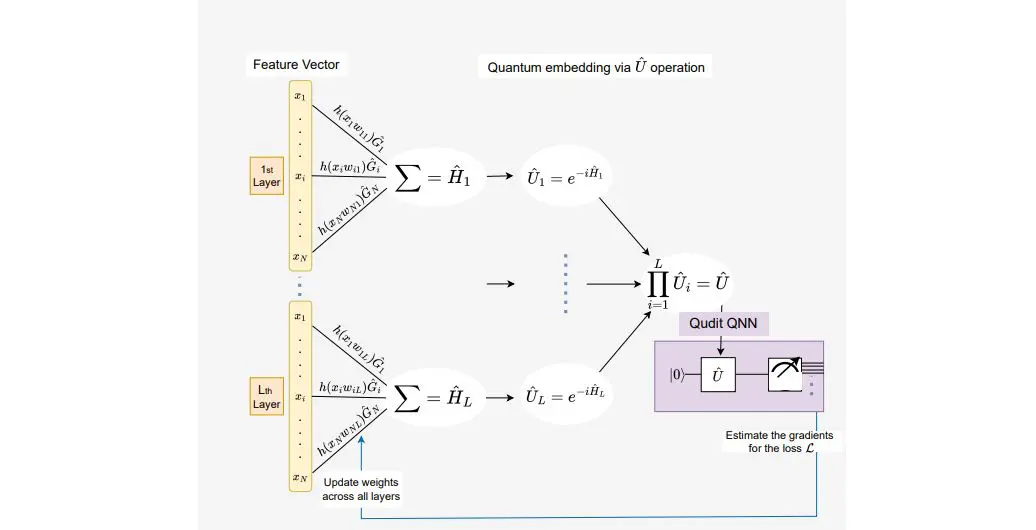
Predicting credit risk demands models that are both accurate and understandable, a challenge that researchers continually address in the financial sector. Georgios Maragkopoulos, Lazaros Chavatzoglou, and Aikaterini Mandilara, alongside colleagues, now demonstrate a novel neural network based on quantum principles, offering a potential breakthrough in this area. Their work introduces a network that encodes both data and its own learning parameters within a unified quantum process, allowing it to explore a vast range of possibilities while simultaneously revealing which factors most influence its predictions. Benchmarking this approach against real-world credit data, the team achieves performance comparable to established machine learning models, such as random forests, while also providing a clear link between learned parameters and feature importance, a crucial step towards building trustworthy and transparent financial tools.
Single Qudit Network Excels at Credit Risk
Scientists have developed a new quantum neural network (QNN) based on a single qudit, a quantum system offering increased complexity compared to standard quantum bits. This approach provides a resource-efficient method for machine learning, encoding both data characteristics and adjustable parameters within a unified quantum process. By leveraging the full range of possible quantum evolutions, the network explores the entire quantum state space while retaining interpretability through learned parameter magnitudes. The research introduces two complementary methods to assess interpretability: a comparison of the model’s feature ranking to that of Logistic Regression, and a feature-poisoning test where selected features are replaced with random noise.
Results confirm the QNN achieves competitive performance while offering a tractable path toward interpretable quantum learning. The feature-poisoning test, in particular, assesses how well the model assigns low weights to corrupted features, confirming its ability to discern meaningful information. Measurements confirm the QNN’s architecture, integrating encoding and adjustable layers into a single quantum process, enables internal feature importance assessment via learned weight magnitudes, eliminating the need for external explanation tools. The team validated the model’s performance using a large-scale financial dataset, demonstrating predictive accuracy and interpretability comparable to classical baselines. This work establishes a foundation for interpretable quantum learning and highlights the potential of compact, fully quantum architectures for practical deployment in high-stakes domains like finance. Experiments using a real-world, imbalanced credit-risk dataset from Taiwan reveal the QNN consistently outperforms Logistic Regression, achieving macro-F1 scores comparable to those of Random Forest models.
Qudit Networks Balance Accuracy and Interpretability
This research presents a new qudit-based quantum neural network designed for financial applications, specifically credit risk assessment. The team successfully demonstrated that this network achieves predictive performance comparable to traditional neural networks while simultaneously offering a level of interpretability similar to linear regression and random forest models. This balance is achieved through a unique encoding strategy that co-encodes both data and adjustable parameters within a unified quantum system, allowing for transparent feature importance ranking. Evaluations using a real-world credit risk dataset from Taiwan confirm the network’s effectiveness, showing that increasing the network’s complexity enhances its classification capabilities. Importantly, this work represents one of the few quantum formulations to achieve high accuracy on a practical financial dataset, suggesting a viable path towards interpretable quantum machine learning in finance.
Qudit Networks for Credit Risk
Scientists have developed a novel quantum neural network (QNN) based on a single qudit, a quantum system with multiple states, offering a potentially more expressive approach to machine learning. The team encoded both data features and adjustable parameters within a unified quantum process, leveraging the full range of possible quantum evolutions to explore the entire quantum state space while maintaining interpretability through learned parameter magnitudes. The research introduces two complementary metrics to quantify interpretability: a comparison of the model’s feature ranking to that of Logistic Regression, and a feature-poisoning test where selected features are replaced with noise. Results demonstrate the QNN achieves competitive performance while offering a tractable path toward interpretable quantum learning.
Measurements confirm the QNN’s architecture, integrating encoding and adjustable layers into a single quantum process, enables internal feature importance assessment via learned weight magnitudes, eliminating the need for external explanation tools. The team validated the model’s performance using a large-scale financial dataset, demonstrating predictive accuracy and interpretability comparable to classical baselines. Experiments using a real-world, imbalanced credit-risk dataset from Taiwan reveal the QNN consistently outperforms Logistic Regression, achieving macro-F1 scores comparable to those of Random Forest models.
🗞 Feature Ranking in Credit-Risk with Qudit-Based Networks
🧠 ArXiv: https://arxiv.org/abs/2511.19150