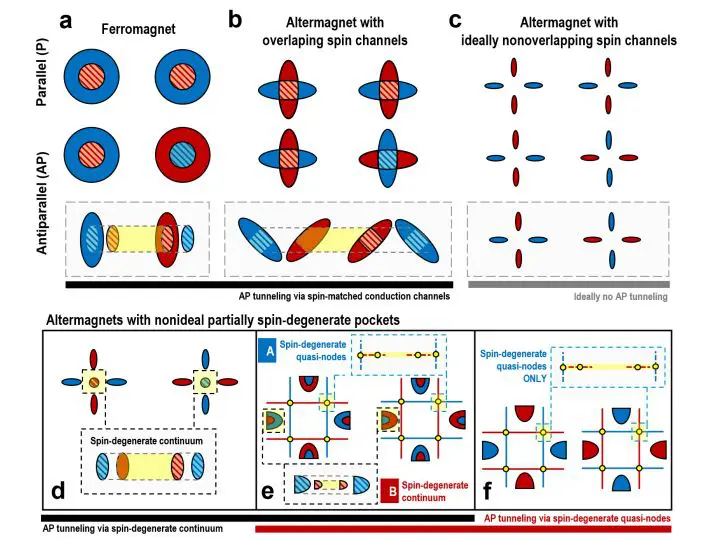
Altermagnetism, a recently discovered phenomenon characterised by zero net magnetisation and unique spin-split band structures, presents a promising pathway for next-generation spintronics. Xingyue Yang from Peking University, Shibo Fang from Singapore University of Technology and Design, and Zongmeng Yang from Peking University, alongside their colleagues, investigate how the geometry of the Fermi surface in altermagnetic materials impacts performance in tunnel junctions. The team focuses on three experimentally synthesised materials, revealing that flatband-driven Fermi surfaces significantly minimise overlap between spin channels, a crucial factor for achieving high tunneling magnetoresistance. Notably, their work demonstrates an unprecedented intrinsic tunneling magnetoresistance exceeding 1000% in a -based device, and further enhancement to over 2000% with an insulating barrier, establishing this material as a leading candidate for future altermagnetic-spintronic devices and highlighting the importance of flatband Fermi surface geometry in achieving superior performance.
Non-Collinear Magnetism and Zero Net Moments
This comprehensive research explores altermagnetism, a novel magnetic order with significant potential for spintronics and magnetic tunnel junctions (MTJs). The work details the fundamental principles of altermagnetism, where spins align in a non-collinear fashion, resulting in zero net magnetic moment but finite spin polarization, a key distinction from conventional magnetic materials. This unique arrangement leads to splitting of electronic bands, observable through advanced spectroscopic techniques, and crucial for potential applications. The research extensively investigates various materials exhibiting altermagnetic properties, with chromium antimony (CrSb) emerging as a leading candidate repeatedly confirmed to display this unique magnetic order through multiple experimental methods, including detailed structural analysis.
Manganese triselenide nitride (Mn3SnN) and vanadium diselenide oxide (V2Te2O) are also explored for their potential in MTJs, alongside other materials with complex crystal structures, highlighting the importance of symmetry breaking in enabling altermagnetism, often requiring the absence of inversion symmetry. The potential of altermagnetism shines in device applications, particularly in magnetic tunnel junctions, where researchers are investigating altermagnetic materials as electrodes to enhance giant tunnel magnetoresistance (GMR) and tunnel magnetoresistance (TMR) effects, leveraging the spin polarization of the altermagnetic layer to maximize performance. These materials can also act as spin filters, selectively transmitting electrons with specific spin orientations, and offer possibilities for creating multi-state MTJs, extending to spin-orbit logic devices and edgetronics, exploring the use of two-dimensional altermagnetic materials for novel functionalities. A significant portion of the research relies on computational methods to understand and predict the behavior of altermagnetic materials, employing density functional theory (DFT) for electronic structure calculations, often enhanced with DFT+U to account for strong electron correlations.
Software packages like VASP and QuantumATK are used for modeling and simulating electronic transport, with accurate selection of exchange-correlation functionals and thorough convergence testing crucial for obtaining reliable results, and computational modeling used to design and optimize MTJ structures with altermagnetic electrodes. This research establishes altermagnetism as a promising new area within spintronics, offering the potential to overcome limitations of traditional ferromagnetic materials. While CrSb currently leads the way, further research is needed to optimize its properties and explore other materials, with computational modeling remaining essential for understanding and designing these materials and devices, and the focus now shifting towards device fabrication and characterization. Demonstrating functional devices based on altermagnetic materials represents the next major step, and exploring two-dimensional materials offers exciting possibilities for creating novel spintronic devices.
Flatband Altermagnetic Tunnel Junction Fabrication and Analysis
Scientists engineered novel altermagnetic tunnel junctions (AMTJs) using three experimentally synthesized altermagnetic materials, investigating how flatband-driven Fermi surfaces maximize performance. The study reveals that these materials host flat altermagnetic Fermi sheets, confining spin degeneracy to minimal arc-like or nodal-like regions, drastically reducing spin overlap. To fabricate high-performance AMTJs, researchers selected titanium dioxide (TiOF2) as an insulating barrier material, chosen for its excellent lattice match and wide band gap, both preserved within the heterostructure. Detailed examination of transport characteristics along different crystallographic directions reveals that current flow along one direction exhibits spin-polarized transport analogous to conventional ferromagnetic materials.
Transmission calculations reveal distinct patterns for spin-up and spin-down electrons, with spin-up electrons forming continuous conduction channels throughout the Brillouin zone, while spin-down electrons are limited to isolated pockets. In the antiparallel configuration, available transmission states are markedly reduced, restricting tunneling to small regions where spin-down pockets overlap with opposite-spin Fermi sheets, ultimately achieving a spin polarization of 73. 2%. By integrating transmission spectra, scientists calculated the total transmission and corresponding TMR ratio as a function of energy, demonstrating a record-high TMR of 9.
1×10 4 % for a KV2Se2O|Cr2Se2O|KV2Se2O device. This exceptional performance originates from the combination of the altermagnetic flatband Fermi surface geometry of KV2Se2O, which minimizes nodal-like conduction channels in the antiparallel state, and the symmetry-matched Cr2Se2O insulating barrier. The study establishes a theoretical performance ceiling for KV2Se2O-based AMTJs, providing a quantitative benchmark for material selection and a conceptual framework for designing next-generation spintronic devices.
KV2Se2O Exhibits Record Tunneling Magnetoresistance
This work demonstrates a significant breakthrough in spintronic materials, establishing potassium divanadate selenide oxide (KV2Se2O) as a compelling candidate for advanced magnetic tunnel junctions (MTJs). Researchers achieved an unprecedented intrinsic tunneling magnetoresistance (TMR) exceeding 10 3 % in KV2Se2O-based AMTJs, a value significantly higher than that observed in conventional MTJs. This remarkable performance stems from the unique flatband-driven Fermi surface geometry of KV2Se2O, which minimizes spin-channel overlap and drastically enhances tunneling efficiency. Detailed quantum transport simulations revealed that KV2Se2O possesses only arc-like or nodal-like intersections between opposite-spin channels, a direct consequence of its quasi-two-dimensional morphology and the presence of quasi-2D altermagnetic flatbands.
This minimal overlap strongly suppresses transmission in the antiparallel state, leading to the exceptionally high TMR ratios observed, reaching 4. 3×10 3 % with a vacuum barrier, and further optimization of the insulating barrier increased this to an impressive 9. 1×10 4 %. This value surpasses the theoretical limits of conventional iron|magnesium oxide|iron MTJs by a considerable margin. Investigations into the impact of crystallographic orientation revealed that aligning transport along directions with larger opposite-spin overlap reduced the TMR, underscoring the critical role of Fermi surface engineering. These findings highlight the potential of altermagnetic flatband design and precise crystallographic control to achieve high-performance AMTJs, paving the way for next-generation spintronic architectures with enhanced efficiency and stability.
Flatbands Enhance Altermagnetic Tunneling Performance
This research demonstrates the critical role of flatband-driven Fermi surface geometry in achieving high-performance altermagnetic tunnel junctions, a promising platform for spintronics. Through detailed computational investigations of three experimentally synthesized altermagnets, the team established that minimizing overlap between opposite-spin conduction channels is key to maximizing tunneling magnetoresistance (TMR). Notably, these materials exhibit flat altermagnetic Fermi sheets, confining spin degeneracy to minimal regions and drastically reducing spin overlap.
🗞 Altermagnetic Flatband-Driven Fermi Surface Geometry for Giant Tunneling Magnetoresistance
🧠 ArXiv: https://arxiv.org/abs/2511.17277




See today’s quantum computing news on Quantum Zeitgeist for the latest breakthroughs in qubits, hardware, algorithms, and industry deals.