The intersection of mechanics and general relativity remains a challenging frontier in physics, with few experiments successfully bridging these two fundamental frameworks. Haocun Yu, Dorotea Macri from the Massachusetts Institute of Technology, and Thomas Morling from the University of Vienna, alongside their colleagues, now present a significant advance in this field. They have constructed a 50-kilometre optical interferometer, built using fibre optics on a laboratory table, capable of detecting subtle changes in the phase of single photons. This innovative instrument achieves a phase sensitivity sufficient to detect minute gravitational effects, demonstrating the potential to observe gravitational redshifts within a standard laboratory setting and opening new avenues for testing the predictions of general relativity.
Single Photons Test Quantum Field Theory
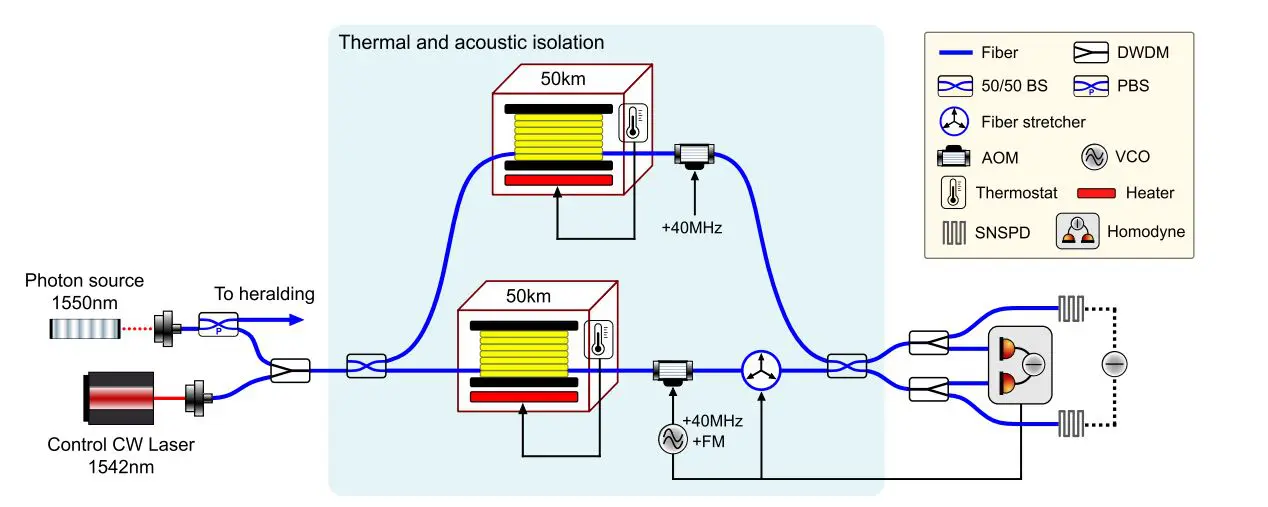
Scientists engineered a 50-kilometer fiber optic interferometer to test predictions from quantum field theory in curved spacetime, employing single photons to measure subtle phase shifts. The experiment aims to determine if gravity affects classical and quantum light in the same way, potentially revealing new physics beyond our current understanding. Researchers characterized the interferometer using both classical light and single photons generated from entangled pairs, achieving precise control over the quantum states of light. The single-photon source, based on a specialized crystal and laser, reliably produces pairs of entangled photons with high brightness.
This source is crucial for generating the quantum states used in the experiment. The interferometer, constructed from extensive lengths of optical fiber, allows for precise measurement of phase differences. The team achieved a phase noise of approximately 6x 10 -4 rad/√Hz at 0. 1Hz with classical light, and a sensitivity of 4. 42x 10 -3 rad/√Hz at 0.
1Hz with single photons, demonstrating the system’s stability and precision. Multiple measurement runs confirmed the consistency of the results, highlighting the reliability of the experimental setup. Researchers utilized a feedback control system to maintain stable conditions, ensuring accurate measurements. Future plans involve creating a height difference between the interferometer arms to precisely measure the gravitational phase shift experienced by both classical and quantum light, enabling a rigorous test of quantum field theory in curved spacetime.
Gravitational Potential Measurement with Fiber Interferometry
Scientists have constructed a 50-kilometer tabletop fiber interferometer, achieving unprecedented sensitivity in a laboratory setting for probing the intersection of quantum mechanics and general relativity. The study pioneered a method for measuring optical phase shifts of single photons within differing gravitational potentials, a crucial step towards testing predictions beyond Newtonian gravity. The interferometer utilizes two extensive spools of low-loss fiber, carefully positioned to create a measurable difference in gravitational potential along the photon paths, and is maintained under precise temperature control to minimize environmental noise. Single photons are generated and directed through the interferometer, where they encounter subtle phase shifts induced by the gravitational potential difference.
The system employs fiber beam splitters to precisely divide and recombine the photon beams, enabling interference patterns that reveal minute changes in phase. Researchers achieved a phase sensitivity of 4. 42x 10 -6 radians root-mean-square (RMS) within a frequency range of 0. 01 Hertz to 5 Hertz, a significant advancement over previous laboratory-scale interferometry experiments. This enhanced sensitivity allows the detection of a phase-shift signal of (6.
18 ±0. 44) x 10 -5 radians RMS at 0. 1 Hertz, associated with a modulated gravity-induced signal, demonstrating the capability to detect gravitational redshifts in a local laboratory environment. A weak laser field is used to stabilize the interferometer, further minimizing drift. The study establishes a new milestone for quantum sensing with large-scale optical interferometry, paving the way for rigorous tests of phenomena predicted by general relativity in a controlled laboratory setting.
Quantum Interferometry Senses Gravitational Wave Signals
Scientists have realized a groundbreaking laboratory-based fiber interferometer, achieving unprecedented sensitivity for probing the intersection of quantum mechanics and general relativity. The team constructed a 50-kilometer tabletop interferometer, utilizing single photons to measure optical phase shifts with exceptional precision. Experiments demonstrate a phase sensitivity of 4. 42 × 10−6 rad root-mean-square (RMS) within a frequency range of 0. 01Hz to 5Hz, establishing a new milestone in quantum sensing with large-scale optical interferometry.
This remarkable sensitivity allows the detection of minute phase shifts, with the interferometer successfully resolving a simulated signal of (6. 18 ±0. 44) × 10−5 rad RMS at 0. 1Hz. This signal magnitude is comparable to the gravitational phase shift expected from a tabletop apparatus, demonstrating the capability to detect gravitational redshifts within a local laboratory environment.
The work surpasses the sensitivity of all previous single-photon fiber interferometers, opening new avenues for testing fundamental physics. The interferometer operates by splitting single photons into two paths, each traveling through 50 kilometers of optical fiber, and then recombining them to create an interference pattern. By precisely measuring changes in this pattern, scientists can detect extremely small phase shifts caused by external factors, including gravity. This breakthrough delivers a powerful new tool for exploring the fundamental laws governing the universe.
Quantum Gravity Tests with Fiber Interferometry
This research demonstrates a significant advance in quantum sensing through the construction of a 50-kilometer fiber interferometer capable of detecting phase shifts at the single-photon level. The team achieved a phase sensitivity sufficient to resolve gravity-induced signals within a laboratory setting, establishing a crucial milestone for testing predictions derived from general relativity. This achievement represents a key step towards experimentally bridging the gap between quantum mechanics and gravity, a long-standing challenge in physics. The experiment successfully detected gravitational redshifts using a photonic quantum state, opening new avenues for exploring fundamental gravitational effects on quantum systems. While the current sensitivity is limited by optical loss within the fiber system, detailed analysis of loss sources has been performed, and potential improvements, such as utilizing ultra-low-loss fibers and minimizing connection losses, have been identified. The researchers are currently developing a next-generation interferometer incorporating a modulated vertical height difference between interferometer arms, aiming to compare gravitational effects on both classical and quantum light and further investigate the interplay between gravity and quantum fields.
🗞 50-km fiber interferometer for testing gravitational signatures in quantum interference
🧠 ArXiv: https://arxiv.org/abs/2511.17022


See today’s quantum computing news on Quantum Zeitgeist for the latest breakthroughs in qubits, hardware, algorithms, and industry deals.