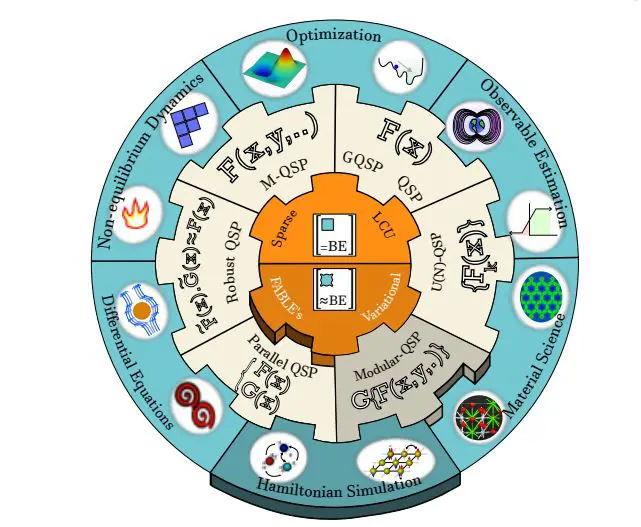
The pursuit of practical quantum computing faces a critical challenge, bridging the gap between theoretical algorithms and real-world applications in fields like chemistry, physics and optimisation. Kevin J. Joven, Elin Ranjan Das, Joel Bierman, and colleagues, including Aishwarya Majumdar, Masoud Hakimi Heris, and Yuan Liu, address this issue by proposing a set of properties essential for scalable computational science methods. Their work demonstrates how block-encodings and polynomial transformations offer a unified framework capable of meeting these demands, presenting recent advances in constructing these encodings and adapting signal processing techniques for polynomial transformations. This research highlights the potential for these methods to scale effectively on modern computing architectures, paving the way for significant progress in simulating complex systems and estimating key observables.
Quantum Algorithms for Simulation and Optimization
Core Algorithms for Quantum Simulation and Optimization
Quantum simulation, a dominant theme, focuses on modelling quantum systems relevant to chemistry and materials science. The Variational Quantum Eigensolver (VQE) and Quantum Approximate Optimization Algorithm (QAOA) are key algorithms for finding ground state energies and solving optimisation problems. Quantum Phase Estimation (QPE), Bayesian versions, Amplitude Estimation, and Quantum Krylov Subspace Methods offer further algorithmic approaches, while Quantum Signal Processing (QSP) provides a technique for implementing functions of matrices. A crucial technique involves block encoding, a method for representing classical data on a quantum computer.
Researchers also explore imaginary-time block encoding and methods like Trotterization and Adiabatic Quantum Computation for approximating complex calculations. Dissipative preparation of quantum states offers another approach to state creation, with applications spanning quantum chemistry, materials simulation at finite temperatures, and the modelling of ultrafast dynamics. Researchers are actively addressing challenges such as barren plateaus, which hinder the training of quantum neural networks and variational algorithms. They analyse optimisation landscapes and evaluate the resources required for each algorithm, favouring those that scale polynomially or even sublinearly with problem size.
Complexity analysis helps determine computational cost, and combining classical optimisation techniques with quantum computation offers a promising avenue for improvement. The work considers how information is represented on qubits and the complexity of quantum gates. Silicon photonic chips represent a promising quantum hardware platform, and researchers utilise nested Gausslet basis sets to represent quantum states. Specific techniques such as Krylov diagonalisation and imaginary time evolution are employed, alongside Gausslet basis sets and polynomial-time algorithms. Quantum Neural Networks (QNNs) and Quantum Krylov Subspace Methods offer further algorithmic possibilities.
Addressing Current Hardware Challenges and Limits
Addressing Current Hardware Challenges and Limits
Emerging themes include the pursuit of near-term quantum advantage with current, noisy quantum computers and the critical need for fault tolerance through error correction. The role of classical computation in quantum algorithms is also recognised, as many algorithms combine classical and quantum steps. Overall, the field is rapidly evolving, focused on leveraging quantum computers to solve complex problems in chemistry, materials science, and optimisation.
Block-Encodings and Polynomial Transformations for Scalability
Block-Encodings and Polynomial Transformations for Scalable Computation
Developing Scalable Quantum Computational Frameworks
Recent advancements in both quantum hardware and error correction are driving the field towards practical applications. This work proposes key properties for scalable computational science methods and explores how block-encodings and polynomial transformations can provide a unified framework. Researchers present progress in constructing and assembling block-encodings, alongside generalisations of signal processing algorithms to perform polynomial transformations efficiently, demonstrating scalability on parallel and distributed architectures. The core concept of block-encoding involves embedding a matrix into a larger unitary matrix, requiring ancillary qubits due to the expanded Hilbert space.
Unitary Dilation: Mathematical Formalism for Quantum Circuits
A unitary dilation exists for any matrix with a norm less than or equal to one, enabling its representation on a quantum computer via a quantum circuit. Specifically, for a Hermitian matrix, a unitary matrix can be constructed such that measurements reveal its properties. For general, non-Hermitian matrices, researchers utilise polar decomposition, expressing the matrix as the product of a unitary matrix and a positive semi-definite Hermitian matrix. This allows for the construction of a unitary dilation, and a Hermitian dilation can be constructed via an intermediate step, leveraging properties of Hermitian matrices even when the original matrix is not Hermitian, potentially simplifying block-encoding circuits.
One method involves defining a Hermitian matrix from any matrix by arranging it and its conjugate transpose in a specific block form, resulting in eigenvalues related to the singular values of the original matrix. These techniques enable the efficient encoding of matrices for quantum computation, paving the way for applications in simulating complex systems and solving challenging optimisation problems. The work demonstrates the potential of these methods through scalable implementations on parallel computing architectures, bridging the gap between theoretical algorithms and practical computational science.
Scalable Quantum Algorithms via Polynomial Transformations
Recent advances in quantum hardware and error correction are driving progress towards practical quantum computation. Researchers have identified key properties that scalable quantum computational methods should possess, focusing on a framework built around block-encodings and polynomial transformations. This work demonstrates how these techniques can offer a unified approach to constructing and assembling quantum algorithms, alongside generalisations of signal processing methods to perform polynomial transformations efficiently. The team highlights the scalability of these quantum signal processing methods when implemented on parallel and distributed computing architectures, paving the way for tackling increasingly complex problems.
Promising applications have been explored in areas such as real-time and imaginary-time evolution, expectation value estimation, and optimisation problems within chemistry, physics, and broader scientific domains. While acknowledging the challenges of the early fault-tolerant era, where quantum algorithm complexity will increase, the researchers emphasise the importance of bridging the gap between theoretical development and practical application for computational scientists. The authors note that further progress relies on continued improvements in quantum hardware and a demystification of fault-tolerant quantum algorithms to facilitate wider adoption within the computational science community. Future work will likely focus on refining these algorithmic primitives and exploring their potential to deliver practical quantum advantage across a range of scientific disciplines.
🗞 Scalable Quantum Computational Science: A Perspective from Block-Encodings and Polynomial Transformations
🧠 ArXiv: https://arxiv.org/abs/2511.16738