Researchers are developing new ways to understand complex states of matter, particularly those exhibiting topological order where traditional methods struggle to identify distinct phases. Shamminuj Aktar, Rishabh Bhardwaj, and Andreas Bärtschi, alongside colleagues at Los Alamos National Laboratory, now demonstrate a powerful technique called quantum data learning to characterise phase transitions in a two-dimensional model system. The team trains a convolutional neural network to classify ground states generated across a range of conditions, successfully mapping the overall phase structure and accurately pinpointing the transition between phases. This approach, which bypasses the need to predefine specific measurable properties, not only recovers known results but also offers a promising framework for exploring more exotic states of matter and understanding finite volume effects in complex physical systems, exceeding the performance of classical methods.
Quantum Simulation of Field and Matter Systems
This collection of research explores the exciting intersection of quantum computing, high-energy physics, and condensed matter physics. A central goal is using quantum computers, or quantum simulators, to solve problems currently intractable for conventional computers, promising breakthroughs in understanding fundamental particles and exploring phenomena like confinement and phase transitions. Researchers are also investigating strongly correlated electron systems and topological phases of matter, exotic states with potential applications in quantum computation. A key focus is simulating lattice gauge theories on quantum computers, with efforts underway to develop realistic schemes for complex systems.
Quantum simulators, such as those built with Rydberg atom arrays, offer a physical platform for modeling these systems. Scientists are also developing quantum algorithms, including techniques like q-means for machine learning, and exploring classical shadows for efficiently learning quantum states. Machine learning plays a crucial role, assisting in tasks like reconstructing quantum states and improving simulation accuracy. Theoretical investigations delve into topological phases of matter, including spin liquids and toric code models, and explore various phase transitions. Loop gas models provide a framework for studying these transitions and understanding topological order.
In high-energy physics, researchers aim to simulate Quantum Chromodynamics (QCD) on quantum computers and explore the role of entanglement in particle physics, testing fundamental physics with Bell inequalities. Quantum techniques are also being applied to reconstruct the Standard Model Effective Field Theory (SMEFT), potentially revealing physics beyond the Standard Model. Ultimately, this research converges quantum computing, machine learning, and fundamental physics, aiming to tackle challenging problems and deepen our understanding of the quantum world.
Quantum Phase Learning with Neural Networks
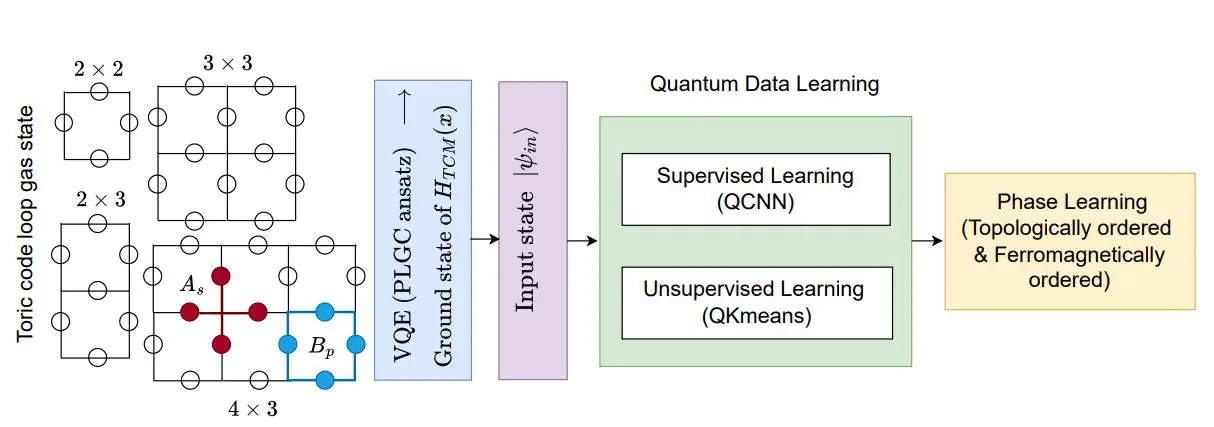
This study introduces a novel quantum data learning (QDL) approach, directly analyzing quantum states to characterize complex physical systems without relying on identifying classical observables. Researchers generated ground states for the 2+1-dimensional toric-code loop-gas model, utilizing a parametrized loop-gas circuit coupled with a variational eigensolver technique across multiple lattice sizes. A quantum convolutional neural network (QCNN) was then trained to classify phases and capture the overall phase structure of the model, enabling comprehensive analysis of quantum behavior. To refine the learning process, scientists implemented a physics-aware training protocol, deliberately excluding the region near the phase transition point to focus on learning the broader phase structure before tackling this challenging area.
In parallel, an unsupervised quantum k-means method, based on state overlaps, was implemented, partitioning the dataset into two distinct phases without prior labeling, providing an independent validation of the supervised learning approach. The supervised QDL approach successfully recovered the phase structure and accurately located the phase transition, aligning closely with previously reported values. The unsupervised QDL approach also recovered the phase structure, locating the transition with a small offset, as expected in finite-volume systems, confirming the method’s effectiveness even with limited computational resources. Both QDL methods consistently outperformed classical alternatives, establishing QDL as a powerful framework for characterizing topological quantum matter and probing phase diagrams of higher-dimensional systems.
Quantum Data Learning Characterizes Topological Phases
Scientists achieved a breakthrough in characterizing topological matter using quantum data learning (QDL), bypassing the need to identify classical observables. The research team applied QDL to the 2+1-dimensional toric-code loop-gas model under a magnetic field, generating ground states across multiple lattice sizes using a parametrized loop-gas circuit and a variational eigensolver approach. They then trained a convolutional neural network to classify phases and capture the overall phase structure of the model, employing a physics-aware training protocol that excluded the near-critical region for rigorous testing. Experiments revealed that both the supervised QDL approach, utilizing the convolutional neural network, and an unsupervised k-means method successfully recovered the phase structure of the model.
The supervised method accurately located the phase transition, while the unsupervised method, partitioning the dataset into two phases without prior labeling, located the transition with a small offset, as expected in finite volumes. Measurements confirm that both QDL methods outperformed classical alternatives in learning the phase transition. Finite-size scaling demonstrated that the transition point, extrapolated from the QCNN results, aligned closely with benchmark values obtained through Quantum Monte Carlo simulations. The team implemented an unsupervised k-means method based on state overlaps, which successfully partitioned the dataset into two distinct phases without any prior labeling. This approach provided an independent validation of the phase structure and located the phase transition, further demonstrating the effectiveness of QDL. The research establishes QDL as an effective framework for characterizing topological matter, studying finite volume effects, and probing phase diagrams in higher-dimensional systems, opening new avenues for understanding complex quantum phenomena.
Quantum Machine Learning Maps Phase Transitions
This research demonstrates the effectiveness of quantum data learning (QDL) as a framework for characterizing complex phases of matter, specifically within the 2+1-dimensional toric-code loop-gas model. By employing quantum convolutional neural networks (QCNNs) and unsupervised k-means clustering, scientists accurately identified the topological-to-ferromagnetic phase transition and located the critical point with high precision, closely matching results obtained through established Quantum Monte Carlo methods. The QCNNs exhibited robust performance even when trained on data generated from relatively small quantum systems, highlighting their potential for extracting critical behavior with limited quantum resources. The unsupervised k-means method successfully identified the phase boundary without requiring pre-labeled data, although with a slight deviation in the transition point, as expected in finite-size systems.
Importantly, these quantum machine learning approaches outperformed classical alternatives, such as conventional convolutional neural networks and logistic regression, which consistently overestimated the transition point. While the current study acknowledges limitations imposed by the modest size of the simulated lattices, future work aims to scale these QDL methods to larger systems and more complex models, leveraging advancements in state preparation and quantum hardware. This research establishes a promising route toward learning phase diagrams of lattice gauge theories, with potential applications to understanding quantum chromodynamics and exploring complex phenomena in high-energy physics.
🗞 Quantum Data Learning of Topological-to-Ferromagnetic Phase Transitions in the 2+1D Toric Code Loop Gas Model
🧠 ArXiv: https://arxiv.org/abs/2511.16851




See today’s quantum computing news on Quantum Zeitgeist for the latest breakthroughs in qubits, hardware, algorithms, and industry deals.