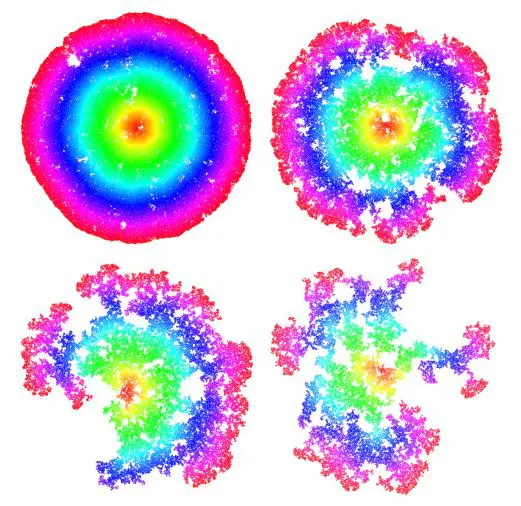
The challenge of defining a natural distance on complex, fractal surfaces has long occupied mathematicians and physicists, and recent work by Jason Miller and Yi Tian addresses this problem for a specific type of fractal known as a conformal loop ensemble carpet. They demonstrate the existence and uniqueness of a conformally covariant geodesic metric on these carpets, a significant achievement because it establishes a well-defined way to measure distances within these intricate structures. This metric arises as the natural scaling limit of Minkowski first passage percolation, effectively identifying the shortest path between any two points on the carpet, and builds upon earlier findings by Miller regarding the behaviour of this percolation process. The team’s result provides a crucial step towards understanding the geometric properties of these carpets and may ultimately connect them to the chemical distances observed in physical systems like the critical Ising model.
The research focuses on the structure of the neighbourhoods surrounding all paths connecting pairs of points within complex systems. Previous work established that the metric function admits subsequential limits, and this paper demonstrates that this limit is unique. This uniqueness is characterised by a specific set of axioms, providing a complete description of the limiting behaviour. The researchers conjecture that this metric describes the scaling limit of the chemical distance metric for discrete loop models that converge to conformal loop ensembles (CLEs) for parameters κ greater than 8/3 and less than 4, including the critical Ising model for κ equal to 4.
Conformal Loop Ensembles and Liouville Gravity
This body of work investigates conformal loop ensembles (CLEs), Liouville quantum gravity (LQG), and related topics in probability and mathematical physics. The research explores the construction, properties, and Markovian characterisation of CLEs, and their connections to other objects like loop-soup. Scientists are also studying random surfaces with specific scaling behaviours, often described by a Gaussian free field, focusing on geodesics, distances, and metrics on these random surfaces. The Schramm-Loewner evolution (SLE) serves as a powerful tool for studying CLEs and related objects. The research is heavily focused on understanding the scaling limits of various random planar maps and surfaces, guided by the principle of conformal invariance.
The goal is often to understand objects that remain unchanged under conformal transformations. A significant focus lies on defining and studying geodesics and distances on these random surfaces, particularly in the context of LQG and CLEs. Scientists are also studying the connection between discrete models like loop-erased random walks and spanning trees, and the continuous limits described by CLEs and LQG. This body of work paints a picture of a vibrant research area at the intersection of probability, mathematical physics, and complex analysis, building a rigorous mathematical foundation for understanding random surfaces and their geometric properties.
Unique Geodesic Metric on Chordal Loop Ensembles
This work establishes the existence of a canonical geodesic metric on the carpet of a chordal loop ensemble (CLE), a fundamental object in two-dimensional statistical physics. Scientists proved that for any given parameter κ, between 8/3 and 4, a unique metric can be defined on the intricate carpet structure formed by these loops. This metric is constructed explicitly as the scaling limit of Minkowski first passage percolation, effectively determining distances by considering the infimum of the Lebesgue measure of neighbourhoods around all possible paths connecting points. The team demonstrated that this metric is not simply any possible limit, but a unique solution characterised by a specific set of axioms.
Experiments revealed that the metric arises as the limit of a particular approximation scheme, confirming its well-defined nature and establishing its canonical status. The researchers achieved this by proving the tightness and nontriviality of subsequential limits associated with the approximation scheme, ultimately showing that these limits converge to a single, unique metric. The resulting metric provides a new tool for analysing properties of the CLE carpet, extending beyond previously understood characteristics like Hausdorff dimension and conformally covariant measure. The team anticipates that this metric will also accurately describe the scaling limit of chemical distances in lattice models that converge to the CLE, offering insights into the behaviour of these complex systems. This breakthrough delivers a mathematically rigorous foundation for understanding the geometry of these loop ensembles and opens new avenues for research in areas such as conformal field theory and critical phenomena.
Unique Geodesic Metric in Loop Ensembles
This work establishes the existence of a canonical geodesic metric on the carpet of a chordal loop ensemble, constructing it explicitly as the scaling limit of Minkowski first passage percolation. Researchers demonstrated that this metric is uniquely characterised by a specific set of axioms, building upon earlier findings that showed the existence of nontrivial subsequential limits in this context. The achievement lies in proving the uniqueness of this limit and confirming its alignment with the defined axioms, offering a rigorous mathematical description of the geometry inherent in these complex systems. The team further investigated the presence of “shortcuts” within this metric, identifying conditions under which annuli of certain radii contain a significant number of these direct paths. This analysis involved defining probabilistic events related to the existence of geodesics with specific properties, and establishing lower bounds on their probabilities, thereby demonstrating the prevalence of these shortcuts with high probability. The findings suggest a connection between this constructed metric and the chemical distance metric found in discrete loop models that converge to chordal loop ensembles, potentially offering insights into critical phenomena like the critical Ising model.
🗞 Existence and uniqueness of the conformally covariant geodesic metric on simple conformal loop ensemble carpets
🧠 ArXiv: https://arxiv.org/abs/2511.16208