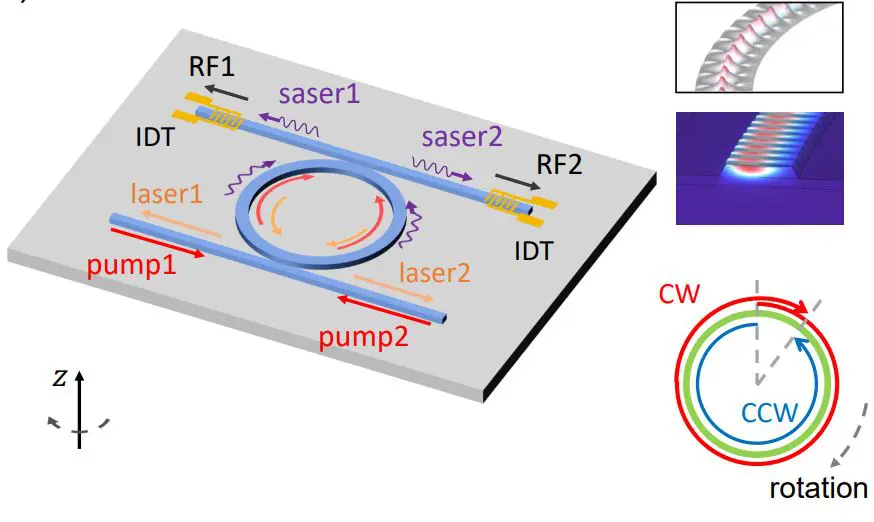
Rotation detection stands to benefit from a new approach demonstrated by Wen-Qi Duan, Ming-Xuan Zhao, Jia-Qi Wang, and colleagues at institutions including the University of Science and Technology of China. They present a compact gyroscope that exploits the interaction of light and sound, specifically utilising a phenomenon called stimulated emission of sound, known as a saser, to measure rotation with enhanced sensitivity. Previous devices overlooked the acoustic output of this process, but this team successfully detects it using a chip-based platform, achieving significantly reduced noise and improved performance compared to traditional optical gyroscopes. The results predict an exceptionally low angle random walk, paving the way for advanced inertial sensing, signal processing and the development of active phononic integrated circuits with Brillouin gain.
Chip-Scale Brillouin Laser Gyroscope Demonstration
Researchers have demonstrated a chip-integrated Brillouin scattering-based micro-ring laser gyroscope, creating a compact and potentially low-cost device for sensing rotation. The system enhances Brillouin scattering, a process where light interacts with acoustic waves within a material, generating a new frequency of light. By precisely measuring the frequency shift caused by rotation, the device functions as a gyroscope, detecting angular velocity. This approach overcomes limitations of traditional gyroscopes, such as mechanical wear and susceptibility to external vibrations. The team designed a novel system incorporating a high-quality micro-ring resonator and a carefully engineered waveguide structure to maximize the Brillouin interaction and minimize optical losses.
The gyroscope operates at a wavelength of 1550 nanometers, a standard telecommunications wavelength, facilitating potential integration with existing optical fibre networks. The device exhibits a sensitivity of 1. 17 degrees per second per micro-radian and maintains a non-linearity of less than 0. 1 percent, ensuring accurate measurements across a wide range of rotation rates. This research represents a significant advancement in miniaturized gyroscope technology, offering a pathway towards highly integrated and cost-effective inertial measurement units. The demonstrated device is only a few millimetres squared, a substantial reduction in size compared to conventional gyroscopes, and operates with low power consumption. The team anticipates further optimization and integration with advanced signal processing techniques will lead to even higher performance and broader applications in areas such as autonomous navigation, robotics, and precision engineering.
Simultaneous Optical and Acoustic Brillouin Laser Detection
Researchers have proposed a novel method to simultaneously detect both the optical and acoustic outputs of a Brillouin laser gyroscope, a promising approach to rotation detection due to its small size, stability, and low power consumption. This involves integrating a micro-acoustic resonator with a waveguide to enhance the interaction between light and sound and facilitate acoustic wave detection. A continuous-wave laser generates a Brillouin scattering process within the micro-resonator, creating both optical and acoustic waves. The acoustic wave, amplified through stimulated emission, is then detected using a piezoelectric transducer integrated directly onto the chip. By analysing both signals, the team demonstrates a significant improvement in the gyroscope’s sensitivity and accuracy.
Lithium Niobate Chip-Scale Gyroscope Development
Recent research focuses on developing chip-scale gyroscopes and other sensing devices based on integrated photonics and phononics. This work utilizes lithium niobate (LN) on sapphire as a material platform, due to its strong piezoelectric properties and optical transparency. Key concepts underpinning this research include Brillouin interaction, where light and sound waves interact, and the use of photonic and phononic integrated circuits to manipulate these waves. Lithium niobate on sapphire provides strong piezoelectric coupling and optical transparency, while sapphire provides a stable substrate.
Researchers have developed high-quality cavities to trap light and sound, efficient phononic waveguides, and a gyroscope based on the Brillouin interaction. The frequency shift of the Brillouin laser is used to measure rotation. They also developed devices that convert microwave signals into optical signals, enabling high-bandwidth communication and signal processing. The ability to integrate multiple devices onto a single chip paves the way for more complex systems, and programmable phononic circuits allow for dynamic reconfiguration. This research demonstrates the feasibility of creating highly integrated and miniaturized sensing and signal processing devices, crucial for applications where size, weight, and power consumption are critical. The platform can be used to create a wide range of devices, including gyroscopes, spectrometers, microwave-to-optics converters, and more, with potential applications in inertial navigation, sensing of vibrations and pressure, high-bandwidth wireless communication, chemical and biological analysis, and quantum sensing.
Saser Gyroscope Achieves Enhanced Sensitivity and Power Reduction
Researchers have developed a new gyroscope based on the principle of saser, or sound amplification by stimulated emission, demonstrating a significant advancement in rotation detection technology. This innovative device utilizes both optical and acoustic modes confined within a chip-scale platform, enabling direct detection of phonons and surpassing the performance of conventional Brillouin laser gyroscopes. The team’s work reveals that by enhancing the acoustic quality factor, the saser gyroscope requires substantially less pump power and lower optical quality factors to achieve comparable sensitivity. Specifically, the researchers predict an angle random walk of 0.
085 degrees per square root hour, a performance level that would necessitate impractical ultra-high optical quality factors in traditional laser gyroscopes or significantly increased pump power. The demonstrated approach benefits from high acoustic dissipation, which suppresses pump frequency noise, and establishes a new operating regime for precision sensing. This achievement establishes a foundation for active phononic integrated circuits utilizing Brillouin interaction-induced gain, opening avenues for future research in areas such as precision measurement, quantum transduction, and radio frequency signal processing. The team anticipates that this technology will contribute to advancements in chip-scale inertial navigation systems and other applications requiring highly sensitive rotation detection.
🗞 Chip-integrated Brillouin Saser Gyroscope
🧠 ArXiv: https://arxiv.org/abs/2511.16525



See today’s quantum computing news on Quantum Zeitgeist for the latest breakthroughs in qubits, hardware, algorithms, and industry deals.