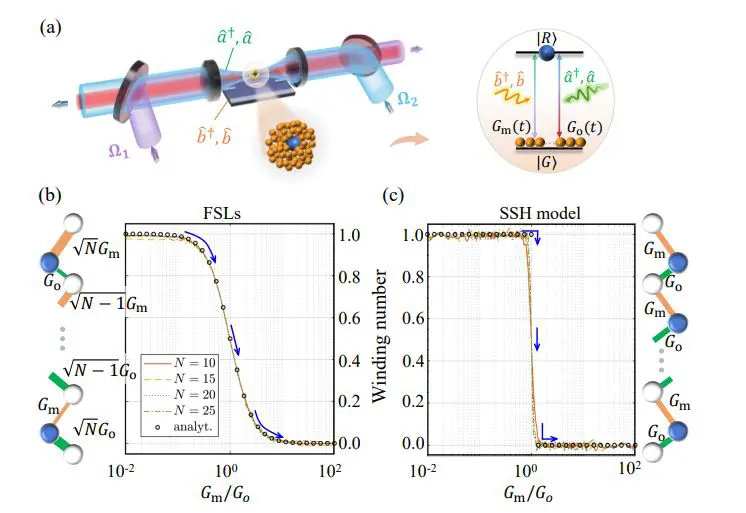
Researchers are developing new ways to convert signals between microwave and optical frequencies, a crucial step for linking different quantum technologies, and a team led by Pei-Yao Song from Zhengzhou University, along with Jin-Lei Wu and Weibin Li, now demonstrate a highly efficient method using a unique hybrid system of Rydberg atoms and cavities. The team constructs a platform for converting signals at the single-photon level, leveraging the creation of ‘Fock-state lattices’ where photon movement depends on the number of photons present. This innovative approach establishes topologically protected photon transport, meaning the signal remains stable and robust, and crucially reveals continuous variations in a key property called the winding number. This achievement establishes a robust mechanism for efficient signal conversion in specially designed systems and opens exciting possibilities for exploring fundamental physics with continuous winding numbers within atom-cavity systems.
Extensive Quantum Physics Literature Review
This comprehensive list details the extensive body of prior work informing the research, demonstrating a thorough understanding of the existing knowledge base. The references span a wide range of topics within quantum physics, suggesting an interdisciplinary approach. Key themes include quantum optics and photonics, Rydberg atoms, topological physics, cavity optomechanics, and quantum information, with publications also covering superconducting circuits and condensed matter physics. The inclusion of recent publications from high-impact journals demonstrates the research is at the forefront of the field. The sheer number of references demonstrates a comprehensive understanding of the existing literature and an interdisciplinary approach to the investigation, suggesting a cutting-edge study in quantum physics likely involving Rydberg atoms, topological effects, and potentially superconducting circuits or optomechanical systems.
Topological Photon Transport via Rydberg Atom Ensembles
Scientists engineered a novel platform for converting microwave to optical photons at the single-photon level, utilizing a unique Rydberg atom-cavity system. This work leverages a hybrid configuration, coupling a microwave resonator and an optical cavity through an ensemble of Rydberg atoms, to create Fock-state lattices where photon hopping rates depend on the number of photons at each site. The team identified a zero-energy mode inherent to this dual-mode system, which serves as the foundation for a high-efficiency single-photon transducer capable of topologically protected photon transport between microwave and optical modes. To characterize these lattices, researchers developed a dynamical, mean chiral displacement (MCD) method to determine winding numbers, overcoming limitations associated with traditional topological invariant calculations.
This MCD method dynamically tracks the chiral displacement of the system to extract topological information, allowing observation of continuous variations in the winding number, a feature absent in the discrete values of the Su-Schrieffer-Hepp (SSH) model. To achieve efficient photon conversion, scientists implemented time-dependent modulation of the coupling fields, carefully selecting parameters to avoid gap shrinking and facilitate faster topological pumping. Numerical simulations demonstrated that a pumping duration of 8. 2 microseconds is sufficient for 5 photons, effectively shifting the photon distribution center and realizing the desired photon operation in the quantum transducer. This approach offers a scalable and robust pathway for exploring topological physics and developing advanced quantum technologies.
Rydberg Atoms Enable Efficient Photon Transduction
Scientists engineered a novel platform for efficient microwave-to-optical photon conversion at the single-photon level, utilizing a unique Rydberg atom-cavity system. This work establishes a topological transport mechanism, leveraging a hybrid configuration where a microwave resonator couples to an optical cavity via an ensemble of Rydberg atoms. The team successfully created Fock-state lattices, where the rate at which photons hop between sites is dependent on the number of photons present, and identified a zero-energy mode crucial for high-efficiency transduction. Experiments demonstrate the robustness of this system, even when disorder is introduced, with winding number measurements closely matching theoretical predictions.
The researchers measured transducer fidelities exceeding 91% for various input states, including Fock, coherent, and squeezed vacuum states. Furthermore, the study reveals a continuous evolution of the winding number, differing from conventional topological pumping methods. This continuous evolution results in a progressive displacement of the photon distribution center, demonstrating the potential for robust quantum interfaces connecting superconducting microwave processors with optical communication channels and establishing a topologically protected quantum interface with promising applications in hybrid quantum networks.
Topological Pumping Enables Quantum Photon Transduction
This research demonstrates a novel platform for efficient conversion between microwave and optical photons at the single-photon level, utilizing a unique configuration involving Rydberg atoms and cavities. The team engineered synthetic Fock-state lattices, where the rate at which photons move depends on the number of photons present, and identified a zero-energy mode that facilitates high-efficiency transduction, effectively linking microwave and optical domains and establishing a robust quantum interface. Crucially, the system exhibits a continuous evolution of the winding number during topological pumping, differing from conventional discrete phase transitions and allowing for progressive displacement of the photon distribution center. The researchers demonstrate high-fidelity transduction exceeding 91% for various input states, including Fock, coherent, and squeezed vacuum states, and confirm the platform’s robustness against parameter fluctuations.
This work establishes a topologically protected quantum interface connecting superconducting microwave processors with optical communication channels, offering a promising foundation for exploring exotic topological phenomena and building robust hybrid quantum networks. The authors acknowledge that the demonstrated robustness is limited to coupling-strength fluctuations up to 10%, and further investigation is needed to assess performance under more substantial disorder. They suggest that integrating this platform with other topological devices represents a promising avenue for future research and the development of advanced quantum technologies.
🗞 Topological Quantum Transducers in a Hybrid Rydberg Atom System
🧠 ArXiv: https://arxiv.org/abs/2511.15439