The escalating complexity of modern wireless networks necessitates innovative approaches to resource management, and a team led by Tung Giang Le from Pusan National University, Xuan Tung Nguyen from PHENIKAA University, and Won-Joo Hwang from Pusan National University now demonstrates a significant advance in this field. Researchers developed a fully quantum Graph Neural Network, leveraging the power of Parameterized Quantum Circuits to perform graph learning with enhanced efficiency. This novel network implements message passing using quantum principles, achieving comparable performance to classical methods while dramatically reducing the number of necessary parameters and harnessing the inherent parallelism of quantum computation. The team’s end-to-end quantum approach, applied to device-to-device power control for maximizing signal quality, represents a crucial step towards realising quantum-accelerated optimisation for future wireless systems.
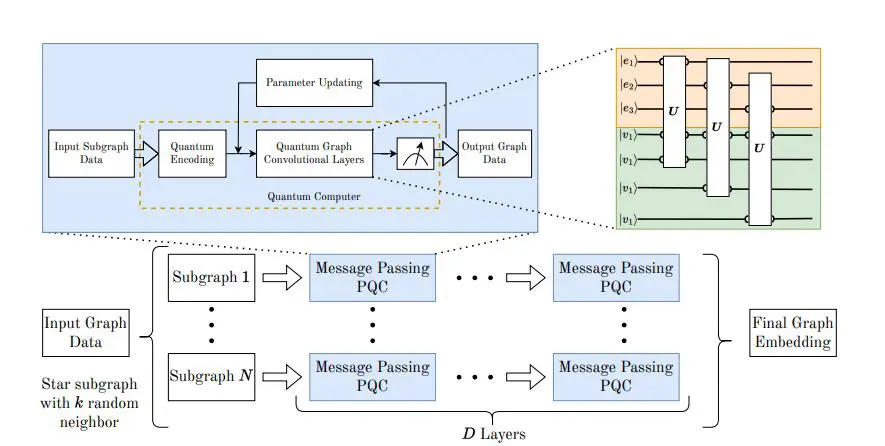
Complexity demands scalable resource management. Classical Graph Neural Networks excel at graph learning, but incur high computational costs in large-scale settings. The Quantum Graph Convolutional Layers encode features into quantum states, process graphs with unitaries compatible with current quantum hardware, and retrieve embeddings through measurement. When applied to device-to-device power control for maximizing signal-to-interference-plus-noise ratio, the quantum network matches classical performance with fewer parameters and inherent parallelism. To manage the limitations of current quantum hardware, the team engineered a stochastic graph decomposition technique, dividing the network into overlapping star subgraphs. This decomposition leverages random neighbor sampling, ensuring each node acts as a central hub once while also potentially serving as a leaf node in other subgraphs, thereby preserving local network structure for quantum processing.
The core of the methodology involves a quantum-compatible message passing mechanism implemented through PQCs. For each star subgraph, a shared unitary operator processes the central node, a leaf node, and the connecting edge, effectively aggregating incoming messages via quantum operations. This process allows for efficient information exchange within the subgraph, leveraging the principles of superposition and entanglement. The team designed the quantum graph convolutional layer (QGCL) to perform this operation, processing each star subgraph independently before combining the results. After applying multiple layers of QGCLs, the resulting node embeddings are used for downstream tasks, such as power allocation optimization.
Experiments focused on optimizing power control for device-to-device
Experiments focused on optimizing power control for device-to-device (D2D) communication, aiming to maximize the signal-to-interference-plus-noise ratio (SINR). The performance of the QGNN was evaluated against classical methods, including Graph Convolutional Networks (GCNs) and the widely used Water-filling with MMSE (WMMSE) algorithm. Experiments conducted on a D2D power allocation task demonstrate the QGNN’s superior performance compared to both a classical Graph Convolutional Network (GCN) benchmark and the widely used WMMSE power allocation method. Results show the QGNN rapidly surpasses the WMMSE baseline, continuing to improve and ultimately achieving a sum-rate gain of approximately 6% over the GCN. Notably, the QGNN’s training and testing curves closely align, indicating both faster convergence and improved generalization capabilities. This proof-of-concept demonstrates the potential of quantum-native graph learning for wireless resource management, paving the way for more efficient and scalable wireless networks.
This research presents a fully quantum Graph Neural Network (QGNN) designed for wireless resource management, specifically device-to-device (D2D) power allocation. The team successfully implemented message passing using parameterized quantum circuits within the QGNN, achieving performance comparable to classical methods while utilizing fewer parameters. In tests maximizing signal-to-interference-plus-noise ratio, the QGNN surpassed a widely used classical benchmark and demonstrated faster convergence, ultimately achieving a six percent gain in sum rate. The demonstrated QGNN represents a step towards quantum-accelerated optimization for wireless networks, showcasing the potential of native quantum graph learning.
👉 More information🗞D2D Power Allocation via Quantum Graph
🗞 D2D Power Allocation via Quantum Graph Neural Network
🧠 ArXiv: https://arxiv.org/abs/2511.15246



See today’s quantum computing news on Quantum Zeitgeist for the latest breakthroughs in qubits, hardware, algorithms, and industry deals.