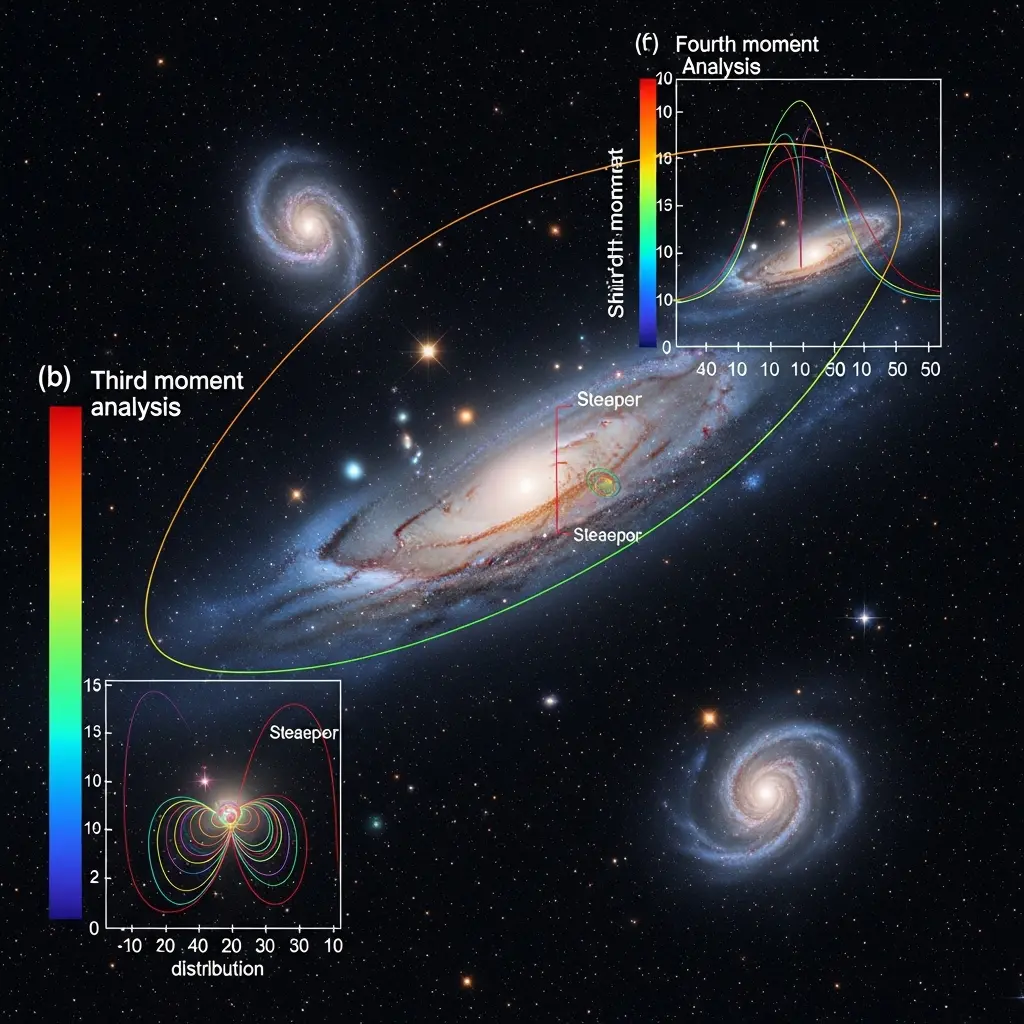
Modified Newtonian Dynamics, proposed as an alternative to dark matter, receives further theoretical support from new work exploring the fundamental structure of spacetime. M. E. Pietrzyk, V. A. Kholodnyi, I. V. Kanattšikov, and J. Kozicki investigate how the chaotic nature of quantum gravity affects gravitational forces, building on previous models that link modified gravity to the behaviour of particles within a ‘spin connection foam’. Their calculations reveal that considering higher-order effects within this framework generates more complex and potentially more accurate modifications to Newtonian gravity, leading to steeper transitions in the MOND behaviour and, crucially, a prediction of nearly-flat rotation curves for galaxies, mirroring observations without invoking unseen dark matter. This research expands the theoretical basis for MOND, offering a compelling pathway to explain galactic dynamics through fundamental modifications to our understanding of gravity itself.
Analyzing Higher Moments of Quantum Spin Connection
In the non-relativistic static limit of the spin connection foam, which represents the quantum analogue of Minkowski spacetime within precanonical quantum gravity, researchers now demonstrate the consequences of employing higher moments, specifically third and fourth, of the corresponding geodesic equation with a random spin connection term. These higher moments yield more general quantum modifications of the Newtonian potential, expressed as qMOND potentials in terms of Gauss and Appell hypergeometric functions. Furthermore, the approach generates more general, and steeper, MOND interpolating functions, and introduces a new modification of MOND at low accelerations, termed mMOND. This mMOND exhibits an almost-flat asymptotic rotation curve proportional to r−1/18, a characteristic expected to operate at extremely low acceleration scales.
Spin Connection Modifies Gravity at Galactic Scales
Quantum Effects Explaining Galactic Dynamics without Dark Matter
Applying Quantum Effects to Newtonian Dynamics
This work investigates modifications to Newtonian dynamics, exploring whether quantum effects related to the spin connection can explain phenomena currently attributed to Dark Matter. The authors propose a framework where the spin connection, a fundamental concept in general relativity describing how the orientation of a particle changes as it moves, plays a role in modifying gravitational forces at galactic scales. They aim to provide an alternative to Dark Matter by explaining observed galactic rotation curves and other anomalies through modifications to gravity itself. The research utilizes precanonical quantization, a technique treating space and time equally, to avoid difficulties encountered in standard quantization methods.
Quantum Corrections Explain Galaxy Rotation Dynamics
The core idea is that quantum fluctuations of the spin connection introduce corrections to the Newtonian gravitational potential, becoming significant at large distances, like those found within galaxies. This leads to the observed flat rotation curves of galaxies, without requiring the presence of unseen matter. The work relies on advanced mathematical tools, including differential geometry, quantum field theory, and specialized functions like hypergeometric series, to model these effects. The team employs a polysymplectic geometric framework and the De Donder-Weyl Hamiltonian formalism to derive the equations governing the spin connection’s behaviour.
The authors claim their model can explain the observed flat rotation curves of galaxies without invoking Dark Matter, and is consistent with the Baryonic Tully-Fisher relation, which connects a galaxy’s luminosity to its rotation speed. The research offers a new perspective on galactic dynamics, potentially resolving the long-standing mystery of Dark Matter.
Quantum Spacetime Fluctuations and Particle Motion
Novel Quantization Approaches for Spacetime Geometry
Novel Approaches Using Precanonical Quantization of Spacetime
This research presents a novel approach to modifying Newtonian dynamics by exploring the quantum geometry of spacetime, specifically focusing on fluctuations within the spin connection, a fundamental aspect of general relativity. Researchers utilized precanonical quantization, a method treating space and time variables equally, to derive a Schrödinger equation governing the behaviour of spacetime itself. Solutions to this equation describe the quantum state of Minkowski spacetime, the flat spacetime of special relativity, and its non-relativistic static limit. The team then investigated how test particles move within this fluctuating spacetime, considering not just the average gravitational force, but also higher-order moments, third and fourth, of the geodesic equation, which describes particle trajectories.
These higher moments account for the random nature of the spin connection due to quantum fluctuations. Calculations reveal that considering these moments leads to modified Newtonian potentials expressed using complex mathematical functions, Gauss and Appell hypergeometric functions, and generates steeper MOND interpolating functions. Crucially, the results demonstrate the emergence of a new modification of MOND, termed mMOND, at low accelerations, exhibiting an almost-flat asymptotic rotation curve. This mMOND operates at galactic scales, similar to the original MOND theory, and is a key outcome of considering the quantum fluctuations of the spin connection. Scientists have now demonstrated that considering higher-order moments of the geodesic equation, beyond simply the variance of acceleration, yields significant modifications to Newtonian dynamics. Specifically, calculations involving the third and fourth moments of the equation produce more general forms of the MOND potential, expressed using complex mathematical functions, and lead to steeper MOND interpolating functions. Future research will focus on exploring the implications of these findings for cosmology and the large-scale structure of the universe, as well as investigating the potential for observational tests to distinguish between this quantum-based MOND modification and other dark matter models. This work offers a promising new avenue for understanding the nature of gravity and the structure of the cosmos.
🗞 Modifications of Newtonian dynamics from higher moments of quantum spin connection in precanonical quantum gravity
🧠 ArXiv: https://arxiv.org/abs/2511.15025