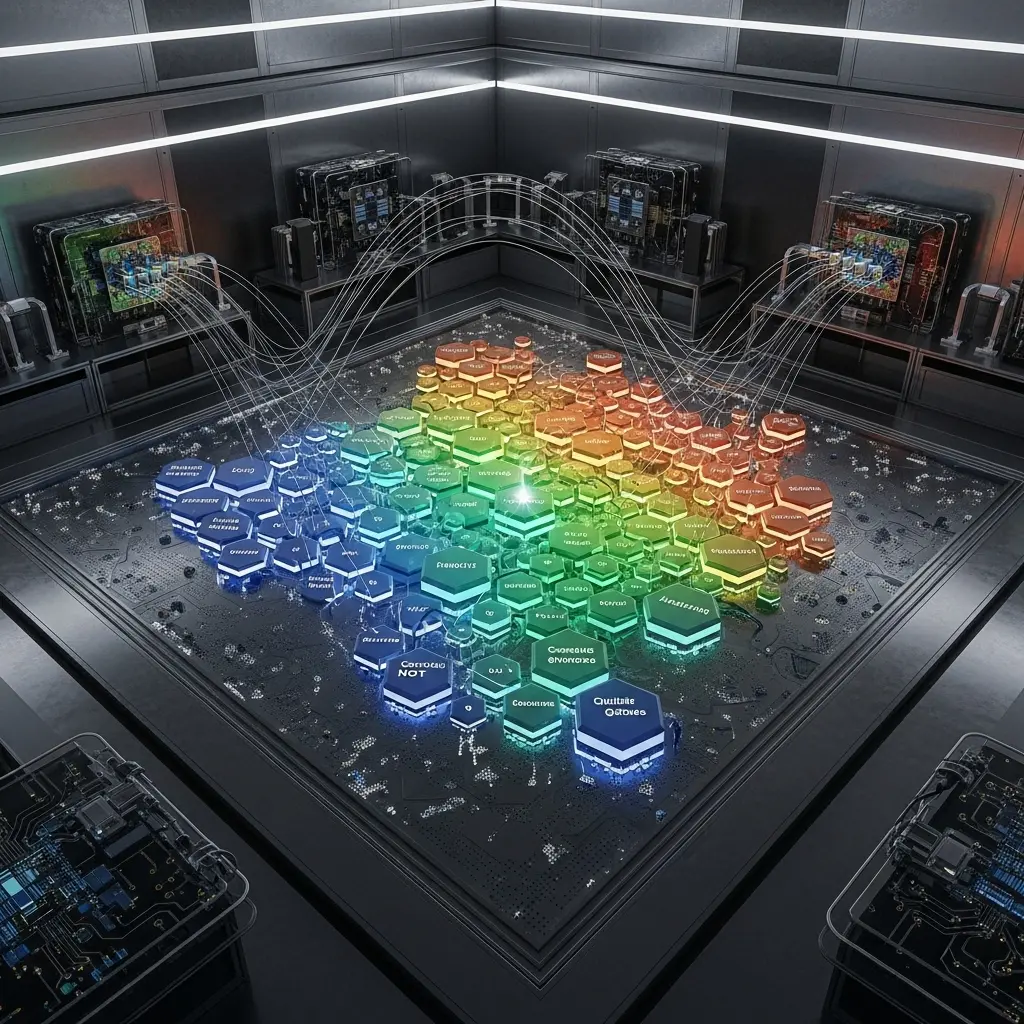
Tile codes represent a potentially more efficient approach to quantum error correction than established surface codes, yet their underlying mathematical structure remains largely unexplored. Nikolas P. Breuckmann of Breuqmann Ltd, alongside Shin Ho Choe and Jens Niklas Eberhardt from IQM Quantum Computers and the Johannes Gutenberg-Universität respectively, and their colleagues, now establish a comprehensive description of the logical operators that govern these codes. Their work demonstrates that tile codes possess a natural and efficient structure, allowing logical operations to be generated through simple, localised updates, and reveals a deep connection to advanced mathematical frameworks like Koszul complexes. Crucially, the team introduces the concept of ‘derived automorphisms’, novel operations for manipulating encoded quantum information that, unlike similar processes in surface codes, actively perform logical gates, paving the way for more powerful and versatile fault-tolerant quantum computation using tile codes.
The studies explore various quantum codes, including surface codes, LDPC codes, bicycle codes, toric codes, and hypergraph product codes, alongside investigations into different quantum computing architectures encompassing superconducting qubits, neutral atoms, and qubit-resonator systems, all aiming to create stable and scalable quantum systems. Scientists are actively developing techniques for fault-tolerant quantum computation, seeking methods to reliably perform calculations even in the presence of errors. Researchers are increasingly combining different quantum error correction techniques and architectures to achieve improved performance. Advanced mathematical tools, such as algebraic geometry and group theory, are playing a growing role in the design and analysis of these codes. This research pioneers the use of homological algebra and algebraic geometry to analyze the boundaries of these quantum low-density parity-check (qLDPC) codes, providing new structural insights and laying the groundwork for their use in fault-tolerant quantum computation. The research frames stabilizer CSS codes within a homological algebra context, treating them as chain complexes of vector spaces, allowing analysis of logical operators through the lens of cohomology groups. To investigate tile codes, scientists consider an infinite two-dimensional lattice where qubits reside on each edge and stabilizer tiles define the code’s structure. These tiles, arranged in a translationally invariant fashion, ensure the stability of quantum information. A key innovation is the introduction of “derived automorphisms,” operations that can manipulate encoded quantum information even in codes lacking traditional symmetries, implemented by extending and shrinking the lattice, inducing a product of logical gates.
Tile Code Logical Operators and Boundaries
Recent work has established tile codes as a promising alternative to surface codes for quantum error correction, offering increased encoding efficiency. This research delivers a precise description of the logical operator space within tile codes, demonstrating that, under certain conditions, these codes admit a natural basis of logical operators localized along lattice boundaries, efficiently generated by a cellular automaton. The team developed an algebraic and algebro-geometric framework for understanding tile codes, resolving them through translationally invariant Pauli stabilizer models. This approach reveals that the logical dimension of a tile code corresponds to the number of intersection points defining the stabilizer tiles. Furthermore, scientists introduced the concept of derived automorphisms for quantum codes, operations that can exist even without traditional symmetries, implemented by extending and shrinking the lattice structure, inducing a product of gates on the logical qubits.
Tile Code Structure and Automorphism Discovery
This work establishes a rigorous mathematical framework for understanding tile codes, a promising alternative to surface codes for fault-tolerant quantum computation. Researchers have successfully described the logical operator space of tile codes, demonstrating that a natural and efficient basis for these operators exists along lattice boundaries, generated by a simple cellular automaton. The team developed both algebraic and algebro-geometric tools to resolve tile codes, linking them to translational Pauli stabilizer models and a specific mathematical complex. A key achievement is the introduction of “derived automorphisms”, a novel concept extending beyond traditional symmetries in quantum codes. These operations, implemented by extending and shrinking the lattice structure of tile codes, induce logical gates on the encoded information, offering a potentially low-overhead method for quantum computation. The researchers demonstrated that these derived automorphisms preserve the symplecticity of the logical basis, maintaining the code’s mathematical structure during operation.
🗞 Logical Operators and Derived Automorphisms of Tile Codes
🧠 ArXiv: https://arxiv.org/abs/2511.14589

See today’s quantum computing news on Quantum Zeitgeist for the latest breakthroughs in qubits, hardware, algorithms, and industry deals.