
Preparing the fundamental building blocks of quantum systems, particularly their ground states, presents a significant hurdle in advancing quantum technologies, and researchers continually seek faster, more reliable methods to achieve this. Prashasti Tiwari from University College London, Dylan Lewis from Imperial College London, and Sougato Bose, also at University College London, alongside their colleagues, now demonstrate a novel approach to rapidly synthesise these complex many-body states. Their work circumvents the traditionally slow and error-prone methods of adiabatic state preparation by employing a carefully optimised “solver” Hamiltonian to evolve an initial state for a fixed, short duration. This technique promises to dramatically reduce the time and potential for decoherence when creating entangled quantum states, paving the way for more efficient quantum sensing, simulations, and the exploration of complex quantum dynamics.
Variational Quantum Algorithms and Ground State Preparation
Scientists are actively developing methods for preparing the ground states of quantum systems, the lowest energy configurations crucial for understanding material properties and simulating complex phenomena. A central focus is on variational quantum algorithms, which approximate ground states using parameterized quantum circuits, and overcoming challenges like barren plateaus, regions where optimization becomes extremely difficult. Integrating machine learning techniques further enhances these algorithms, improving their efficiency and scalability through pre-training and tailored ansatz design. Ground state preparation involves finding the lowest energy state of a quantum system using a quantum circuit with adjustable parameters, optimized to minimize the system’s energy.
Balancing the circuit’s expressibility with its trainability is a constant trade-off, and the inherent noise in quantum computers can degrade performance. Researchers are employing “warm starts,” initializing parameters with prior knowledge, and leveraging classical techniques like tensor networks to pre-train algorithms or inform ansatz design. Despite progress, scaling these techniques to larger systems remains difficult due to the exponential growth of the computational space. To address this, scientists are employing techniques like matrix product state pre-training and transfer learning with smooth solutions to accelerate optimization. Ultimately, the field requires combining variational quantum algorithms with other techniques to improve performance and trainability, paving the way for more robust and scalable algorithms.
Fixed-Time Evolution of Entangled Ground States
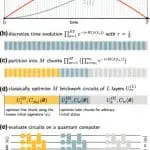
Scientists have developed a new method for preparing many-body entangled ground states, bypassing the limitations of traditional approaches. This technique utilizes a short, fixed-time evolution governed by a specifically designed “solver” Hamiltonian, transforming an initial “fiducial” state into the desired ground state of a target system. This approach avoids the slow switching of Hamiltonian terms that can introduce errors and offers a faster route to state preparation. The core of this method involves classically optimizing the parameters of the solver Hamiltonian using energy minimization. Experiments focused on preparing up to ten qubit states, demonstrating the scalability of the technique. By focusing on a fixed-time evolution, scientists mitigated the accumulation of errors that can arise during prolonged quantum operations, offering a valuable tool for exploring complex quantum phenomena.
Fast Ground State Preparation with Optimized Hamiltonians
Scientists have achieved a breakthrough in preparing many-body entangled ground states, essential resources for sensing, studying dynamics, and simulating complex physical processes. The research demonstrates a novel method using short, fixed-time evolution governed by a “solver” Hamiltonian, optimized classically to act upon an initial “fiducial” state. This approach bypasses the time-consuming adiabatic switching traditionally required for ground state preparation, mitigating errors and offering a faster route to quantum state control. Experiments involved preparing states of up to ten qubits using this methodology, employing anisotropic Heisenberg models as the solver Hamiltonian.
The team successfully optimized the parameters of this Hamiltonian using energy minimization, resulting in high-fidelity preparation of ground states for both Heisenberg spin graphs and chains. Measurements confirm that this method delivers high fidelity preparation with reduced optimization times, demonstrating its potential for practical implementation. The research utilizes a versatile approach, exploring both chain and complex graph topologies to represent a broad range of quantum systems. Incorporating “warm start” strategies, leveraging solutions from smaller systems, significantly reduces iteration counts and prevents the disappearance of gradients during optimization, effectively addressing the “barren plateau” problem.
Rapid Ground State Preparation of Spin Systems
This research demonstrates a rapid method for preparing the ground state of complex many-body quantum spin systems, circumventing the limitations of traditional adiabatic or relaxation-based approaches. Scientists achieved this by evolving an initial, readily prepared state using a specifically designed “solver” Hamiltonian, rather than directly manipulating the target system’s Hamiltonian. The solver Hamiltonian acts for a fixed, short duration, offering a significant speed advantage. The team successfully identified optimal solver Hamiltonians through classical optimization, minimizing the system’s energy to achieve high-fidelity ground state preparation for systems of up to ten qubits. They found that combining a “warm start” approach with incremental adjustments to the solver Hamiltonian yielded the most effective results, allowing for the efficient creation of ground states for further investigations in quantum simulation. The computational cost of finding the optimal solver Hamiltonian currently limits the method to around ten to fourteen qubits.
🗞 Fast Quantum Many Body State Synthesis
🧠 ArXiv: https://arxiv.org/abs/2511.12923



See today’s quantum computing news on Quantum Zeitgeist for the latest breakthroughs in qubits, hardware, algorithms, and industry deals.