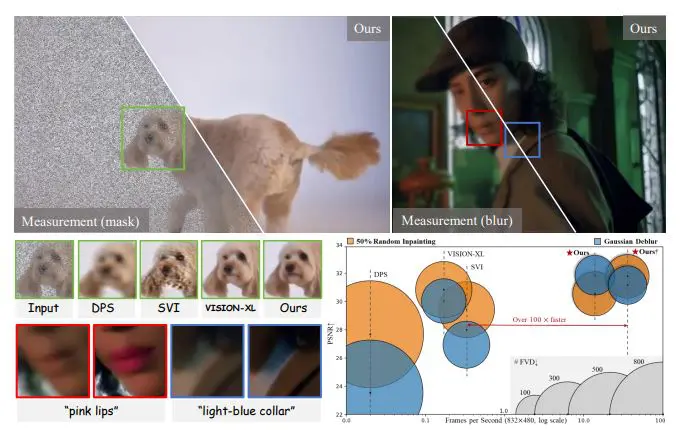
Reconstructing high-quality video in real time presents a significant challenge for applications ranging from video conferencing to augmented reality, demanding both visual fidelity and minimal delay. Weimin Bai, Suzhe Xu, and Yiwei Ren, alongside colleagues from Peking University, address this problem with InstantViR, a new framework for ultra-fast video restoration. The team overcomes the limitations of existing diffusion-based methods, which often suffer from temporal inconsistencies or slow processing speeds, by distilling a powerful video diffusion model into a streamlined, single-pass system. This innovative approach enables InstantViR to achieve reconstruction quality comparable to, or exceeding, current state-of-the-art techniques while operating at over 35 frames per second, representing a substantial leap towards practical, real-time video enhancement and opening new possibilities for interactive and streaming vision applications.
Diffusion Models Restore Degraded Video Sequences
Researchers are tackling the problem of restoring degraded videos, aiming to reconstruct clean, high-quality footage from blurry, incomplete, or noisy sources. They achieve this by leveraging diffusion models, a type of generative model that learns to reverse the process of adding noise to data. By learning to remove noise, these models can generate realistic video content. The key innovation lies in adapting these models to solve video restoration problems, rather than simply creating new content. The work focuses on making diffusion models fast and efficient for video processing, targeting real-time or near-real-time performance.
This is achieved through several techniques, including distillation, careful selection of network architecture, and optimization strategies. Scientists explore various network architectures, including transformers and U-Nets, to optimize performance. Optimization strategies, such as fast sampling and one-step diffusion, further reduce processing time. The research team demonstrates state-of-the-art performance on various video restoration benchmarks, achieving real-time or near-real-time performance. The proposed methods demonstrate improved visual quality, as measured by objective metrics and confirmed by subjective evaluations.
Some methods exhibit zero-shot capabilities, generalizing to new video datasets without retraining. This work makes significant contributions to video restoration by developing fast and efficient diffusion-based methods, opening up new possibilities for practical applications like video conferencing, live streaming, and video editing. The release of open-source models and code promotes further research and development in this area.
Fast Video Reconstruction via Diffusion Distillation
Scientists have developed InstantViR, a new framework for ultra-fast video reconstruction that leverages the power of video diffusion models without the typical computational cost. Recognizing that existing diffusion-based approaches struggle to balance high perceptual quality with real-time performance, researchers engineered a system that distills a powerful bidirectional video diffusion model into a causal autoregressive network. This student network directly maps a degraded video to its restored version in a single forward pass, inheriting the teacher’s strong temporal modeling capabilities while eliminating slow, iterative optimization processes. The distillation process is unique in that it requires only the teacher diffusion model and the known degradation operators, removing the need for paired clean and noisy video data.
To further accelerate processing, the team replaced the standard video diffusion backbone with LeanVAE, an ultra-efficient spatiotemporal tokenizer. This replacement was achieved through an innovative teacher-space regularized distillation scheme, ensuring consistency with the teacher prior while enabling low-latency processing in latent space. The system employs a streaming causal inverse architecture, utilizing block-wise attention and KV caching to further reduce latency and maintain high-fidelity reconstruction. Experiments demonstrate that InstantViR achieves over 35 frames per second on A100 GPUs, delivering up to 100times speedup compared to iterative video diffusion solvers. The method successfully addresses streaming random inpainting, Gaussian deblurring, and super-resolution tasks, matching or surpassing the reconstruction quality of existing diffusion-based baselines. This breakthrough enables practical applications of high-quality video restoration in real-time, interactive, and editable streaming scenarios, effectively bridging the gap between diffusion-level quality and real-time performance.
Realtime Video Reconstruction Via Knowledge Distillation
Scientists have developed InstantViR, a new framework for reconstructing high-quality video from degraded or incomplete data, achieving a significant breakthrough in real-time video processing. The work addresses a fundamental challenge in video restoration, balancing reconstruction quality with processing speed, and delivers diffusion-level results with up to 100times speedup compared to existing iterative methods. Experiments demonstrate that InstantViR achieves over 35 frames per second on NVIDIA A100 GPUs, enabling practical applications in streaming, telepresence, and augmented/virtual reality. The team achieved this speedup through a novel distillation process, transferring the knowledge from a powerful, yet slow, bidirectional video diffusion model (the teacher) to a fast, causal autoregressive student network.
This student network learns to directly map degraded video to a restored version in a single forward pass, eliminating the need for slow, iterative optimization. Importantly, the training process requires no paired clean/noisy video data, relying instead on the teacher diffusion model and the known degradation process. Measurements confirm that this approach maintains high fidelity and temporal coherence, avoiding the flickering often seen in frame-by-frame processing. To further enhance performance, scientists replaced the standard video diffusion backbone with LeanVAE, an ultra-efficient spatiotemporal tokenizer.
This innovative design, guided by a teacher-space regularization scheme, minimizes computational bottlenecks while preserving the quality of the restored video. The results show that InstantViR seamlessly adapts to various video restoration tasks, including streaming random inpainting, Gaussian deblurring, and super-resolution, demonstrating its versatility and potential for widespread application. The framework also supports language-guided restoration and editing, allowing for precise control over the reconstruction process.
Realtime Video Reconstruction via Diffusion Distillation
InstantViR represents a significant advance in video reconstruction, addressing the longstanding challenge of balancing reconstruction quality with processing speed. Researchers have developed a novel framework that distills a powerful video diffusion model into a lightweight, single-step process, enabling real-time performance without sacrificing temporal consistency. This achievement bypasses the need for paired training data and replaces computationally expensive components with more efficient alternatives, resulting in substantial speed gains, exceeding 35 frames per second on standard hardware. The team demonstrates that InstantViR matches or surpasses the reconstruction quality of existing diffusion-based methods while achieving up to 100times faster processing.
This breakthrough unlocks the potential for practical applications of high-quality video restoration in interactive and streaming scenarios, such as live broadcast enhancement and on-the-fly video editing. While the accelerated model currently exhibits a slight reduction in quality compared to a version utilizing the original VAE, the researchers acknowledge this limitation and suggest that further alignment of the lightweight VAE’s latent space could close the gap. Future work may also explore scaling the framework to larger video datasets and applying it to other real-time domains.
🗞 InstantViR: Real-Time Video Inverse Problem Solver with Distilled Diffusion Prior
🧠 ArXiv: https://arxiv.org/abs/2511.14208