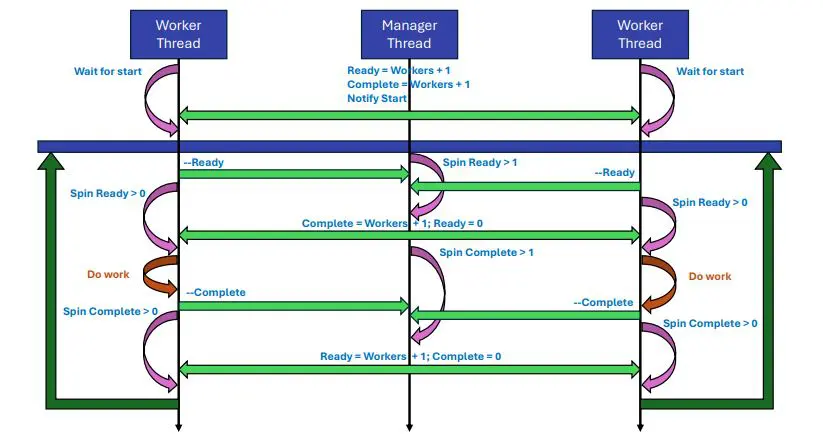
Controlling the superheated plasma within fusion reactors demands incredibly fast and precise calculations, and a team led by A. Rothstein, K. Erickson, and R. Conlin are making significant strides in this area. They developed a new multi-threading library and applied it to critical physics codes, namely TORBEAM and STRIDE, used on the DIII-D fusion experiment. These codes model the behaviour of energetic particles and assess the stability of the plasma, information vital for the safe and efficient operation of future fusion power plants. The resulting real-time performance, with calculations completed in under 200 milliseconds, represents a substantial improvement and paves the way for more sophisticated control systems in the next generation of fusion devices, while the library itself offers a versatile tool for accelerating other real-time physics simulations.
Rothstein, K. Erickson, R. Conlin, A. Bortolon, and E.
STRIDE physics codes are crucial for future fusion power plant operation, providing information about electron cyclotron wave propagation and heating, and also informing about ideal plasma stability limits. The real-time TORBEAM code now executes consistently in under 20ms, while the real-time STRIDE code computes in 100ms. The multi-threading library developed in this work can be applied to other real-time physics-based codes that will be crucial for the next generation of fusion devices. Tokamaks are currently the most promising path to fusion energy.
Real-time MHD Control Validated in Experiments
This work demonstrates the successful deployment of real-time physics codes, TORBEAM and STRIDE, on the DIII-D plasma control system, facilitated by the newly implemented multi-threading library. These codes, crucial for controlling electron cyclotron heating and assessing plasma stability, now operate within relevant timescales for plasma control, completing calculations in under 20 milliseconds and 100 milliseconds respectively. Prior to this development, such timely computation was not achievable, highlighting the significance of the multi-threading library in enabling advanced plasma control strategies. The research team identified data pre-processing as a key area for further optimisation, noting that a substantial portion of the computation time is currently spent converting data formats.
While the current implementation represents a substantial advance, the authors suggest that parallelizing this pre-processing step, alongside utilising faster hardware, could yield additional performance gains. Furthermore, this multi-threading library is broadly applicable to other real-time physics-based codes intended for future fusion devices, potentially accelerating developments in areas such as vertical stability calculations and physics-based profile prediction. The team emphasises the value of robust, physics-based models, noting their reliable performance from initial operation, a key advantage over machine learning approaches that may require extensive validation.
Real-Time Plasma Control With Multithreading
This work demonstrates the successful deployment of real-time physics codes, TORBEAM and STRIDE, on the DIII-D plasma control system, facilitated by the newly implemented multi-threading library. These codes, crucial for controlling electron cyclotron heating and assessing plasma stability, now operate within relevant timescales for plasma control, completing calculations in under 20 milliseconds and 100 milliseconds respectively. Prior to this development, such timely computation was not achievable, highlighting the significance of the multi-threading library in enabling advanced plasma control strategies. The research team identified data pre-processing as a key area for further optimisation, noting that a substantial portion of the computation time is currently spent converting data formats.
While the current implementation represents a substantial advance, the authors suggest that parallelizing this pre-processing step, alongside utilising faster hardware, could yield additional performance gains. Furthermore, this multi-threading library is broadly applicable to other real-time physics-based codes intended for future fusion devices, potentially accelerating developments in areas such as vertical stability calculations and physics-based profile prediction. The team emphasises the value of robust, physics-based models, noting their reliable performance from initial operation, a key advantage over machine learning approaches that may require extensive validation.
🗞 Parallelized Real-time Physics Codes for Plasma Control on DIII-D
🧠 ArXiv: https://arxiv.org/abs/2511.11964
See today’s quantum computing news on Quantum Zeitgeist for the latest breakthroughs in qubits, hardware, algorithms, and industry deals.