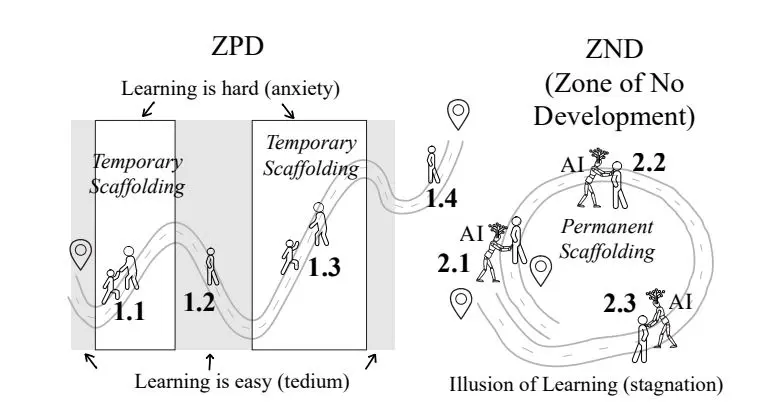
The increasing prevalence of artificial intelligence in education presents a challenge to established learning theories, potentially creating situations where continuous assistance hinders genuine intellectual growth. Euzeli C. dos Santos Jr. and Tracey Birdwell, from Purdue University, investigate this emerging problem by revisiting Vygotsky’s Zone of Proximal Development, but through the framework of Peer-to-Peer Teaching. Their work introduces the concept of the Zone of No Development, a state where constant digital support prevents the necessary cognitive struggle for independent learning and ultimately impedes intellectual autonomy. By proposing deliberate disconnection and ethical fading as key principles, this research demonstrates how AI tools can instead foster agency and ensure that technology enhances, rather than replaces, the essential effort required for durable learning and self-regulation.
Through careful theoretical analysis and framework design, this research demonstrates how deliberate disconnection and ethical awareness can restore a learner’s agency, ensuring that technological tools enhance, rather than replace, developmental effort. Researchers conceptualize the Zone of No Development as a state where continuous assistance replaces cognitive struggle, ultimately hindering intellectual autonomy. To operationalize P2P Teaching, scientists designed a cyclical process embedding phases of connection, disconnection, and reflection.
A core component of this framework involves deliberately withdrawing AI assistance at precise moments, restoring productive struggle as a natural stage of intellectual growth. This “fading” mechanism is particularly emphasized during a “Creation” phase, where learners are required to reconstruct knowledge from first principles without digital mediation. The study advocates for assessment practices that reinforce this principle, employing examinations with no open books, no internet access, and no AI assistance to evaluate internalized knowledge and independent reasoning. Researchers further emphasize the importance of establishing an explicit ethical contract between instructor and learner, articulating the expectation that students will disengage from AI during specific learning phases, cultivating intellectual honesty and self-regulation.
The work distinguishes between mere “learning” and the
The work distinguishes between mere “learning” and the construction of durable knowledge, and between this and “intellectual autonomy”, the ability to reason and problem-solve independently. Scientists argue that continuous AI assistance can blur this distinction, enabling task completion without fostering the independence required to extend, adapt, or creatively apply knowledge. Researchers demonstrate that while AI can initially appear to expand a learner’s Zone of Proximal Development by reducing frustration, this expansion can be deceptive. The study reveals that persistent AI support may diminish a learner’s capacity for self-regulated reasoning over time, effectively collapsing the Zone of Proximal Development. The team proposes the Prompt-to-Primal (P2P) Teaching framework as a solution, an AI-integrated pedagogical approach designed to transform AI interaction into a catalyst for deep learning.
This framework defines structured phases, beginning with student-generated prompts and culminating in instructor-guided reasoning grounded in first principles. A critical component of P2P Teaching is Phase 4b, which explicitly restricts the use of large language models and requires students to revert to traditional learning methods, such as pencil and paper. The team highlights the emergence of an “illusion of learning” when AI provides instantaneous feedback, potentially leading students to misinterpret ease of access as genuine mastery. By contrasting temporary support with permanent digital mediation, the study highlights how unchecked assistance can create an illusion of learning, preventing students from building the independent reasoning skills needed to extend and adapt their knowledge. To address this potential pitfall, the team proposes the Prompt-to-Primal (P2P) Teaching framework, designed to restore learner agency through deliberate phases of connection, disconnection, and reflection.
This framework emphasizes the importance of ‘fading’ assistance,
This framework emphasizes the importance of ‘fading’ assistance, particularly during creative tasks, to ensure students regain control and cultivate cognitive endurance. The authors acknowledge that while AI offers valuable opportunities to extend access to guidance, its responsible integration requires a clear understanding of when to step back and allow productive struggle to occur. The research team emphasizes that authentic education necessitates effort, delay, and challenge, conditions that technology should amplify, not eliminate. While the P2P framework offers a promising pathway to mitigate the risks of over-assistance, further research is needed to explore its practical implementation across diverse educational contexts and subject areas. The findings underscore the critical need to preserve the integrity of the learning process and prevent the descent into a state where continuous support hinders, rather than fosters, genuine intellectual growth.
🗞 The Unspoken Crisis of Learning: The Surging Zone of No Development
🧠 ArXiv: https://arxiv.org/abs/2511.12822




See today’s quantum computing news on Quantum Zeitgeist for the latest breakthroughs in qubits, hardware, algorithms, and industry deals.