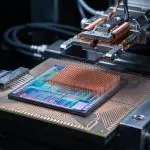
Detecting and mapping magnetic fields at the microscale presents a significant challenge with broad implications for fields ranging from materials science to biomedicine. Hao-Cheng Weng, John G. Rarity, Krishna C. Balram, and colleagues at the University of Bristol and University of Sheffield now demonstrate a scalable platform for achieving this, integrating nitrogen-vacancy centres with silicon-nitride photonic circuits to create an array of eight nanoscale magnetic sensors. This innovative approach allows simultaneous and independent readout from each sensor, enabling the team to reconstruct magnetic fields and accurately localise a tiny needle tip with unprecedented precision. The researchers further show, through simulation, the potential of this technology to track magnetic microrobots designed for applications within the human body, representing a crucial step towards practical, real-world biomedical sensing without the need for complex laboratory equipment.
Nitrogen-vacancy centres (NVs) represent promising solid-state nanoscale quantum sensors with applications spanning material science to biotechnology. Employing multiple sensors concurrently offers advantages for investigating the spatiotemporal correlations of fluctuating fields or the dynamics of point defects.
Diamond NV Centers Detect Magnetic Fields
This research demonstrates significant advancements in utilising NV centers for highly sensitive detection of magnetic fields, stemming from the spin-dependent fluorescence of these centres which responds to external magnetic influences. This sensitivity enables applications such as biomagnetic imaging, detailed magnetic field mapping, and precise tracking and control of micro and nano-robots within biological environments. Ongoing research focuses on improving sensor sensitivity through techniques like pulsed quantum filtering and minimising power broadening. Scientists are also actively miniaturising and integrating NV centers with microelectronic circuits and photonic chips to create compact and scalable sensors, including diamond-on-chip devices and integrated photonic diamond chips.
These efforts extend to developing wearable magnetoencephalography (MEG) systems for real-world brain imaging applications. Micro and nano-robots often rely on external magnetic fields for actuation and steering. NV center-based sensors provide a means to precisely track their position and control their movement, opening doors for applications in biomedicine, including targeted drug delivery to cancer cells, minimally invasive surgical procedures, neural stimulation, and in-vivo tracking. Researchers are exploring advanced control strategies using addressable transmitters operated as magnetic spins for precise localisation and control.
The research incorporates diamond-on-chip technology, creating diamond-based sensors directly on silicon chips for seamless integration with existing electronics. Combining NV centers with photonic circuits enhances signal collection and processing, while the development of portable and wearable sensors expands the range of real-world applications. Efforts to scale up the fabrication of diamond-based sensors are underway to enable mass production. Overall, this research highlights a rapidly evolving field with the potential to revolutionise medical diagnostics and treatment, fundamental science, and robotics. The work points towards a future where diamond-based quantum sensors and magnetically controlled micro/nano-robots will play a crucial role in advancing healthcare, robotics, and our understanding of the world around us.
Eight NV Sensors Locate Microscale Magnetic Sources
Scientists have achieved scalable operation of eight nitrogen-vacancy (NV) sensors integrated with silicon-nitride photonic circuits, enabling simultaneous and distinct readout from each sensor. This platform allows for multi-point magnetic field reconstruction and demonstrates microscale magnetic localisation of a 30µm-sized needle tip. Experiments reveal the ability to locate the needle tip with an error below its dimension and track its dynamic movement with high fidelity. The team characterised the magnetic field sensitivity of the eight sensors, finding a sensitivity of approximately 25 μT/√Hz in zero field, increasing to ≥50 μT/√Hz under a 1 mT magnetic field and further doubling to ≥100 μT/√Hz under 1.
5 mT. Measurements confirm the operating window extends from 0. 2 mT to 2. 2 mT, with the sensors demonstrating a proportional relationship between Zeeman splitting and magnetic field magnitude. Through multi-point field reconstruction using a Convolutional Neural Network (CNN), the researchers successfully localised the needle tip.
The CNN, trained with 737 labelled data points, achieved an average localisation error of 23µm, which is within the 30µm diameter of the needle tip. The model accurately estimated the needle tip position across a 260µm by 1000µm area, demonstrating the potential for real-time tracking and precise magnetic source localisation. These results pave the way for biomedical applications, including monitoring magnetic microrobots designed for biological and clinical purposes, without the need for complex bulk optics.
Nanoscale Magnetic Field Reconstruction with NV Centres
This work demonstrates a scalable platform for nanoscale magnetic field sensing by integrating eight nitrogen-vacancy (NV) centres with a silicon-nitride photonic integrated circuit. The researchers achieved simultaneous and distinct readout from each sensor, enabling multi-point magnetic field reconstruction and, ultimately, precise magnetic localisation of a 30µm-sized needle tip. The achievement represents a significant step towards practical biomedical applications of NV-centre-based sensors, offering a complexity-reduced alternative to systems relying on bulk optics. The researchers acknowledge that the current sensitivity of the sensors has room for improvement through enhancements in diamond quality, increased pump power, and advanced magnetometry protocols. Future work could focus on optimising these parameters to further enhance sensitivity and expand the platform’s capabilities for monitoring the position and orientation of magnetic microrobots designed for biological and clinical purposes. The demonstrated ability to perform real-time imaging and dynamic tracking establishes a foundation for advanced sensing and manipulation in complex biological environments.
🗞 Photonic-integrated quantum sensor array for microscale magnetic localisation
🧠 ArXiv: https://arxiv.org/abs/2511.11496

See today’s quantum computing news on Quantum Zeitgeist for the latest breakthroughs in qubits, hardware, algorithms, and industry deals.