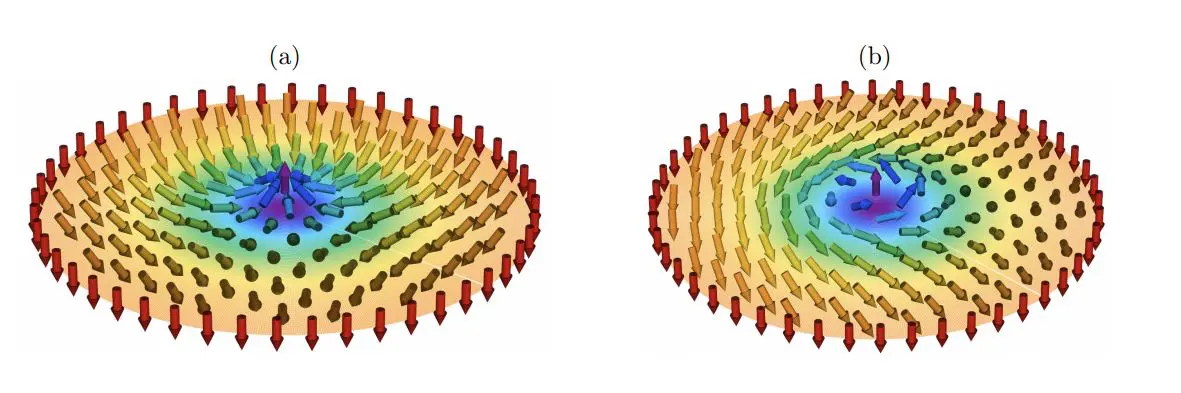
Skyrmions, swirling spin textures with potential for revolutionising data storage, represent a promising alternative to conventional magnetic technologies, offering the possibility of high-density, low-power spintronic devices. Martín Latorre, Joaquín Barra, and Juan Pablo Vera, from Universidad de Chile, alongside Sebastián Allende from Universidad de Santiago de Chile, and their colleagues, now demonstrate how elastic dislocations, defects within a material’s structure, can act as effective, yet shallow, traps for these skyrmions. This research establishes a fundamental link between topological magnetism and topological elasticity, revealing that dislocations influence skyrmion motion and can confine them within a magnetic material. The team’s analysis identifies distinct quantum states for skyrmions within these traps, and importantly, illustrates how arrays of dislocations could function as nanoscale ‘frets’ to control skyrmion movement with minimal energy input, paving the way for innovative racetrack memory devices.
Skyrmions and Topological Magnetism for Devices
Research into skyrmions, nanoscale swirling magnetic textures, is rapidly advancing the field of topological magnetism and opening doors to innovative device technologies. Scientists are actively investigating the fundamental properties of these textures and exploring their potential for applications in data storage and logic devices. This involves detailed theoretical modeling and experimental observation of their dynamics and responses to external stimuli. Current research explores the behavior of skyrmions, particularly their movement and control, using electric currents and magnetic fields. A key concept is the development of “racetrack memory,” where skyrmions represent bits of information and their position along a track determines the stored data. The topological Hall effect provides a means to detect and characterize these textures, while researchers also investigate the role of magnons in skyrmion dynamics. Advanced concepts, such as topological phase transitions, are being explored, potentially leading to the development of quantum devices based on skyrmions.
Skyrmion Trapping and Quantized Motion by Dislocations
Scientists have uncovered a fascinating interplay between screw dislocations and skyrmions within magnetic materials, establishing a connection between the material’s elasticity and its magnetic properties. Through both classical and quantum mechanical analyses, researchers demonstrate that dislocations act as shallow traps for skyrmions, influencing their motion. Classical analysis reveals how dislocations impede skyrmion motion, offering insights into controlling spin-based devices. Extending this analysis to the quantum realm, scientists identified discrete energy states associated with skyrmion motion, revealing their behavior as quantized quasiparticles with distinct energy levels linked to their translational and internal degrees of freedom. Detailed investigation of the stress fields generated by dislocations reveals their impact on magnetic anisotropy and the Dzyaloshinskii-Moriya interaction, a crucial factor in skyrmion stability. This work proposes an innovative spintronic device design, utilizing an array of dislocations as “frets” in a racetrack-like structure to control skyrmion motion with low-current activation, potentially leading to energy-efficient data storage and processing technologies.
Dislocations Confine Skyrmions in Magnetic Textures
Researchers have demonstrated a novel interaction between screw dislocations and skyrmions, nanoscale magnetic textures with potential for advanced spintronic devices. This work establishes a link between topological magnetism and elasticity, revealing that dislocations act as shallow traps, confining skyrmion motion within a potential well. Measurements of the system’s total energy show that the Dzyaloshinskii-Moriya contribution varies with the skyrmion’s position. Detailed numerical computations reveal a radially symmetric confinement profile resembling a “Mexican hat” potential with a minimum at a finite distance from the core, indicating the dislocation functions as an isotropic pinning center.
Analysis of the skyrmion’s dynamic behavior, considering spin-transfer torque and Rayleigh dissipation, led to the development of a Thiele’s equation describing its motion. Simulations show that, in the absence of dissipation, the skyrmion undergoes circular motion around the dislocation, while dissipation causes it to settle into an equilibrium position. Experiments quantifying the average long-term velocity of the skyrmion as a function of applied current reveal a trapping mechanism where the velocity vanishes up to a critical current. Extending the analysis to the quantum realm, researchers quantized the motion of the skyrmion, revealing emergent Landau levels and discrete energy states dependent on the skyrmion’s position and the strength of the confinement.
Dislocations Control Skyrmion Motion and States
This research establishes a clear connection between topological magnetism and topological elasticity, specifically investigating how screw dislocations interact with magnetic textures like skyrmions. Through both classical and quantum mechanical analyses, scientists demonstrate that dislocations create shallow traps for skyrmions, influencing their motion within a magnetic lattice. The team identified discrete quantum states governing skyrmion dynamics by employing a Lagrangian formalism and deriving an effective Thiele equation. The findings demonstrate that these interactions can be harnessed for practical applications, with the researchers proposing devices utilizing an array of dislocations as ‘frets’ to control skyrmion movement, analogous to a racetrack, and activated by a low current. This work advances condensed matter physics by integrating concepts from distinct fields and offering new perspectives on the interplay between spin and lattice structures.
🗞 Elastic Dislocation-based Skyrmion Traps: Fundamentals and Applications
🧠 ArXiv: https://arxiv.org/abs/2511.10451



See today’s quantum computing news on Quantum Zeitgeist for the latest breakthroughs in qubits, hardware, algorithms, and industry deals.