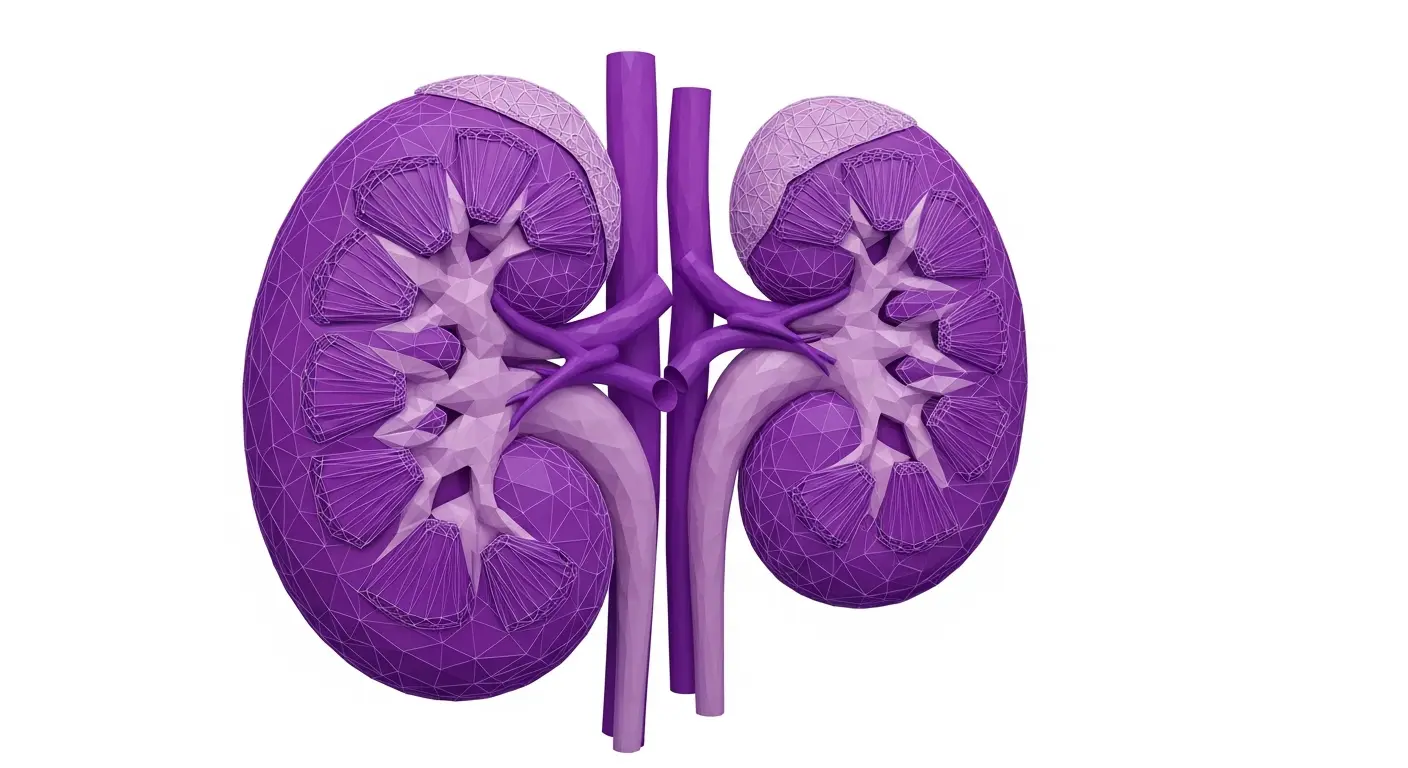
Arslan Munir, Ph.D., associate professor within the Florida Atlantic University (FAU) Department of Electrical Engineering and Computer Science, and international collaborators investigated the potential of quantum computing to improve chronic kidney disease (CKD) detection. The study, conducted within FAU’s College of Engineering and Computer Science, compared a classical machine learning system against a quantum-based approach utilizing complex medical datasets. While current conditions favored the classical system’s speed and accuracy, the quantum model demonstrated promising initial results, suggesting hybrid quantum-classical algorithms could significantly enhance future diagnostic tools for the estimated 850 million individuals worldwide affected by kidney disease.
Early Detection Challenges in Chronic Kidney Disease
Early detection of chronic kidney disease (CKD) is challenging because the condition often presents few symptoms in its initial stages. Globally, an estimated 850 million people have some form of kidney disease, yet many remain undiagnosed until reaching advanced, often irreversible, stages. Traditional diagnostic methods can be slow to identify subtle indicators of kidney damage. This delay is critical, as earlier diagnosis – even before symptoms appear – is vital for slowing disease progression and improving patient outcomes, potentially avoiding the need for dialysis or transplantation for the 10 million currently requiring these interventions.
Researchers at Florida Atlantic University recently compared classical and quantum machine learning approaches for CKD diagnosis. Using a refined dataset and optimization techniques like Principal Component Analysis (PCA) and Singular Value Decomposition (SVD), they assessed the accuracy of Classical Support Vector Machines (CSVM) and Quantum Support Vector Machines (QSVM). CSVM achieved impressive results – 98.75% accuracy with PCA and 96.25% with SVD – significantly outperforming QSVM in both speed (up to 42x faster) and precision under current hardware limitations.
Despite QSVM’s current limitations, the study highlights the potential of hybrid quantum-classical systems. QSVM still achieved 87.5% accuracy with PCA, exceeding some existing classical methods. Researchers emphasize that this isn’t a reflection of the algorithm’s inherent flaws, but rather the constraints of today’s quantum computing technology. Future work focusing on larger datasets and optimized feature selection could unlock the power of quantum machine learning, ultimately leading to faster, more accurate, and accessible CKD diagnostics.
Comparing Classical and Quantum Machine Learning
A recent Florida Atlantic University study directly compared classical and quantum machine learning (ML) for early detection of chronic kidney disease (CKD). Researchers utilized Support Vector Machines (SVMs) – both classical (CSVM) and quantum (QSVM) – alongside data optimization techniques like Principal Component Analysis (PCA) and Singular Value Decomposition (SVD). The goal was to assess which approach yielded greater diagnostic accuracy and efficiency, a crucial step toward improving patient outcomes for a disease affecting an estimated 850 million globally.
When paired with PCA, the CSVM achieved an impressive 98.75% accuracy, significantly outperforming the QSVM at 87.5%. Using SVD, the accuracy gap widened further – 96.25% for CSVM versus 60% for QSVM. Importantly, the classical SVM also proved substantially faster, exceeding the QSVM’s speed by up to 42x. These results demonstrate that, with current hardware, classical ML remains superior for CKD detection, despite the theoretical promise of quantum computation.
However, researchers emphasize the QSVM’s performance isn’t a dead-end. Its 87.5% accuracy (with PCA) still surpasses several existing classical SVM methods, suggesting quantum-classical hybrid systems hold potential. By combining the strengths of both paradigms, and as quantum hardware matures, these systems could refine diagnostic precision and address challenges in healthcare analytics, ultimately paving the way for earlier and more effective CKD detection and treatment.
Future of Quantum-Enhanced Diagnostic Tools
Researchers at Florida Atlantic University are exploring how quantum computing can enhance early detection of chronic kidney disease (CKD). Traditional methods often miss subtle indicators, leading to late diagnoses among the 850 million globally affected. The FAU team compared a classical Support Vector Machine (SVM) with a Quantum SVM (QSVM), utilizing data optimization techniques like Principal Component Analysis (PCA) and Singular Value Decomposition (SVD) to refine diagnostic accuracy. This work aims to move beyond standard machine learning for improved precision.
While the classical SVM achieved impressive results – up to 98.75% accuracy with PCA – the quantum approach currently lags behind, reaching 87.5% under the same conditions. However, researchers emphasize this isn’t a limitation of the quantum algorithm itself, but rather current hardware constraints. Notably, the QSVM did outperform some existing classical methods, suggesting a viable path for hybrid quantum-classical systems to bolster diagnostic capabilities. Speed was also a factor, with the classical system proving up to 42 times faster.
The study highlights the potential of combining machine learning with next-generation quantum technologies. Future work will focus on exploring additional quantum machine learning algorithms and applying these methods to larger, more diverse datasets. Optimizing feature selection is also key for scalability. This research offers a promising leap toward earlier, faster, and more accurate CKD diagnosis, ultimately aiming to improve patient outcomes and revolutionize healthcare analytics.