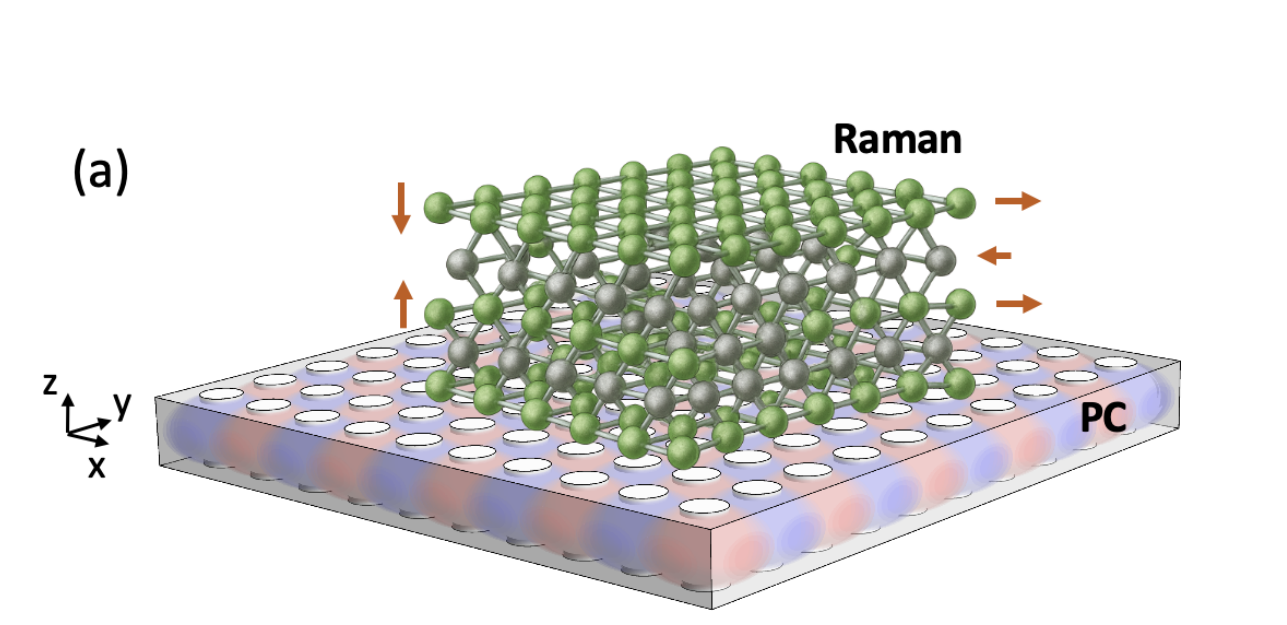
Fluctuations, inherent in all physical systems, typically degrade signal quality, but researchers now demonstrate how to actively engineer these fluctuations for potentially beneficial outcomes. H. P. Ojeda Collado and Ludwig Mathey, both from the University of Hamburg, lead a study exploring fluctuation amplification in complex systems combining light and matter. Their work extends fluctuation engineering to scenarios involving multiple interacting light and vibrational modes within a specially designed cavity, revealing how collective fluctuations can be controlled by manipulating the properties of light and sound waves. The team demonstrates that, unlike simpler systems, these multi-mode interactions allow for both selective attenuation and amplification of fluctuations, even exceeding expected scaling with system size, and opens new avenues for designing advanced spectroscopic tools and platforms operating in the terahertz range.
Nanoscale Light-Matter Interactions and Quantum States
Researchers are extending the principles of fluctuation engineering to more complex systems, investigating how light and matter interact in non-equilibrium conditions and within hybrid structures combining light and vibrational energy. This work generalises fluctuation engineering to scenarios involving multiple interacting light and sound waves, revealing collective behaviors not seen in simpler systems. The team demonstrates that by carefully engineering the way photons and phonons interact, they can control fluctuations, selectively amplifying light fluctuations and attenuating Raman fluctuations in a multi-mode system.
Engineered Light-Phonon Interactions Control Fluctuations
Scientists have demonstrated a new method for controlling fluctuations in light and sound within complex materials by carefully engineering the relationship between frequency and momentum of both photons and phonons. Experiments and simulations reveal that achieving flat bands, where frequency is independent of momentum, amplifies light fluctuations and diminishes Raman fluctuations, with the effect increasing alongside the number of interacting modes. This amplification scales with the square root of the number of modes, demonstrating a collective enhancement of light fluctuations, and can even exceed this scaling in specific modes. This research reveals non-reciprocal control of phonons, meaning that Raman mode fluctuations can be selectively reduced or amplified by tuning the photonic band gap. This control arises from the interplay between light and sound waves, allowing for precise manipulation of fluctuations within the material. The team’s model and methodology provide a pathway for designing novel platforms and advanced spectroscopic techniques in the terahertz regime, potentially enabling new technologies for sensing and materials characterization.
Controlling Light-Matter Fluctuations in Cavity Systems
This research significantly advances understanding of how to control fluctuations in complex light-matter systems, specifically those combining Raman scattering and optical cavities. By carefully engineering the way photons and phonons interact within a multi-mode system, scientists have achieved unprecedented control over these fluctuations, demonstrating that collective amplification of cavity fluctuations increases with the number of interacting modes. Importantly, they identified conditions where this amplification can be enhanced beyond standard scaling in specific modes. The study reveals that manipulating the dispersion of photons and phonons allows for both selective attenuation and non-resonant amplification of Raman fluctuations, a capability not observed in simpler systems. This level of control extends to the ability to tune fluctuations even without precise resonance conditions, offering greater flexibility in system design and potentially leading to advancements in quantum sensing, spectroscopy, and the development of novel platforms for manipulating quantum materials in the terahertz regime.
🗞 Fluctuation amplification engineering in multimode Raman-cavity systems
🧠 ArXiv: https://arxiv.org/abs/2511.08586
See today’s quantum computing news on Quantum Zeitgeist for the latest breakthroughs in qubits, hardware, algorithms, and industry deals.