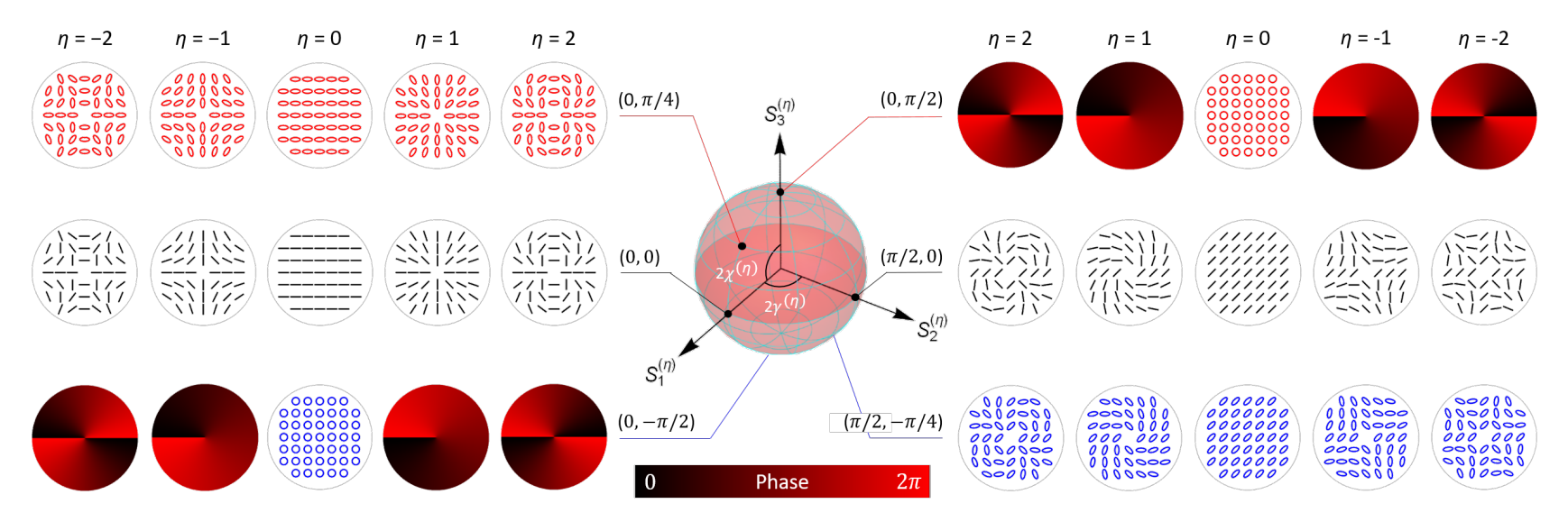
The precise control of light’s polarisation remains a fundamental challenge in optics, and researchers continually seek more efficient methods for manipulating its complex states. Mohammad Umar, Sarvesh Bansal, and Paramasivam Senthilkumaran, from the Indian Institute of Technology Delhi and the Universitá di Napoli Federico II, now demonstrate a new approach to achieving this control, building upon the established concept of an SU(2) gadget for manipulating light on the Poincaré sphere. Their work introduces an ‘effective’ SU(2) gadget specifically designed for higher-order Poincaré spheres, utilising a carefully constructed arrangement of waveplates, and enabling controlled navigation of complex light states. This achievement represents a significant step forward in the deterministic engineering of structured light, with potential applications spanning areas such as polarisation singularities, vector vortex beams, and the rapidly evolving field of spin-orbit photonics.
Higher-Order Poincaré Spheres and Polarization Control
Scientists are expanding the understanding of light polarization by moving beyond the traditional Poincaré sphere to a higher-dimensional version, allowing for the representation and manipulation of more complex light beams. This research focuses on controlling the polarization state of light, a crucial aspect of many optical technologies and fundamental studies, and explores how tools like q-plates and metasurfaces can be used to create vector beams with spatially varying polarization. The work builds upon established principles of polarization optics, extending them to represent intricate light structures and systematically control the polarization state across an entire beam, enabling new possibilities in areas like optical trapping, microscopy, and communications. This involves understanding the mathematical framework describing these higher-dimensional polarization states and developing methods to precisely manipulate them.
Coaxial Waveplates for Complete Polarization Control
Scientists recently achieved a breakthrough in controlling structured light by realizing complete polarization control on the higher-order Poincaré sphere. They engineered a novel optical device, built from carefully arranged waveplates, that functions as a single element under specific conditions, allowing for precise navigation of polarization states in this expanded space. The team demonstrated that the relative alignment of these waveplates governs systematic control of polarization on the sphere’s surface, enabling the creation of polarized singular beams with spatially varying polarization distributions while maintaining uniform ellipticity. Researchers quantitatively characterize the polarization topology using the Poincaré, Hopf index, providing a means to assess the handedness of azimuthal rotation of the polarization state.
Complete SU(2) Control of Light Polarization
Scientists recently achieved a breakthrough in controlling light polarization by demonstrating complete polarization control on the higher-order Poincaré sphere. This work extends the understanding of the standard Poincaré sphere to represent spatially inhomogeneous beams with complex polarization distributions. The team engineered an optical device, consisting of quarter-wave and half-wave plates with a specific topological charge, to function as an effective control element for the higher-order sphere. The key to this achievement lies in the precise alignment of the offset angles of the constituent plates, which governs systematic control of polarization on the sphere’s surface. This arrangement effectively acts as a single waveplate, enabling full control over both spin angular momentum and orbital angular momentum, properties crucial for representing complex light structures. Measurements confirm that the engineered device can represent beams associated with various orders of the higher-order sphere, and researchers quantitatively characterize the polarization topology using the Poincaré, Hopf index.
Higher-Order Polarization Control via Waveplates
This research successfully demonstrates a method for controlling polarization on the higher-order Poincaré sphere, utilizing an optical device constructed from waveplates. Scientists achieved this by designing a specific arrangement of quarter-wave and half-wave plates, establishing a functional equivalent to a device for a simpler Poincaré sphere. The key to this advancement lies in the precise alignment of offset angles within the waveplate arrangement, which governs systematic control of polarization states on the higher-order sphere. The team’s work provides a systematic means of determining both the orientation and magnitude of polarization rotation, offering a new approach to manipulating light’s polarization. This waveplate paradigm allows for tunable retardance, enabling controlled movement across the higher-order Poincaré sphere and having direct relevance to the deterministic control and engineering of structured light, including polarization singularities, vector vortex beams, and topological optical fields.
🗞 Effective SU(2) gadget: holonomic walk on higher-order Poincaré sphere
🧠 ArXiv: https://arxiv.org/abs/2511.07670




See today’s quantum computing news on Quantum Zeitgeist for the latest breakthroughs in qubits, hardware, algorithms, and industry deals.